Generative AI such as ChatGPT, Gemini, or Midjourney is changing the way we create visual content. Whether it is realistic images to anime-like video, fake media driven by AI is taking over the internet, and what is real and what is fake has never been more confused.
With Google’s Veo 3 and Higgsfield Soul offering hyper-realistic video generation, AI content is getting so close to reality that it is nearly indistinguishable. The rise of this content has created a new challenge: Which one is AI and which one is real?
Fortunately, DuckDuckGo has rollout a powerful tool, a new filter that allows people to hide AI images generated in search results. It is a much-needed step in keeping originality of content on the internet.
Why do you need to filter AI Images?
AI tools like Adobe Firefly, Midjourney, and Gemini can create very realistic images. They often have no visible watermark, and may be difficult to differentiate from real images.
Some metadata or hidden watermarks exist, but most users would never look at them. That is why individuals are unintentionally sharing or using AI-generated fake images, especially on social media.
DuckDuckGo’s New Filter
DuckDuckGo has launched an image search that allows users to filter AI-generated results. This step is especially helpful in an internet filled with artificial images.
They even tested the tool with the search query “baby peacock”, implicitly calling out how AI images flood search results.
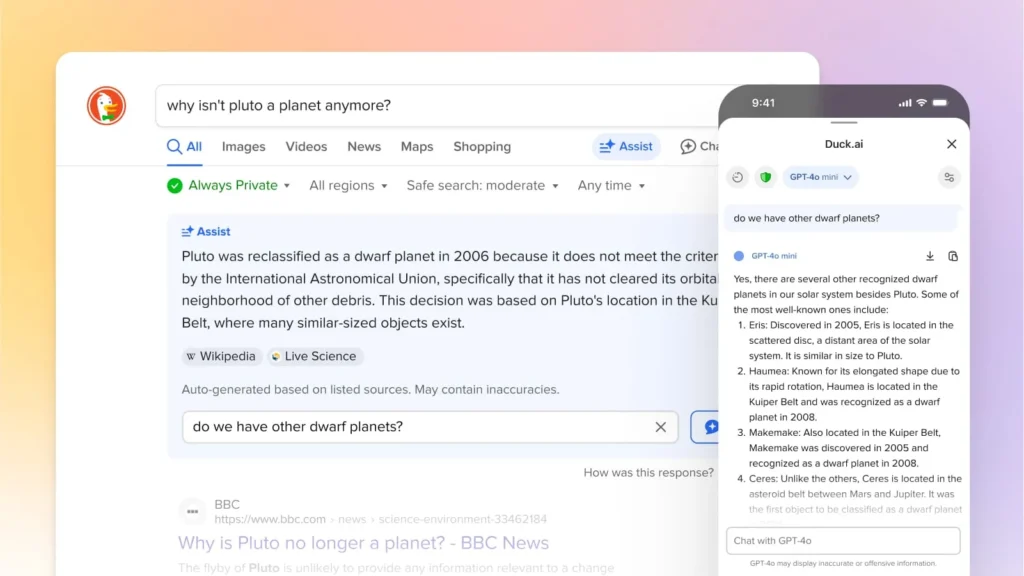
How to Hide AI-Generated Images on DuckDuckGo
Here is a step-by-step guide on how to use DuckDuckGo’s new image filter.
- Go to DuckDuckGo in your browser.
- Type any search term, e.g., “mountain sunrise.”
- Tap on the “Images” tab.
- Look for the “AI images” dropdown menu in the top bar.
- Select the “Hide” option..
- AI-generated images will now be filtered out of your results.
- To reverse this, you can switch back to “Show” anytime.
Does it remove all AI images? Not exactly.
DuckDuckGo blocks AI images by utilizing 3rd-party open-source blocklists like uBlockOrigin and uBlacklist(s) Huge AI Blocklist. While this reduces the AI content, it will not be able to capture all AI-generated results.
However, it is a huge step forward. DuckDuckGo openly acknowledges the limitations, but better to have some filtering than nothing.
Why Google and others should follow DuckDuckGo’s lead
As AI content is getting more realistic and difficult to detect, this feature is to be standard in all search engines. Google, Bing, and others have to focus on user control and transparency.
Users should have an option to search only real content, as the use of AI is taking over daily activities on the internet.