
Rockchip has evolved from a supplier of mobile application processors into one of the most influential companies in the embedded computing market. Today, its processors power everything from single-board computers and AI edge devices to industrial automation systems, digital signage, smart cameras, and commercial robotics.
Rockchip processors can embed almost all the parts that a modern embedded system needs on a single processor chip, which is different from the traditional desktop CPUs. CPUs, GPUs, AI chips, multimedia processors, memory controllers, network and storage interfaces are all packaged in energy-efficient and tiny SoCs that can use Linux or Android, running with little or no external equipment.
The company’s portfolio has expanded rapidly over the last few years. The new processors focus AI inference and multimedia while the legacy processors remain dominant in the industrial sector due to their stable performance and well-developed ecosystem. Therefore, it is not enough to choose the latest Rockchip CPU; it also relies on the work that needs to be carried out, the interfaces that are required, software support, product lifecycle, etc.
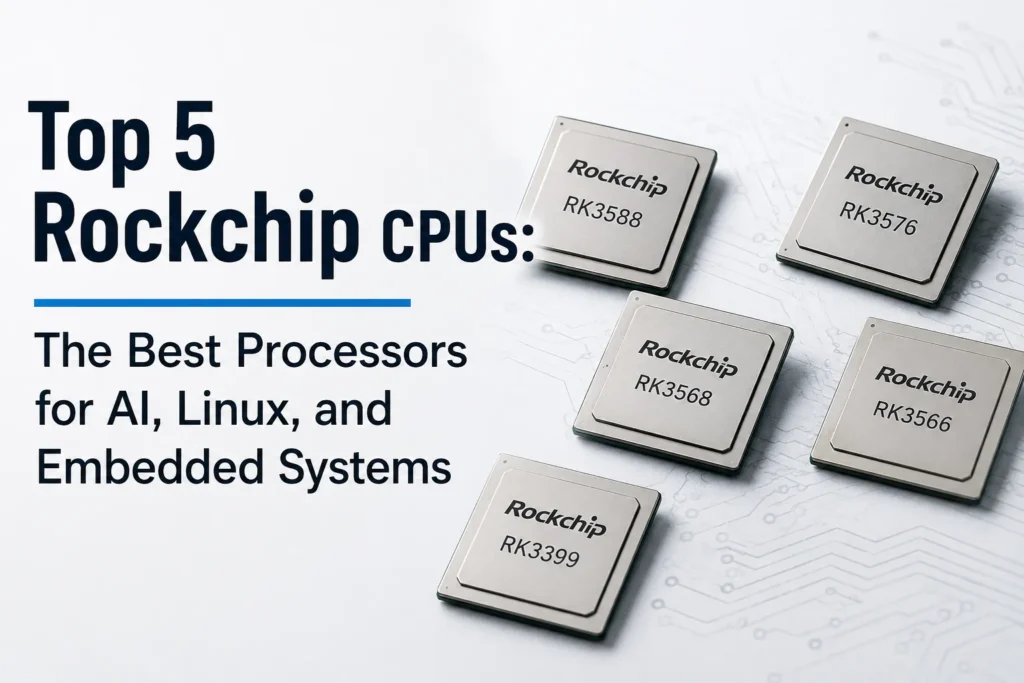
This ranking focuses on the five Rockchip processors that currently deliver the best balance of performance, features, software maturity, and commercial adoption.
1. Rockchip RK3588
No other Rockchip processor has had a greater impact on the ARM embedded market than the RK3588.
The RK3588 is the company’s flagship platform, it is a big step forward in computing power and features compared to its predecessors. Built on Samsung’s high efficiency 8 nm chipmaking process, it features four Cortex-A76 performance cores with four Cortex-A55 efficiency cores to deliver power efficient performance on high multitasking demands.
The Mali-G610 MP4 GPU also brought a major graphics upgrade, and the built-in 6 TOPS NPU enables developers to deploy the latest AI inference models directly on the device, without the need for cloud services. Even in small embedded devices, computer vision, object detection, heavy image processing pipelines and lightweight language models are viable.
The multimedia subsystem is also very nice. Native support for 8K video decoding, multiple display outputs, advanced image signal processors, PCIe 3.0, USB 3.1, SATA and high-speed networking make the RK3588 appropriate for applications which used to require much higher-priced hardware.
Rather than targeting a single market, the processor has become the foundation for a wide variety of products:
- AI edge computers
- High-performance single-board computers
- Industrial gateways
- Network-attached storage (NAS)
- Smart surveillance systems
- Robotics controllers
- Digital signage
- Multimedia servers
Its popularity has also led to broad software support across Ubuntu, Debian, Android, Buildroot, and Yocto, making development considerably easier than on many competing ARM platforms.
Readers interested in a more detailed breakdown of the architecture, benchmarks, multimedia capabilities, and real-world performance can find additional information in RK3588 Simply Explained.
2. Rockchip RK3576
Although the RK3588 remains the flagship, the RK3576 has quickly established itself as one of the most interesting processors in Rockchip’s lineup. The result is a processor that is well suited for the space between entry-level industrial SoCs and high-end embedded computers.
The RK3576 uses a newer Arm CPU architecture with the same Rockchip NPU 6 TOPS, enabling developers to use computer vision, OCR, object detection and other machine learning workloads right on the device. It has AI capability that is pretty close to the top of the pile, despite its lower overall platform price, for many commercial applications.
Multimedia is also very appropriate for today’s embedded products. The video processing power enhanced by high resolution, multiple displays and hardware video acceleration makes the processor appealing for interactive kiosks, digital signage, smart terminals and edge AI appliances.
While the RK3576 contains fewer expansion features and peak processing power compared to the RK3588, it does offer a lower power consumption and lower cost platform; this is a great choice for products that value power efficiency over maximum power.
3. Rockchip RK3568
Few processors have achieved the level of commercial adoption seen by the RK3568.
It has been one of Rockchip’s main platforms for several years now and has been found in a wide variety of embedded platforms such as factory automation equipment, medical equipment, retail terminals, industrial gateways, smart panels, and many others.
The reason is straightforward: reliability.
A new processor is capable of significantly more computing power, but many commercial products do not need the best of the best. The stability, software behaviour, long term availability, and mature Linux support can be more important than the benchmark numbers.
The RK3568 delivers just that.
The quad-core Cortex-A55 processor will support industrial control systems software, HMI interfaces, lightweight AI workloads, IoT gateways and edge networking applications without power usage being an issue. Further extending its usefulness to a wide array of commercial applications are integrated multimedia acceleration and modern connectivity.
The software ecosystem might be RK3568’s strongest attribute. Stable and well-optimized BSPs, a solid support for Linux, and a complete documentation, that have been already developed over several years, lower the development time for manufacturers creating long-life embedded products.
For organizations planning deployments measured in years rather than product cycles, that maturity remains a significant advantage.
4. Rockchip RK3566
The RK3566 occupies an important position in Rockchip’s portfolio because it delivers many of the advantages of the RK3568 at a lower price point.
While the two chips use the same Cortex-A55 CPU architecture, the RK3566 is designed for more budget-conscious designs where advanced industrial interfaces or more expensive connectivity aren’t critical.
This pairing is especially popular with single-board computer manufacturers and Linux developers. Many ARM boards are available for desktops, media playback, retro gaming, affordable servers, smart home automation, and educational projects, and they are powered by the RK3566 chipset.
Additionally, this low power requirement allows passive cooling to be used in many designs which makes enclosure development easier and will provide greater long term reliability.
The RK3566 is not as powerful as some of the newer processors in the Rockchip lineup when it comes to machine learning and multimedia workloads, but it remains one of the best values for money.
It is still a good starting point for those developers who are new to ARM Linux.
5. Rockchip RK3399
Few ARM processors have remained relevant as long as the RK3399.
It was released several years before the current generation of Rockchip SoCs, and was the first SoC to be widely recognized by Linux developers, hardware manufacturers and the single-board computer community. To this day, numerous commercial products are still shipping with RK3399 because of its fully developed software stack and proven production track record.
The processor packs two Cortex-A72 performance cores and four Cortex-A53 efficiency cores, offering some noticeable improvements over the previous generation of Cortex-A55-only processors in some workloads. The RK3399 is now outperformed in most benchmarks, but is more than sufficient for desktop Linux, software development, small servers, multimedia or industrial control.
One major factor that contributes to its longevity is software maturity. The RK3399 kernel has been developed for years, and has been improved by the community and the vendors, which makes it one of the easiest Rockchip kernel to deploy for existing projects.
If a new commercial design is being considered then there are better options available today, but if the software and hardware and an old development environment is required, the RK3399 is a reliable platform.
Comparing the Top Rockchip CPUs
Choosing the right processor involves more than comparing benchmark scores. CPU architecture, AI capabilities, multimedia support, software maturity, and expansion options all influence how well a platform fits a particular application.
| Processor | CPU Architecture | AI Performance | Primary Strength | Typical Applications |
| RK3588 | 4× Cortex-A76 + 4× Cortex-A55 | 6 TOPS | Maximum performance and connectivity | AI, robotics, NAS, edge computing, premium SBCs |
| RK3576 | New-generation Arm architecture | 6 TOPS | Efficient AI computing | Smart terminals, AI cameras, embedded AI |
| RK3568 | 4× Cortex-A55 | Basic AI support | Industrial reliability | Automation, gateways, HMI, IoT |
| RK3566 | 4× Cortex-A55 | No dedicated NPU | Excellent value | Linux SBCs, media players, education |
| RK3399 | 2× Cortex-A72 + 4× Cortex-A53 | None | Mature Linux ecosystem | Legacy products, development, and existing deployments |
The ranking reflects the overall capabilities of each processor rather than a single benchmark. While raw performance naturally favors newer designs, software support, long-term availability, and ecosystem maturity remain equally important for commercial embedded products.
Final Thoughts
Rockchip has developed one of the strongest processors ecosystems of ARM chips in the marketplace today. Rather than providing one processor for all applications, the company has now expanded its reach across virtually the entire embedded computing market, from low cost Linux boards to high-end AI edge computers processing complex machine learning applications on the edge.
The RK3588 stays on top among the current models. It has a powerful CPU with top class graphics, a dedicated 6 TOPS NPU, an excellent multimedia engine and a wide range of high-speed interfaces, making it one of the best chips in Rockchip’s portfolio. It is also the processor most widely adopted for next-generation Artificial Intelligence (AI) devices, high-end single-board computers, industrial edge servers, and high-performance embedded systems.
The other processors have distinct and specific roles. The RK3576 integrates modern AI acceleration to mid-range products, while the RK3568 is a reliable industrial platform with a long tradition, the RK3566 offers superb value for Linux based devices and the RK3399 still powers thousands of current commercial systems with a well-established and supported software stack.
Rather than replacing one another, these processors complement each other. Understanding the strengths of each platform makes it much easier to select hardware that matches both current project requirements and future development plans.




A little discussion goes a long way.
Ask a question, share your experience, or help someone find an answer.
There is room for your perspective.
No discussions match this view yet.
Your voice belongs here
Keep it useful. Keep it kind.