Knoxville has become one of the nation’s most connected midsize cities. Today you can choose from more gigabit-speed plans than many larger metros, so you no longer have to settle. Whether you prioritize speed, price, or fuss-free billing, there’s a package that keeps your Wi-Fi solid.
This guide ranks the seven providers that truly serve Knoxville addresses and shows you how to pick the best fit, without the telecom jargon.
- How we ranked Knoxville’s internet options
- 1. WOW! Internet: best value cable plan
- 2. Xfinity: widest reach and headline cable speed
- 3. Spectrum: unlimited data where it’s available
- 4. AT&T Fiber: fastest widely available speeds
- 5. KUB Fiber: hometown 10-gig powerhouse
- 6. T-Mobile 5G Home: simplest setup for renters
- 7. Satellite internet (Starlink, Viasat, HughesNet): the rural safety net
- How to match these options to your home
- More common scenarios and clear winners
- Knoxville internet FAQs
- Conclusion
How we ranked Knoxville’s internet options
We built this list as a scorecard, not a popularity poll. Every provider had to offer at least one residential plan of 100 Mbps or faster within Knoxville city limits; slower DSL and business-only networks didn’t qualify.
Next we scored five factors that matter daily: customer satisfaction, long-term cost per megabit, verified top speed, address coverage, and helpful extras such as mesh equipment or unlimited data. Reliability carried the most weight because a fast line is useless if it drops during a Zoom call. Value was second, calculated over a full 24-month span so short-term promotions could not hide true prices.
Finally, we double-checked our draft rankings against national satisfaction studies to confirm they matched real-world sentiment. The outcome is a pecking order driven by data, coverage maps, and thousands of Knoxville reviews, not marketing slogans.
1. WOW! Internet: best value cable plan
Why WOW! sits at No. 1
If you judge an internet service by the speed you get for every dollar, WOW! wins. Its entry-level 300 Mbps plan costs about $30 per month and, as outlined on the provider’s Knoxville, TN high speed internet services page, that rate is locked for life with no annual contract, a free Wi-Fi modem, and an optional self-install kit. That single perk shields you from the year-two bill shock that strains many cable budgets.
Knoxville subscribers also praise the human side of WOW!. Local technicians arrive on time, invoices read like plain English, and you can reach a support rep without a phone-maze marathon. Stack those soft perks on top of dependable gig-class speeds and you have a provider that behaves more like a savvy neighbor than a telecom giant. In a market full of flashy promotions, WOW! keeps great service simple and flat-priced.
2. Xfinity: widest reach and headline cable speed
If you enter an address anywhere from Fountain City to Farragut, Xfinity almost always appears first. Comcast’s hybrid fiber-coax grid covers nearly every Knoxville block, so your apartment or cul-de-sac can usually connect the next day without construction. That blanket coverage makes Xfinity the default choice when newer networks have not arrived.
Speed is the other draw. Standard plans top out at 1.2 Gbps, and a few upgraded neighborhoods already see 2 Gbps on the latest DOCSIS equipment. In daily use, downloads often test slightly above the advertised rate, which helps when the whole household streams at once. Uploads lag behind fiber, but the 35 Mbps ceiling still handles cloud backups and video calls for most families.
Prices look friendly at first. A 200 Mbps tier starts near $35 per month, but after 12 months the bill usually rises by $20 to $30. Add the 1.2 TB monthly data cap and a $15 modem rental, and the value weakens unless you negotiate or bring your own equipment.
Convenience is where Xfinity shines. You can bundle mobile lines for steep discounts, tap into thousands of public Wi-Fi hotspots, and manage every service inside one polished app. If you like all-in-one bundles, Xfinity delivers. If you prefer price stability and unlimited data, keep reading; stronger fits appear further down the list.
3. Spectrum: unlimited data where it’s available
Spectrum reaches only parts of Knoxville, yet in those neighborhoods it offers a rare combo: gig-class speed and truly unlimited data. No cap, no overage meter, no fine print. If your household streams 4K video, downloads large games, or backs up files nonstop, that perk alone can outweigh a faster or cheaper promotion elsewhere.
Plans stay simple. You get three choices all contract-free, and the modem is included so you avoid the $15 rental Comcast adds. Pricing starts around $50 per month, rises by about $20 after the first year, then levels out. It may not beat WOW! on headline price, but predictable billing plus unlimited usage often balance the math over 24 months.
Recent network upgrades keep outages low, although uploads plateau near 35 Mbps like other cable lines. Geography is the larger hurdle. Spectrum’s footprint covers pockets of Farragut, Karns, and a few south-county corridors. Enter your address in the checker before banking on unlimited data. If you are in coverage, Spectrum offers a straightforward connection that stays online without a meter.
4. AT&T Fiber: fastest widely available speeds
When you spot a green AT&T Fiber tag on the pole outside, you can likely skip cable headaches. The network delivers 1 Gbps up and down for about $80 per month, includes a Wi-Fi 6 gateway at no extra cost, and never applies a data cap. If you post videos, move large work files, or stream on Twitch, those equal upload speeds feel like shifting from gridlock to open road.
Real-world data supports the claims. FCC tests from 2025 show AT&T Fiber consistently meets or exceeds its advertised speeds, and Knoxville gamers often see single-digit ping times during peak hours. Multi-gig options at 2 and 5 Gbps already serve many subdivisions, keeping pace with smart homes that add cameras, VR headsets, and cloud backups.
Pricing is straightforward. There is no promotional clock, contract, or equipment fee. The amount on your first bill is the amount you will pay next year, barring a rare system-wide adjustment. Add top national satisfaction scores and AT&T Fiber becomes the strongest long-term pick whenever your address qualifies. Enter your street to confirm coverage; if it lights up green, claim it.
5. KUB Fiber: hometown 10-gig powerhouse
KUB started as Knoxville’s electric utility, and today it threads fiber on the same poles to deliver the fastest residential speeds in East Tennessee. The entry plan provides 1 Gbps up and down for about $65 per month. For homes that outgrow a gig, tiers at 2.5 Gbps and 10 Gbps show the network is built for tomorrow’s smart devices.
Speed counts only when the line stays up. Early customers report outages so rare they pass as brief power blinks, and latency averages near 5 ms, which keeps competitive gamers satisfied. Because KUB owns the poles, the same crews that restore electricity also repair fiber after storms, so service returns quickly.
Pricing feels like a utility bill: no teaser rates, no contracts, and a Wi-Fi 6 router included. Data is unlimited. Coverage is the main limit. About 25 percent of the city can subscribe today, mainly north and west of downtown, with new zones added each quarter. Check KUB’s rollout map; if your street shows a green dot, booking an install is an easy win.
6. T-Mobile 5G Home: simplest setup for renters
T-Mobile replaces coax with cellular, shipping a gray gateway that connects to the same 5G airwaves as its smartphones. Place it near a window, follow the app’s tips, and your apartment has broadband within minute, no technician, drilling, or security-deposit drama.
Typical Knoxville speeds land between 100 and 200 Mbps down and about 20 Mbps up, which covers streaming and remote work. Speeds dip during the evening mobile rush, yet latency stays near 30 ms, so video calls remain smooth. Data is unlimited, and the flat $50 monthly charge includes taxes, equipment, and a five-year price lock.
There are caveats. Competitive gamers and heavy uploaders can hit carrier-grade NAT limits, and thick concrete walls may weaken signal. Still, for students, renters, or anyone between leases, T-Mobile Home Internet offers a quick, contract-free path to reliable Wi-Fi.
7. Satellite internet (Starlink, Viasat, HughesNet): the rural safety net
Drive about 20 miles past the outer belt and wired choices vanish. That is where satellite steps in. Starlink’s low-Earth-orbit fleet now delivers roughly 100 to 200 Mbps down and about 20 Mbps up to any Knoxville-area farm with a clear view of the sky. Latency averages near 40 ms; higher than fiber but still workable for video calls and casual gaming. Most important, service reaches any spot where you can mount a dish, whether the nearest utility pole is one mile away or 10.
The trade-off is cost. The hardware kit runs about $600 up front and the monthly bill sits near $100. Traditional geostationary services such as Viasat and HughesNet lower the equipment price but throttle speeds after modest data caps and carry 500 ms latency that breaks real-time apps. We list them because they can be the only option in a few hollers and ridge tops south of the city.
If even a basic cable line is available, you will enjoy smoother performance at a lower price. When the alternative is a 5 Mbps DSL relic or no line at all, Starlink’s plug-and-play broadband lets rural homes stream, work, and learn like the rest of Knox County.
How to match these options to your home
Start with what is wired to your street. Enter your exact address on each provider’s site; the check takes about two minutes and instantly narrows the list. Then use this playbook to find the best fit.
If fiber shows up (AT&T or KUB)
Choose it. Symmetrical speeds, no caps, and stable pricing beat every cable or wireless line. If both are available, lean toward KUB for local support or AT&T for broader bundle perks.
More common scenarios and clear winners
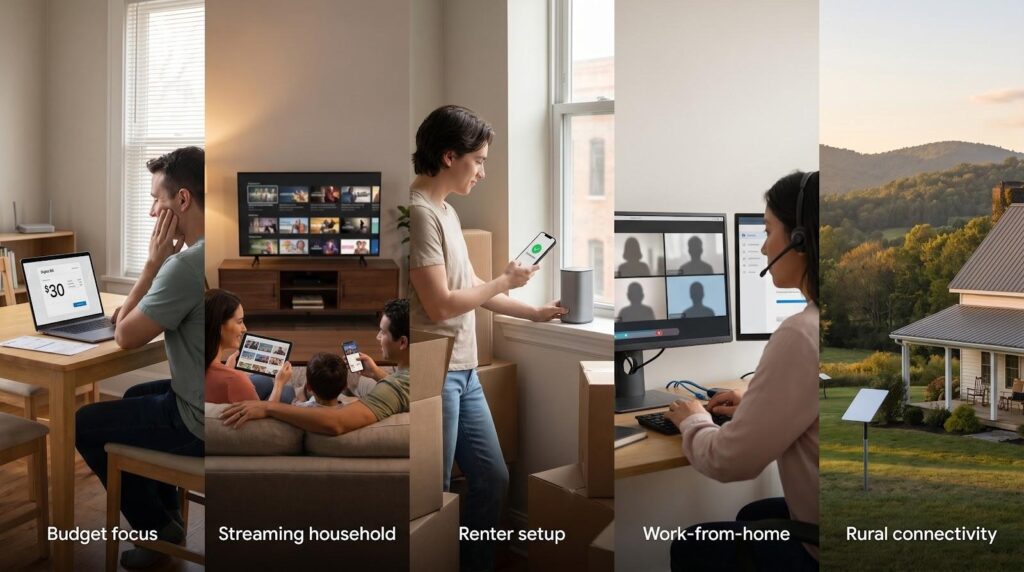
Budget comes first.
If keeping the bill under $40 matters more than raw speed, start with WOW!. Its 300 Mbps promo at $30 per month beats everyone, and the price-for-life option means you will not face a larger bill next year. Xfinity’s lowest tier costs $35, then jumps once the promotion ends, so WOW! remains the safer long-term choice for thrifty households.
Unlimited data for streaming marathons.
Constant 4K streaming requires a plan without a meter. Spectrum is the simplest cable pick because it never tracks usage and still reaches 1 Gbps. If fiber is available, both AT&T and KUB remove caps entirely and add faster uploads, but Spectrum wins when those fiber lines stop a block short of your house.
Renters or students moving often.
T-Mobile 5G Home excels in this case. You self-install in minutes, pay month-to-month, and can carry the gateway to a new dorm or apartment with zero transfer fees. Speeds will not match fiber, yet they beat most shared complex Wi-Fi and spare you landlord wiring headaches.
Work-from-home power users.
Video calls and large cloud uploads benefit from symmetrical bandwidth, so prioritize AT&T Fiber or KUB Fiber whenever they are available. In cable territory, consider pairing your main line with a low-cost T-Mobile or phone hotspot as a backup; the redundancy may add a small expense but can save a meeting.
Rural addresses with no wires.
When every provider lookup returns “unavailable,” order Starlink. The dish costs about $600 up front, yet 100 Mbps in the foothills is a huge leap over 5 Mbps DSL. Give the terminal a clear view of the southern sky and keep a snow brush handy each winter.
Use these scenarios as shortcuts. Identify your biggest need then choose the provider paired with that need. You will avoid decision fatigue and secure a plan that matches how your household uses the internet every day.
Knoxville internet FAQs
Why does Knoxville have so many gig-speed plans?
Competition. Several fiber and cable networks overlap inside the city. Speedtest Intelligence data from early 2026 shows a citywide median download of more than 370 Mbps, driven by KUB Fiber and AT&T Fiber setting a fast pace. When providers compete on speed, residents enjoy quicker and cheaper tiers.
How fast is KUB Fiber growing?
KUB completed phase one of its municipal build in late 2023, wiring 50,000 homes and pledging citywide coverage within the decade (Community Networks). New neighborhoods light up each quarter, so check the map regularly.
Which provider ranks highest for customer satisfaction?
The 2023 American Customer Satisfaction Index telecom study reports that fiber ISPs lead the field, and AT&T holds the national top spot with a score of 80 out of 100 (ACSI). Cable rivals trail by about 10 points, matching the feedback we hear from Knoxville subscribers.
Is 1.2 TB (about 1,200 GB) enough data for a family?
Most households stay below that Xfinity cap, but heavy 4K streaming or large game downloads can exceed it. If you burn through data often, choose Spectrum, AT&T, or KUB; all three remove caps entirely.
Will cable uploads ever match fiber?
Yes, but not immediately. Comcast and Spectrum are testing DOCSIS 4.0 hardware with multi-gig uploads. Knoxville is on the upgrade roadmap, yet full deployment remains at least one to two years away.
Do I need my own router?
Provider gateways work, but a quality Wi-Fi 6 or Wi-Fi 6E router spreads gigabit speeds more evenly. If you rent, compare the monthly fee to buying; most gear pays for itself within a year.
Keep these answers handy as you compare plans. Prices and networks can shift quickly, so revisit them each time you shop.
Conclusion
Knoxville’s internet market offers uncommon choice, from municipal 10-gig fiber to contract-free 5G gateways. Start by checking wired availability at your exact address, lock in fiber whenever possible, and weigh long-term value instead of short-term discounts. With seven competitive providers and clear use-case scenarios, reliable home Wi-Fi is within reach for every neighborhood and budget in East Tennessee.