If you’ve been following single-board computers or edge AI lately, you’ve seen Rockchip. A lot. Five years ago, the name meant cheap Android TV boxes. Today? Rockchip ships everything from $10 camera chips to 32‑TOPS flagships that go toe‑to‑toe with NVIDIA’s Jetson line.
This guide covers the current Rockchip landscape: what’s shipping now, what’s coming, and where each chip actually makes sense.
Rockchip RV1126B: The Small AI Camera Chip
The RV1126B is not trying to compete with RK3588. It was built for smart vision devices that need local AI, video encoding, and Linux in a tiny power envelope.
Key specs:
- Dual‑core Cortex‑A7 CPU
- 2 TOPS NPU (INT8)
- Integrated ISP (HDR, low‑light, noise reduction)
- H.264/H.265 hardware encoding
Where it goes: Compact IPC cameras, edge analytics devices, fanless outdoor systems. No cloud needed for face detection or motion tracking.
The RV1126B keeps showing up because it’s small, mature, and easy to integrate. Manufacturers can reduce PCB complexity and ship working products without external ISP chips.
Rockchip RK3566: The Workhorse
RK3566 is Rockchip’s cost‑ and power‑conscious quad‑core platform. It targets 4K media, basic AI, and standard embedded I/O.
Key specs:
- Quad‑core Cortex‑A55
- ~0.8 TOPS NPU
- Mali‑G52 GPU
- 4K decode, 1080p encode
- 32‑bit DDR controller (DDR3/DDR4/LPDDR4)
Where it goes: Kiosks, signage players, gateways, HMI panels. It runs Linux desktop‑lite workloads without breaking a sweat.
If your product needs 4K playback, a simple UI, and nothing too fancy on AI – RK3566 is the practical choice. It’s cheap, stable, and well‑understood.
Rockchip RK3588: The Current Flagship
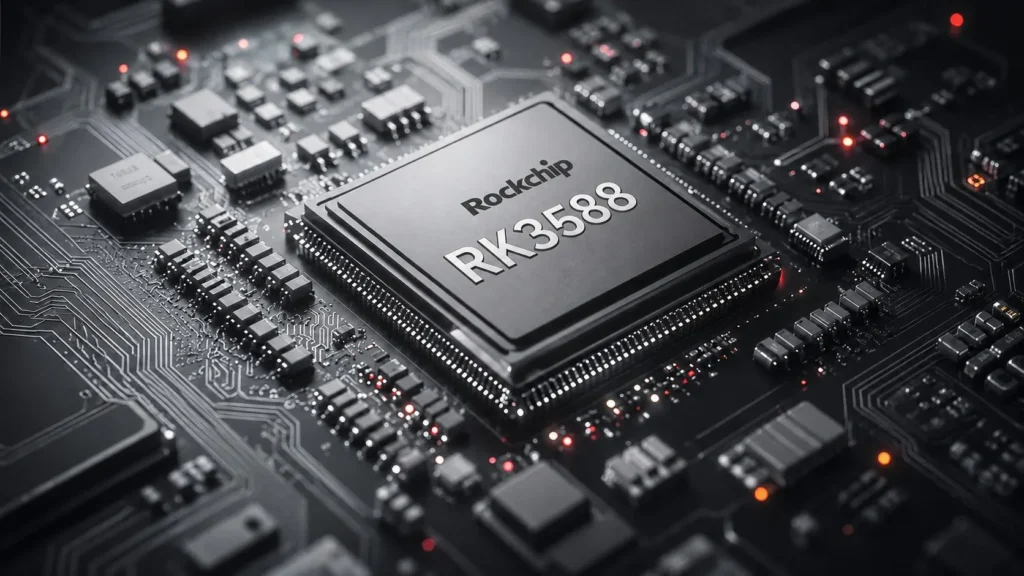
RK3588 is the octa‑core beast that put Rockchip on the map for edge AI. Four A76 big cores plus four A55 little cores. It’s been widely adopted in SBCs, robotics, and industrial systems. Rockchip
Key specs:
- 4x Cortex‑A76 + 4x Cortex‑A55
- 6 TOPS NPU (INT4/INT8/INT16/FP16)
- Mali‑G610 MP4 GPU (2 TFLOPS)
- 8K decode, 8K encode (H.264/H.265)
- Quad‑channel LPDDR4X/LPDDR5, up to 32 GB
- PCIe 3.0, dual HDMI 2.1, MIPI‑CSI
Where it goes: Edge AI servers, multi‑camera analytics, robotics controllers, desktop‑class SBCs. The Orange Pi 5, Radxa ROCK 5B, and Kiwi Pi 5B all run on RK3588.
It’s not the cheapest, but price‑to‑performance is still hard to beat. An RK3588 SBC costs around
120–
120–150. A Jetson Orin Nano is $250+.
Rockchip RK3688: What’s Coming
The RK3688 was announced in 2025. It’s not shipping yet. Expect boards in late 2026 or early 2027. But the specs are already public.
Key specs (preliminary):
- 12 CPU cores (8x Cortex‑A730 + 4x Cortex‑A530)
- 32 TOPS NPU (RKNN‑P3)
- Mali‑class GPU, ~2 TFLOPS
- LPDDR5/6 support, up to 200 GB/s bandwidth
- 8K/60fps encode/decode
- PCIe and UCIe expansion
What it means: 32 TOPS puts RK3688 in entry‑level server AI territory. Think multi‑stream video analytics (6–8 cameras), on‑device LLM inference (Qwen 3B‑class), and advanced robotics.
Radxa is already planning a ROCK 6 SBC based on RK3688. Orange Pi will likely follow.
For most projects today, RK3588 is the safe bet. For 2027 and beyond? RK3688 looks like a monster.
Rockchip RK182X: The AI Coprocessor
RK182X is something different. Not an SBC chip – a dedicated AI coprocessor that sits alongside a main SoC (like RK3588 or RK3576).
Key specs:
- High‑bandwidth DRAM
- Runs 7B LLM/VLM models locally
- TTFT <100ms, output >120 TPS
- Simple air cooling
Where it goes: Humanoid robots, smart cockpits, on‑device AI that can’t wait for the cloud. Rockchip pairs RK3588 (system control) with RK182X (large model inference) so motion control and AI don’t interfere.
Also available as an Automotive AI BOX – a dedicated compute hub for cars. Plugs into existing cockpit systems via USB or GMAC.
Quick Comparison Table
| SoC | CPU | NPU | GPU | Memory | Best For |
| RV1126B | 2x A7 | 2 TOPS | – | LPDDR4 | Smart cameras, edge vision |
| RK3566 | 4x A55 | ~0.8 TOPS | Mali‑G52 | 32‑bit DDR | Kiosks, signage, gateways |
| RK3588 | 4x A76 + 4x A55 | 6 TOPS | Mali‑G610 | 4‑ch LPDDR5 | Edge AI, robotics, desktop SBC |
| RK3688 (future) | 8x A730 + 4x A530 | 32 TOPS | 2 TFLOPS | LPDDR5/6 | Multi‑camera AI, 8K, advanced robots |
| RK182X | Coprocessor | LLM‑class | – | High‑bandwidth | On‑device LLM, automotive AI |
Which Rockchip Should You Pick?
Need a cheap AI camera chip today? RV1126B. It’s mature, well‑supported, and sips power.
Building a kiosk or signage player? RK3566. Quad A55 is plenty for 4K playback and simple UI.
Edge AI, robotics, or desktop SBC? RK3588. It’s the current sweet spot. Widely available, proven, and cheap enough.
Designing for 2027? Watch RK3688. 32 TOPS changes what’s possible at this price tier.
Need local LLM inference without a GPU? RK182X coprocessor. Pair it with RK3588 or RK3576.
Where to Find Real Specs
Marketing TOPS numbers don’t tell the whole story. For detailed Rockchip specs, real‑world performance, and board‑by‑board comparisons, Rockchip specs and comparisons cover the full lineup – from RV1126B to RK3688.
Final Thought
Rockchip isn’t trying to beat Intel or NVIDIA at their own game. They’re winning a different one: affordable, available, and good enough. In 2026, that’s looking pretty smart.