
Technology usually evolves to solve real-world problems. We wanted faster communication, so we got smartphones. We wanted effortless cleaning, so we got robot vacuums.
But every now and then, the tech world takes a sharp turn into absolute absurdity.
Over the decades, brilliant inventors and multi-million-dollar corporations have poured massive resources into products that leave us asking one simple question: Why?
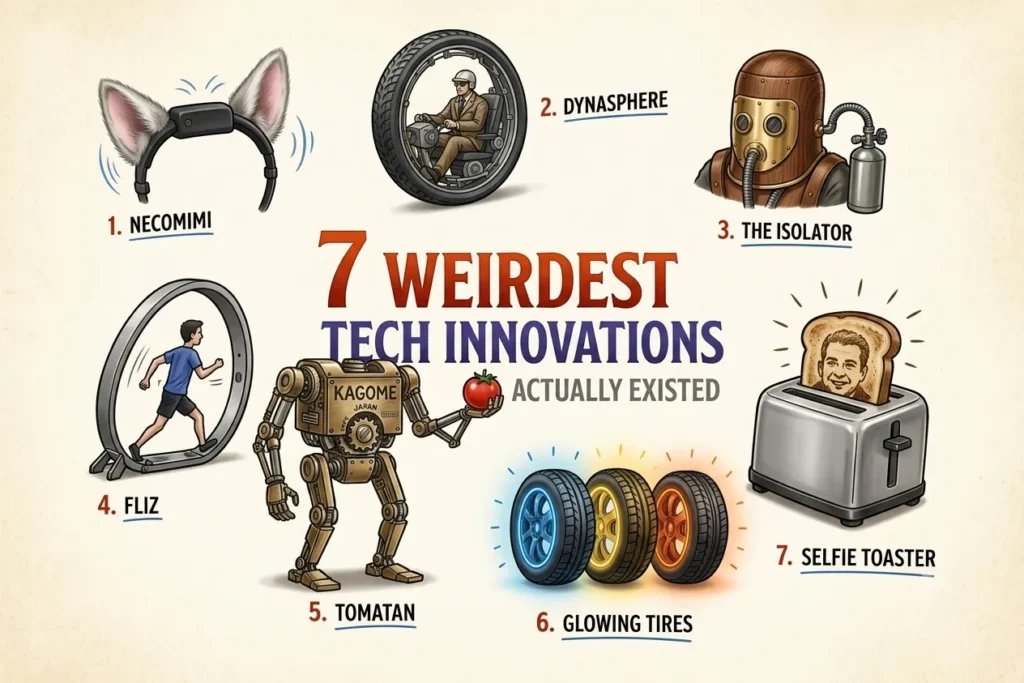
From wearable tomato-feeders to glowing radioactive-looking tires, let’s take a look at seven of the weirdest tech innovations in history.
- 1. Necomimi: The Brainwave-Controlled Cat Ears (2012)
- 2. The Dynasphere: Driving Inside a Giant Wheel (1932)
- 3. The Isolator: A Terrifying Approach to Deep Work (1925)
- 4. Fliz: The Bicycle Without Pedals or a Seat (2012)
- 5. Tomatan: The Wearable Tomato Robot (2015)
- 6. Goodyear’s Glowing Tires (1961)
- 7. The Selfie Toaster (2014)
- Why Do Weird Tech Innovations Keep Happening?
- Frequently Asked Questions
1. Necomimi: The Brainwave-Controlled Cat Ears (2012)

Credit: eBay
Long before neural interfaces like Neuralink became a serious topic of medical discussion, a Japanese company named Neurowear decided to use brainwave technology for something completely different: cosplay.
Launched in 2012, Necomimi consisted of a headband featuring two motorized cat ears. The device used an electroencephalography (EEG) sensor that pressed against the user’s forehead to read neural signals.
The ears reacted dynamically to your mood:
- Perked up when you focused deeply.
- Flattened down when you relaxed.
- Waggled back and forth when your brain activity spiked in excitement.
While it showcased functional consumer-grade biometric tech, the market for people wanting to publicly broadcast their emotional state via mechanical animal ears remained understandably small.
2. The Dynasphere: Driving Inside a Giant Wheel (1932)
Credit: Wikipedia
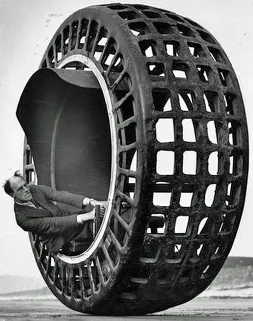
In the early 20th century, engineers were desperately trying to reinvent the automobile. Dr. J.A. Purves took this literally by designing the Dynasphere, a massive, three-meter-high monowheel vehicle.
Instead of sitting on top of the wheel, the driver and passenger sat on a platform rigged inside the wheel itself. A small petrol engine propelled the outer hoop forward while the inner cabin remained (theoretically) level.
| Feature | Dynasphere (1932) |
|---|---|
| Height | Approx. 10 feet (3 meters) |
| Top Speed | 30 mph (48 km/h) |
| Primary Flaw | “Gerbiling” (the cabin could rotate forward inside the wheel during sudden braking) |
The vehicle reached speeds of 30 mph, but it suffered from two fatal design flaws. First, steering was incredibly imprecise, requiring the driver to lean their entire body weight sideways. Second, whenever the driver hit the brakes too hard, the cabin would loop forward inside the tire, a terrifying phenomenon known as “gerbiling.”
3. The Isolator: A Terrifying Approach to Deep Work (1925)

Credit: Wikipedia
Today, we use noise-canceling headphones or apps to block out distractions. In 1925, legendary inventor and author Hugo Gernsback took a far more aggressive approach. He created “The Isolator.”
This invention was a solid wooden helmet that completely encased the wearer’s head. It featured two tiny eye slits lined with thick black paint, forcing the user to see nothing but the paper directly in front of them.
Because the helmet blocked out 95% of ambient sound, it quickly became unbreathable. Gernsback had to attach an external oxygen tank to pump fresh air into the helmet just to keep the user conscious. Unsurprisingly, sitting at a desk looking like a vintage deep-sea diver did not catch on in the corporate world.
4. Fliz: The Bicycle Without Pedals or a Seat (2012)
Credit: Reddit
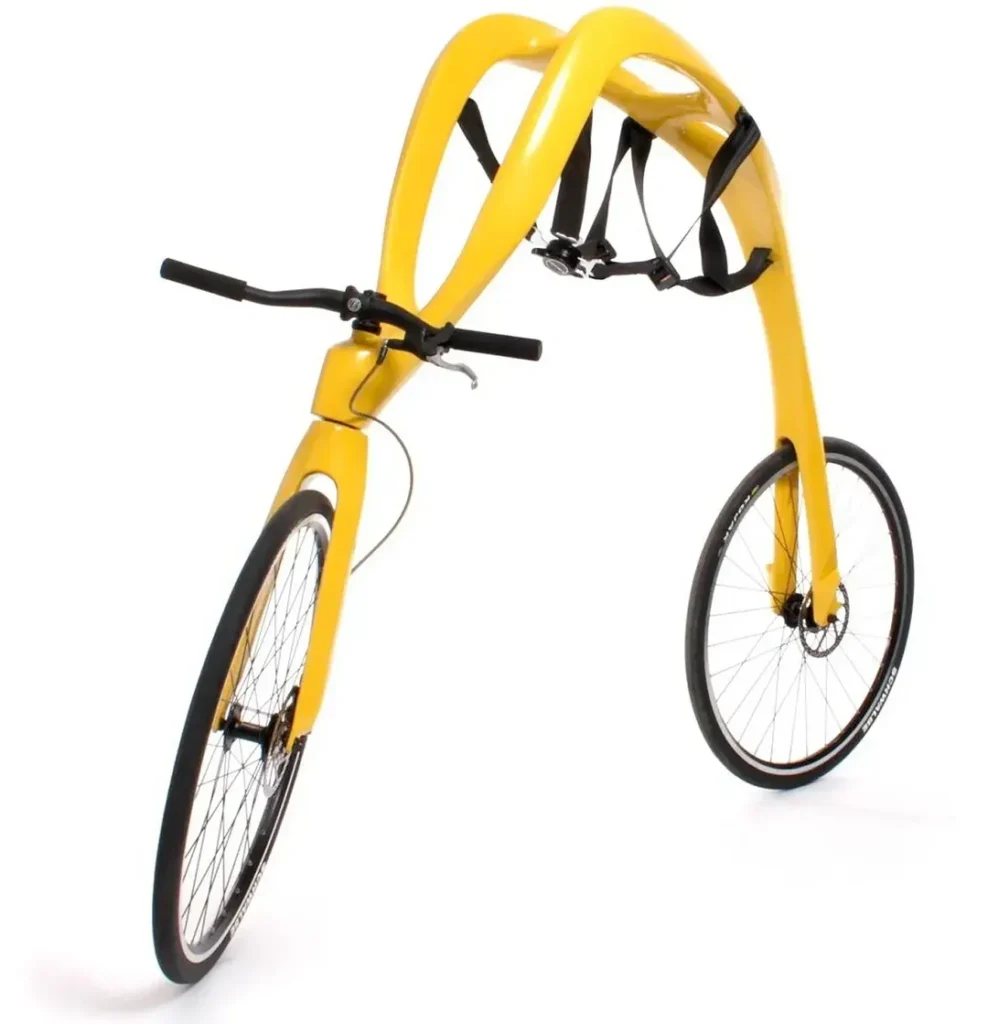
The fundamental concept of a bicycle is simple: you sit on a seat, place your feet on pedals, and move efficiently. In 2012, German designers decided to challenge this basic premise with the Fliz concept bike.
The Fliz completely removed the pedals, the chain, and the seat. Instead, it featured a massive arched frame.
To ride it, you had to strap yourself into a harness hanging from the top of the frame. Once suspended, you moved by sprinting on the ground with your bare feet, lifting them up to coast once you gained momentum. The innovation effectively turned cycling back into running, just with significantly more back strain.
5. Tomatan: The Wearable Tomato Robot (2015)

Credit: fordsbasement
To promote its tomato juice during the Tokyo Marathon, Japanese food giant Kagome created Tomatan. It remains one of the most bizarre pieces of wearable tech ever constructed.
Tomatan was an 8-kilogram (18 lb) robot designed to sit squarely on a runner’s shoulders. The robot featured a friendly, tomato-shaped head and a mechanical arm.
As the runner moved, the robot would automatically swing its arm forward to place a whole tomato directly into the runner’s mouth, providing them with antioxidants and nutrition mid-race. While the engineering worked, carrying an extra 18 pounds of metal on your neck during a 26-mile marathon completely defeated the purpose of saving energy.
6. Goodyear’s Glowing Tires (1961)

In the 1960s, Goodyear believed the future of automotive styling lay right on the pavement. They developed a experimental tire made from Neothane, a translucent synthetic rubber compound.
Engineers mounted 18 tiny incandescent lightbulbs inside the wheel rim. When turned on, light beamed through the translucent rubber, making the tires glow vividly in red, yellow, or blue.
| Challenge | Explanation |
|---|---|
| Driver Distraction | The glowing tires could distract other drivers, especially during nighttime driving. |
| Poor Performance | The translucent material did not provide the same grip and durability as conventional rubber tires. |
| Limited Practicality | The concept looked futuristic but was not suitable for everyday road conditions. |
| Production Challenges | High manufacturing costs and safety concerns prevented the tires from reaching mass production. |
While they looked spectacular in promotional photos, the real-world application was a disaster. The glowing tires heavily distracted other drivers at night. Furthermore, Neothane lost structural integrity quickly, beginning to melt under the extreme heat generated by heavy braking.
7. The Selfie Toaster (2014)

The mid-2010s marked the peak of the “selfie” craze. Capitalizing on this trend, a custom novelty company from Vermont introduced the Selfie Toaster to the world.
The process was simple but highly specific. Buyers uploaded a high-resolution photo of their face to the company’s website. Engineers then used a CNC plasma cutter to create a custom metal insert mimicking the lines of the user’s face.
When inserted into the toaster, the metal plates restricted heat to certain parts of the bread. The result? A piece of morning toast with your own charred face staring back at you.
Why Do Weird Tech Innovations Keep Happening?
Looking back at these inventions, it is easy to dismiss them as complete failures. However, tech historians note that weird innovations are a natural byproduct of a healthy tech industry.
Many modern features we take for granted (like gesture controls, heads-up displays, and biometric tracking) started as deeply unusual, experimental prototypes. Sometimes, inventors have to push a concept way too far to find out exactly where the practical boundaries lie.
Frequently Asked Questions
What is the weirdest tech innovation ever created?
Many technology enthusiasts consider The Isolator (1925) one of the weirdest inventions ever made. It was designed to block distractions by covering the user’s head while reading or working, making it one of the most unusual productivity devices in history.
Did anyone actually buy the Necomimi cat ears?
Yes. Necomimi was commercially available and became popular among cosplay fans, anime enthusiasts, and technology lovers. Although it never reached mainstream success, it gained worldwide attention for using EEG sensors to move robotic cat ears based on brainwave activity.
Why didn’t Goodyear’s glowing tires reach the market?
Goodyear’s glowing tires looked futuristic, but the translucent material couldn’t provide the durability and grip needed for everyday driving. Combined with safety concerns and high production costs, the concept never entered mass production.
Were these weird tech innovations complete failures?
Not at all. While many of these inventions failed commercially, they introduced ideas that later influenced modern technologies, including robotics, wearable devices, smart sensors, and advanced consumer electronics.
Why do companies continue developing strange technology?
Technology companies often build experimental products to test new ideas and explore future possibilities. Even unsuccessful inventions provide valuable lessons that can lead to groundbreaking innovations years later.
Are weird tech innovations still being created today?
Yes. Modern examples include AI powered robots, brain computer interfaces, smart glasses, autonomous delivery robots, and advanced wearable devices. Many of today’s experimental projects could become tomorrow’s everyday technology.






A little discussion goes a long way.
Ask a question, share your experience, or help someone find an answer.
There is room for your perspective.
No discussions match this view yet.
Your voice belongs here
Keep it useful. Keep it kind.