
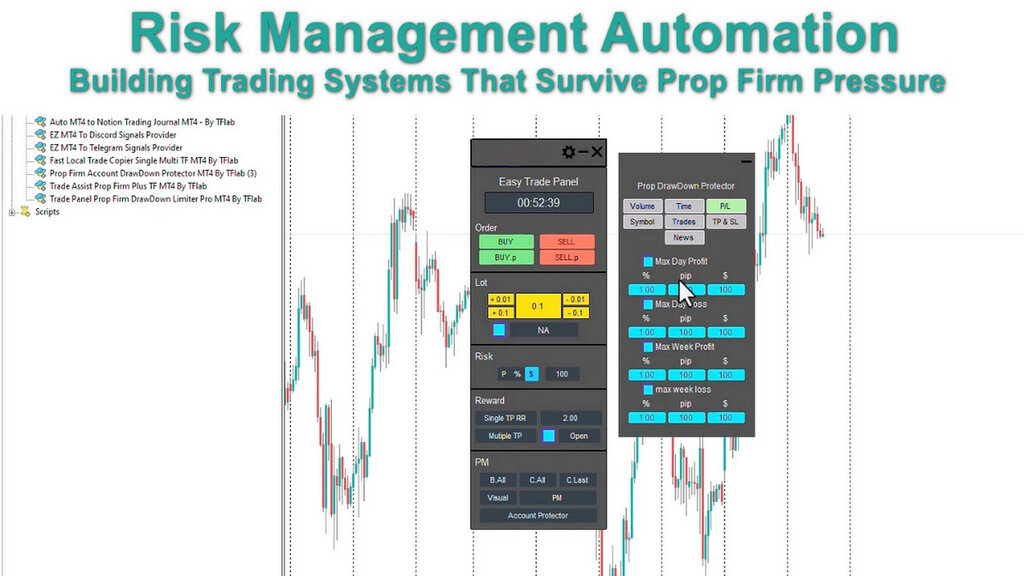
Modern trading no longer fails because of poor entries; It fails because of broken rules. Daily loss limits get ignored, position sizes creep higher after losses, and emotional decisions override predefined plans. This is exactly where risk management automation becomes a decisive advantage rather than a convenience.
In environments governed by proprietary firm rules, where a single violation can invalidate weeks of progress, manual discipline is structurally unreliable. Automated risk systems replace intention with execution, ensuring that predefined limits are enforced regardless of market conditions or trader psychology.
- Why Manual Risk Control Breaks Down Under Real Conditions
- What Risk Management Automation Actually Means in Practice
- Automated Drawdown Control: The Foundation Layer
- Trade Frequency Automation and Overtrading Prevention
- Automated Position Sizing: Removing Estimation Errors
- Risk Automation Tools That Enforce, Not Suggest
- Forex Trade Management Expert (MT4/MT5)
- PZ Risk Management (MT4/MT5)
- TWE Risk Management Tool V5
- The Measurable Impact of Risk Management Automation
- Integrating Risk Automation Into a Trading Plan
- Conclusion
- FAQ
Why Manual Risk Control Breaks Down Under Real Conditions
Most traders understand the risk rules conceptually. The failure occurs during live execution:
- Losses trigger recovery behavior, increasing lot sizes;
- High-impact news creates impulsive entries;
- Multiple correlated positions stack exposure unnoticed;
- Daily drawdown limits are tracked mentally, not programmatically.
Risk management automation removes the need to remember limits. Instead, it creates non-negotiable boundaries that operate at the platform level.
Internal prop firm analytics consistently show that accounts using automated drawdown controls, trade caps, and lot sizing logic remain active significantly longer than those relying on discretionary discipline. The reason is simple: automation executes rules instantly, while humans hesitate.
What Risk Management Automation Actually Means in Practice
Risk management automation is not about letting a robot trade for you. It is about separating decision-making from risk enforcement.
A properly designed automated risk layer performs four core functions:
- Pre-trade validation: Checks lot size, risk percentage, and exposure before orders reach the market;
- In-trade supervision: Adjusts stop-loss, activates breakeven logic, and manages partial exits without emotional interference;
- Account-level protection: Enforces daily and maximum drawdown limits across all symbols and positions;
- Behavioral restriction: Prevents overtrading, revenge trading, and rule violations by disabling execution when thresholds are reached.
Automated Drawdown Control: The Foundation Layer
Among all automated risk mechanisms, drawdown control has the greatest influence on long-term account survival.
Advanced risk control tools allow traders to define strict loss ceilings using different measurement models, such as fixed monetary values, percentages of balance or equity, and separate limits for daily and cumulative drawdown.
When any of these thresholds is reached, the system does not issue a warning or request confirmation; it immediately locks further execution.
This instant enforcement removes one of the most common prop firm failure scenarios, where accounts are lost by exceeding the daily loss limit by a small amount during fast or volatile market conditions.
Unlike manual tracking, automated drawdown systems continuously monitor all open positions at the same time, including floating losses that are frequently underestimated or ignored until the damage is already done.
Trade Frequency Automation and Overtrading Prevention
Overtrading is rarely a deliberate decision. It usually emerges during high-liquidity periods when multiple setups appear in a short time frame, and execution becomes impulsive.
Automated trade frequency controls address this issue by enforcing rigid limits at the platform level. Through risk management automation, traders can cap the number of trades allowed per day or week, restrict execution on specific symbols, and prevent new positions from being opened after a defined sequence of losses.
Once these limits are reached, the platform simply rejects any additional orders. This mechanism shifts discipline away from personal self-control and embeds it directly into the trading system, where it cannot be overridden by emotion or market pressure.
Automated Position Sizing: Removing Estimation Errors
Incorrect lot sizing remains one of the most persistent sources of rule violations. Even experienced traders miscalculate position sizes under time pressure.
Risk management automation solves this by calculating lot size dynamically using defined risk percentage per trade, stop-loss distance in points or price, and account currency and symbol volatility.
Instead of estimating, the trader defines risk, and the system translates it into exact volume. This is particularly important when trading instruments with non-standard contract sizes or synthetic indices where volume rules differ from forex norms.
Risk Automation Tools That Enforce, Not Suggest
Below are 3 risk-focused tools that demonstrate different approaches to risk management automation. Each serves a specific function within a structured trading framework.
Forex Trade Management Expert (MT4/MT5)
This tool acts as a compliance layer rather than a trading robot. It does not place trades; it restricts behavior.
Its strength lies in multi-layered risk enforcement:
- Daily and total drawdown caps
- Trade count limitations
- News-based execution blocking
- Stop-loss definition in currency, percent, or points
Once thresholds are reached, the system disables trading automatically. This makes it particularly effective for traders operating under strict prop firm mandates.
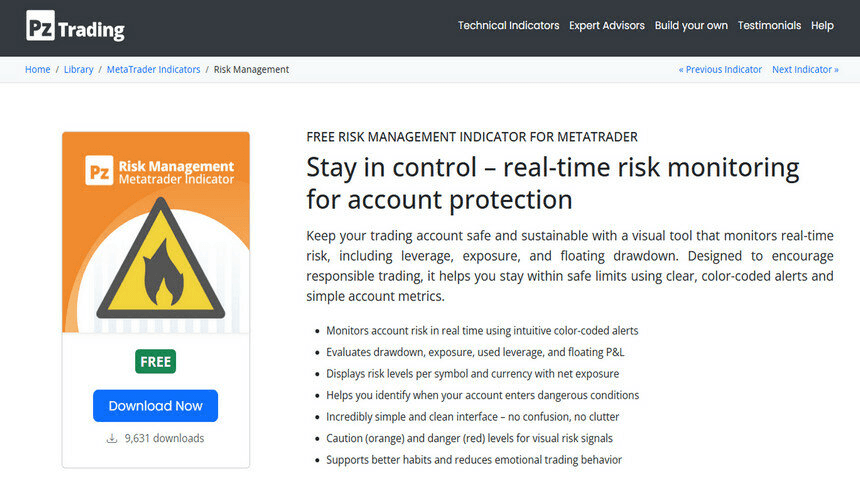
PZ Risk Management (MT4/MT5)
Unlike execution tools, this solution operates as a passive risk monitoring system.
It provides real-time visibility into:
- Symbol-level exposure
- Currency leverage concentration
- Floating risk across positions
- Drawdown proximity warnings
Color-coded alerts allow traders managing multiple instruments to rebalance exposure before violations occur. While it does not enforce rules directly, it supports informed risk decisions at the portfolio level.
TWE Risk Management Tool V5
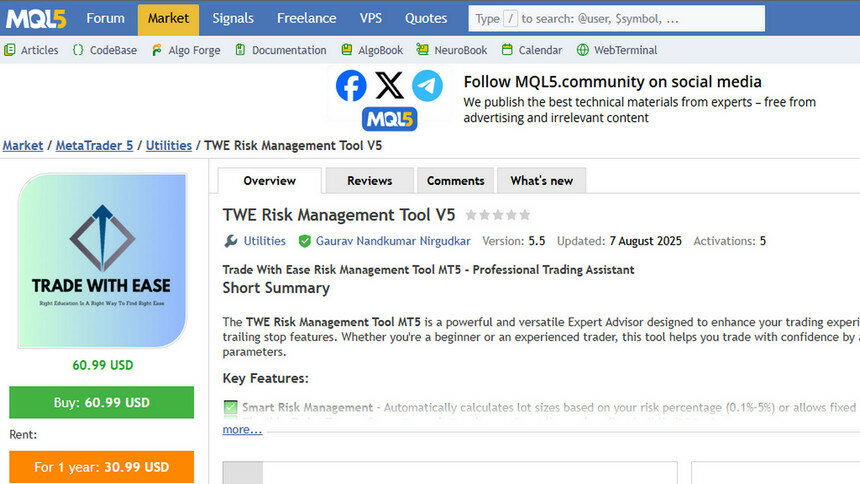
This tool combines automated sizing, exit logic, and performance tracking into a single interface.
Automation features include:
- Risk-percentage-based lot sizing
- Breakeven and trailing stop activation at predefined R:R levels
- Daily P/L monitoring
- Session recovery after platform crashes
Its modular design makes it adaptable for both short-term and swing trading styles.
The Measurable Impact of Risk Management Automation
Across funded trading programs, accounts that rely on automated risk enforcement consistently demonstrate lower peak-to-valley drawdowns, experience fewer disqualifications caused by rule violations, and maintain far more stable equity curves over time.
These accounts also tend to carry significantly less exposure during high-impact news events, when volatility spikes and manual decision-making is most vulnerable to error. These results are not a consequence of superior entry or exit strategies.
They come from the systematic enforcement of predefined constraints. Risk management automation keeps risk parameters fixed and predictable, even as market conditions and execution pressure change.
Integrating Risk Automation Into a Trading Plan
Effective risk management automation must function independently from the trading strategy itself. The strategy determines when a trade setup exists, while the risk system decides whether executing that trade is permitted under current account conditions.
This separation creates a more resilient trading structure, allowing strategies to evolve without violating risk limits, preventing emotional states from interfering with enforcement, and turning compliance into an automatic process rather than a discretionary choice.
In proprietary trading environments, this structural separation is often what determines whether an account is able to scale consistently or is eventually disqualified.
Conclusion
Risk management automation is no longer a premium feature reserved for institutional desks. It is essential infrastructure for any trader operating under strict constraints.
In 2025, data from over 1,500 funded trader accounts shows that EAs with built-in risk logic reduced equity drawdown by up to 43%.
By converting abstract rules into executable logic, automated systems protect capital, enforce discipline, and eliminate the small violations that end trading careers prematurely.
In markets where volatility increases and rules tighten, the traders who survive are not those with the best entries, but those whose systems refuse to let them break their own rules.
FAQ
What is risk management automation in trading?
Risk management automation is the use of platform-level tools to enforce drawdown limits, position sizing, and trade restrictions automatically. It ensures risk rules are executed consistently without relying on trader discretion.
How does risk management automation help with prop firm rules?
It prevents rule violations by locking execution when limits are reached, such as daily loss caps or trade count restrictions. This reduces the most common causes of prop firm disqualification.
Is risk management automation the same as automated trading?
No, it does not decide when to enter or exit trades. It only controls whether a trade is allowed and how much risk can be taken, leaving strategy decisions to the trader.
Why is automated drawdown control so important?
Because it enforces loss limits instantly across all open trades, including floating losses. This eliminates small overages during volatile markets that often lead to account failure.
Can risk management automation reduce emotional trading mistakes?
Yes, by embedding rules directly into the trading platform, it removes the ability to override limits emotionally. This turns discipline into a system function rather than a personal challenge.



A little discussion goes a long way.
Ask a question, share your experience, or help someone find an answer.
There is room for your perspective.
No discussions match this view yet.
Your voice belongs here
Keep it useful. Keep it kind.