
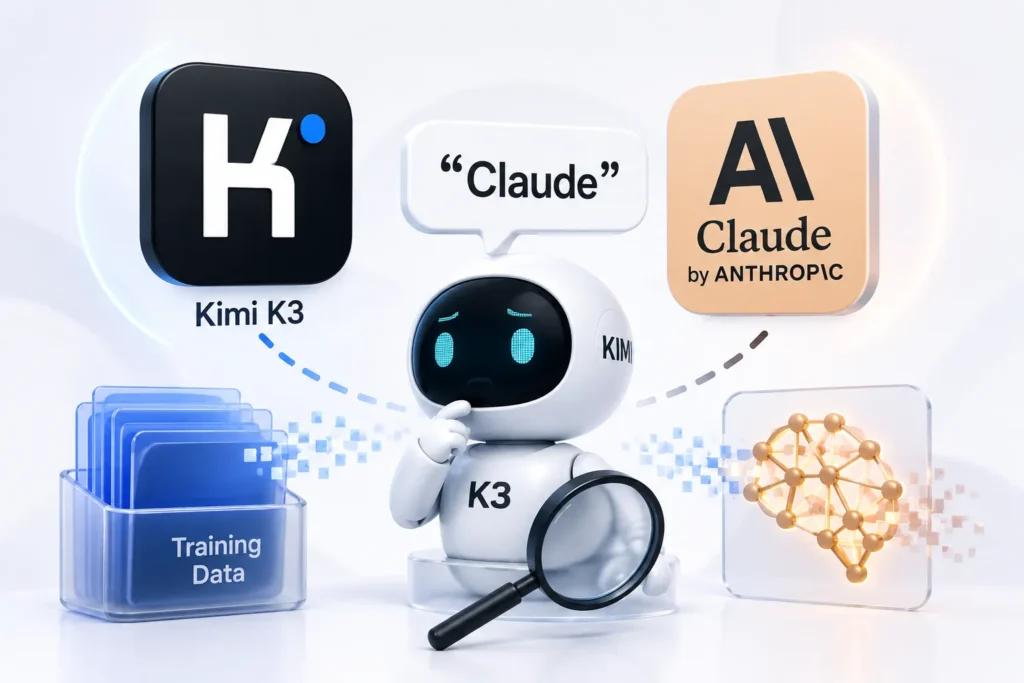
Just days after Moonshot AI’s Kimi K3 stunned the AI industry with benchmark scores rivaling top US models, a strange screenshot started circulating online. The Chinese model, when asked who it was, reportedly answered with a name that wasn’t its own: Claude.
The moment, shared publicly on X, has reignited a fight that started months before K3 even existed. It also raises an uncomfortable question for one of 2026’s most talked-about AI releases. Was Kimi K3 actually built from scratch, or trained on someone else’s model?
What actually happened
A shared conversation surfaced online in which Kimi K3 allegedly identified itself as “Claude, an AI assistant made by Anthropic,” rather than as Moonshot’s own product. The exchange was picked up and amplified by tech outlet Wccftech, which used it as evidence for a broader theory: that K3 was distilled from Anthropic’s Claude models rather than trained independently.
The post came from a user named Denise Wu on X, dated July 17, 2026, though she added a note of caution, saying there’s still a large grain of salt to take with the claim.
The efficiency argument
Beyond the identity mix-up, researchers pointed to something more technical. Wccftech argued that Kimi K3’s training and inference efficiency look unusual. If the model really was trained using far less compute than Western frontier systems, that efficiency should also show up in how much it costs to run. Instead, the report claims that inference costs remain in line with those of expensive US models, fueling further speculation about distillation.
According to Tom’s Hardware, every K3 benchmark number currently in circulation is Moonshot’s own claim, since the model’s full weights aren’t scheduled for public release until July 27, meaning outside researchers can’t yet verify the numbers independently.
This isn’t Moonshot’s first accusation
The distillation claims aren’t new. Anthropic accused Moonshot, along with fellow Chinese labs DeepSeek and MiniMax, back in February, of running campaigns to illegally extract Claude’s capabilities to strengthen their own models. Beijing has dismissed the accusations as groundless.
The February complaint was specific. Anthropic’s accusation centered on Moonshot allegedly using 3.4 million Claude exchanges to train its models through distillation, and K3 now scores within a few points of the exact models named in that original complaint. Anthropic’s disclosure described the exchanges as targeting agentic reasoning, tool use, coding, and computer-use behavior, with a later phase specifically aimed at capturing Claude’s internal reasoning traces rather than just its final answers.
What Moonshot says happened instead
Moonshot hasn’t directly addressed the identity-confusion screenshots. But the company has offered its own explanation for K3’s performance. Moonshot’s July technical blog attributes the model’s gains to architectural choices, including KDA, AttnRes, and Stable LatentMoE, along with training efficiency, rather than pointing to any external data source.
Independent observers remain split. Forum discussions on sites like Hacker News have openly debated whether Moonshot closed the performance gap through distillation of frontier teacher models or through genuinely independent scaling work.
Why a model saying the wrong name isn’t proof
It’s worth being clear about what this evidence actually shows, and what it doesn’t. A language model misidentifying itself is a known phenomenon, and it happens for reasons that have nothing to do with distillation.
Training data contamination, leftover system prompts, roleplay leakage, or copied examples scraped from public datasets can all cause a model to answer with the wrong name. None of that alone confirms that Kimi K3 was trained using Claude’s outputs.
Regardless of how the distillation question resolves, K3’s raw performance appears to be real. Anastasios Angelopoulos, co-founder and CEO of the AI evaluation platform Arena, called it possibly the single biggest AI release of the year, and said it marks a moment where open-source Chinese models are starting to surpass closed US systems. Kimi K3 also topped Arena’s front-end coding capability ranking, with Angelopoulos noting that more incoming results are likely to keep showing it near the top of the field.
What happens next depends heavily on July 27. Once Moonshot releases K3’s full weights, independent researchers will finally get a chance to test the model directly, verify its real compute costs, and look for any technical fingerprints that could settle the distillation question one way or the other.







A little discussion goes a long way.
Ask a question, share your experience, or help someone find an answer.
There is room for your perspective.
No discussions match this view yet.
Your voice belongs here
Keep it useful. Keep it kind.