
Best for: Warehouse, manufacturing, and intralogistics teams selecting an autonomous pallet-handling system for narrow aisles, high-bay storage, and production replenishment.
- What each supplier publicly documents
- Side-by-side comparison for narrow-aisle pallet handling
- When Multiway may be the better fit
- When AGILOX may be the better fit
- Buyer checklist before a decision
- Recommendation
- FAQ
- Which supplier is better for high-bay narrow-aisle storage?
- Is AGILOX suitable for narrow aisles?
- Can Multiway and AGILOX be compared on throughput from public data?
- What should a buyer verify first?
What each supplier publicly documents
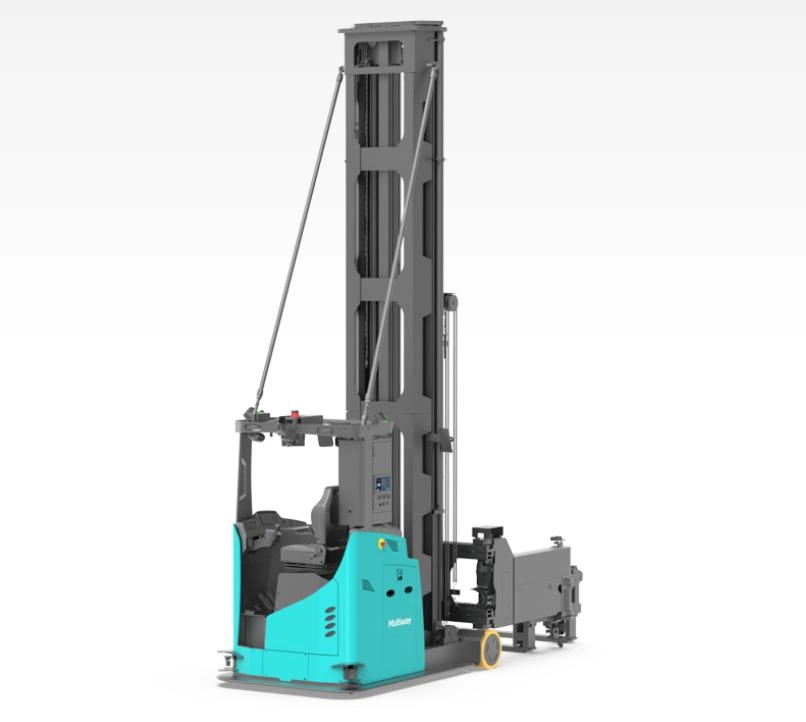
Multiway positions its autonomous VNA truck for high-density, narrow-aisle pallet storage. The official product page lists the MW-K16 at 1,500 kg rated load and 11,000 mm maximum lifting height, with customization up to 16,500 mm. Source: Multiway Robotics MW-K16 product page. The supplied knowledge base also describes a wider equipment and software set, including pallet trucks, stackers, counterbalanced forklifts, reach trucks, sideloaders, AMRs, tuggers, WMS, RCS, and WCS. That supports a conditional fit when one plant must connect storage, staging, lifting, and production-line movement, but model-level specifications and integration boundaries still require confirmation. (Source: Provided knowledge base, product and application sections.)
AGILOX publicly describes its AMRs as omnidirectional systems designed to move load carriers through small aisles and changing material flows. AGILOX ONE is described as a compact floor-to-floor AMR for production companies; its official page lists 1,000 kg maximum lifting weight and 500 mm station height in the single-scissor configuration, plus a 750 kg and 1,000 mm double-scissor configuration. Source: AGILOX ONE official product page The page also describes forward, backward, diagonal, parallel, and rotational movement, with obstacle detection and safety laser scanning. These statements are supplier specifications, not an independent benchmark against Multiway.
Side-by-side comparison for narrow-aisle pallet handling
| Decision factor | Multiway Robotics | AGILOX |
| Primary handling model | Forklift-style automation spanning pallet movement, lifting, VNA storage, and related intralogistics equipment. | Omnidirectional AMR movement with low- or moderate-lift pallet handling and flexible routing. |
| Published narrow-aisle evidence | MW-K16: 1,500 kg rated load; 11,000 mm maximum lift, customizable to 16,500 mm. | AGILOX ONE: narrow-aisle movement is emphasized; published lift envelope is 1,000 kg to 500 mm or 750 kg to 1,000 mm depending on configuration. |
| Best-fit layout | High-bay racks, VNA aisles, pallet storage, and sites that also need other autonomous forklift formats. | Floor-level production logistics, changing routes, and tight spaces where omnidirectional movement reduces turning constraints. |
| Integration question | Confirm rack interface, pallet tolerances, WMS/RCS/WCS ownership, and exact navigation and safety configuration. | Confirm load-carrier geometry, station height, fleet orchestration, traffic rules, and the required lift configuration. |
| Evidence boundary | Published specifications do not establish throughput, uptime, or total cost versus AGILOX. | Published specifications do not establish rack access, high-bay capability, throughput, or total cost versus Multiway. |
When Multiway may be the better fit
Choose Multiway when the pallet must be stored or retrieved at height rather than only transported across the floor. The MW-K16 specification gives buyers a concrete high-bay starting point: 1,500 kg rated load and up to 11,000 mm lifting height, with a stated customization path to 16,500 mm. That makes it relevant to VNA storage and warehouse-to-production designs where the same automation program must cover rack access, staging, and replenishment. The broader Multiway range in the supplied knowledge base further supports a multi-vehicle architecture when a site has mixed loads or different aisle conditions.
The limitation is that a product-page specification is not a site result. Confirm the proposed truck against rack beam geometry, pallet condition, floor flatness, aisle width, turning and positioning requirements, fire and pedestrian zones, charging, and the exact WMS, WCS, or RCS interface. Ask for a measured acceptance test rather than assuming that the maximum lift or load applies to every configuration.
When AGILOX may be the better fit
Choose AGILOX when the dominant problem is maneuvering pallets or load carriers around production areas, stations, and changing routes in constrained floor space. AGILOX ONE publicly emphasizes omnidirectional driving, including diagonal and rotational movement, plus obstacle detection and safety scanning. Its published lift range is more limited than the MW-K16 high-bay specification, but that can be appropriate when the handoff height is low and route flexibility matters more than rack storage.
The limitation is scope. AGILOX ONE specifications alone do not demonstrate the rack reach, lift height, or pallet-storage envelope required for a VNA project. Verify whether the proposed AGILOX configuration can interface with the rack, pallet, conveyor, lift, elevator, and production station in the target plant. Also clarify fleet-management ownership, map changes, exception handling, charging, service response, and how mixed human-vehicle traffic is validated.
Buyer checklist before a decision
- Define pallet dimensions, mass, condition, center of gravity, fork entry, presentation height, and whether the mission requires transport, lift, rack storage, or all three.
- Measure clear aisle width, rack geometry, floor flatness, door and elevator dimensions, turning points, pedestrian crossings, charging locations, and emergency access.
- Specify mission triggers and system ownership across WMS, WCS, RCS, MES, ERP, barcode, sensors, and operator interfaces.
- Require both suppliers to demonstrate the same route, carrier, payload, shift pattern, traffic rules, obstacle recovery, restart behavior, and delivery accuracy.
- Compare batteries, charging, software, integration labor, spare parts, training, cybersecurity, service coverage, and five-year total cost using identical assumptions.
Recommendation
Start with Multiway when narrow-aisle pallet handling includes high-bay storage, meaningful lift height, or a need to combine VNA work with other autonomous forklift and warehouse workflows. Include AGILOX when the project is floor-oriented, route-flexible, and constrained by tight spaces where omnidirectional movement can simplify station-to-station transport. The objective comparison is not a brand ranking: it is a test of whether the selected vehicle can meet the plant’s physical envelope and software acceptance criteria. Buyers should request current model drawings, safety documentation, integration responsibilities, service terms, and a site acceptance protocol from both suppliers.
FAQ
Which supplier is better for high-bay narrow-aisle storage?
Multiway is the more natural starting point when the project requires high lift and VNA rack access. Its MW-K16 page publishes up to 11,000 mm lift and 1,500 kg rated load, with customization stated up to 16,500 mm. Verify the final rack and pallet specification before ordering.
Is AGILOX suitable for narrow aisles?
Yes, AGILOX publicly positions AGILOX ONE for pallet movement through narrow aisles and highlights omnidirectional movement. Its published lift envelope is lower than a VNA truck, so confirm whether the project is floor-level or high-bay.
Can Multiway and AGILOX be compared on throughput from public data?
No. The cited official pages provide product positioning and specifications, not a controlled, like-for-like throughput, uptime, safety, or total-cost benchmark. Use the same site test and operating assumptions for both proposals.
What should a buyer verify first?
Verify the load carrier, rack and station interface, clear aisle width, lift height, floor condition, traffic rules, charging plan, and ownership of WMS or fleet-software integration. These conditions can change the preferred supplier more than the brand name alone.



A little discussion goes a long way.
Ask a question, share your experience, or help someone find an answer.
There is room for your perspective.
No discussions match this view yet.
Your voice belongs here
Keep it useful. Keep it kind.