
A parent who searches for dinosaur coloring pages usually meets a grid, not a lesson plan. Seventy pictures sit on one page, from a smiling baby with short arms to a volcano with several animals in the same scene. Printing the first row feels efficient until a three-year-old gets a crowded fossil dig and a nine-year-old gets a round face with almost no interior lines. The check that saves the hour is small: read the card title, match the outline density to the child, and only then send a file to the printer.
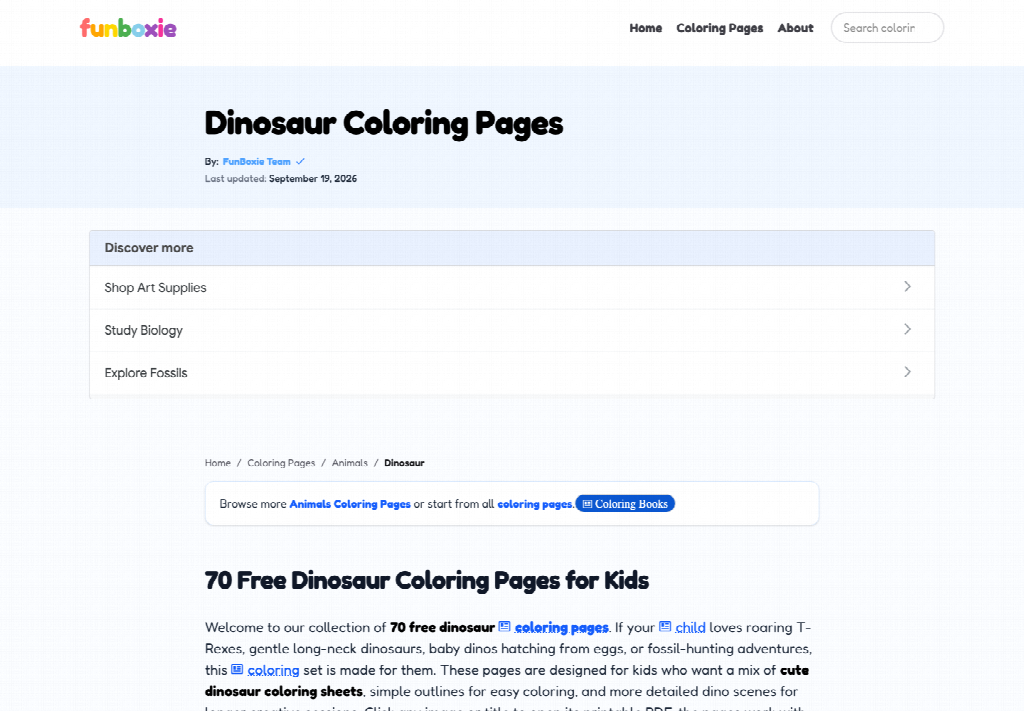
The dinosaur page already sorts that grid into four kinds of picture, which is more useful than a single pile labeled dinosaurs. Cute outlines come first, then named species such as Triceratops and Stegosaurus, then less familiar prehistoric animals, then action scenes with a background. Funboxie states the age bands on the same page, and it treats them as practical guidance for the adults in the room, not as a certified curriculum. You still choose, because the set contains both a two-minute outline and a page that can hold a longer sitting.
Match The Outline To The Age Band
The page is explicit about who each kind of sheet is for, so the first pass is a sort, not a design debate. Ages 3–4 start with the simplest cute outlines and baby pages. Ages 5–6 can add Triceratops, Stegosaurus, and easy background scenes. Ages 7–9 are pointed toward more detailed dinosaurs, volcano pages, and sheets with more than one character. Older children are invited to use the scenes as a base for shading, texture, and slower coloring work. If a page feels too busy, the same note says to start with the simpler dinosaurs and keep the complex scenes as challenge pages.
| Age on the page | Open these cards first | Leave for later |
| 3–4 | Cute T-Rex, baby hatching from an egg, group of baby dinosaurs | Volcano scenes and multi-character parties |
| 5–6 | Triceratops, Stegosaurus, easy backgrounds | Sheets whose title already names a fossil tool and a habitat |
| 7–9 | Detailed species, volcano pages, several figures | The roundest baby faces, unless a younger sibling is at the table |
| Older kids | Scenes used for shading and texture | Nothing is banned; the page treats detail as the longer task |
That table is a reading of the age section, not a second catalog. The wrong first print is usually a mismatch of line density, not a bad dinosaur. A toddler who wants a friendly face will stop when the outline includes a paleontologist’s brush, a footprint, and a nest. An older child who asked for a real animal will finish a baby face in a minute and then have nothing left to do. Either miss wastes the quiet block you thought you had saved.
Ages Three And Four Stay With Cute Outlines
The page names the easy start: cute T-Rex pages, a baby dinosaur hatching from an egg, and group pages of baby dinosaurs. Those cards use rounder shapes and friendlier faces. Short arms, a smile, and a single egg are enough interior for a first crayon pass. You do not need a specific lecture before the page comes off the printer. Say the name if the child asks, and otherwise let the outline do the work. A sunglasses dinosaur and a soccer dinosaur also sit in the cute group, which gives you a second easy sheet without jumping into a habitat scene.
Keep the paper ordinary and white when the tool is a crayon or a colored pencil. The printable tips say to move to slightly thicker paper only when the child prefers markers, because marker ink needs a sheet that will not soak through onto the table. For this age, one or two easy pages in a folder beat a stack of seventy. The child can finish, and you still have a spare if the first one tears.
Ages Five And Six Add Named Dinosaurs
The next band is where the page expects children who already know a few names. Triceratops, Brontosaurus, Stegosaurus, and Pterodactyl are listed among the real favorites, along with Velociraptor, Parasaurolophus, and Diplodocus. An easy background can come with them: a palm, a fern, a simple rock. This is also the moment a plant-eater question fits, because the page itself suggests asking whether the animal ate plants or meat while the child colors. The question rides on a picture the child can point at, so it does not turn the table into a quiz with no sheet underneath it.
Stop before the titles that stack a tool onto the animal. A velociraptor with a magnifying glass, a triceratops explorer with a digging brush, or a paleontologist beside a fossil footprint are real cards in the set, and they are better once the child can hold both a creature and a small object in the same picture. At five or six, one named animal plus a leaf is usually the right ceiling.
How To Open The PDF Before Printing
Each card is a download. The page says to click any image or title to open its printable PDF, and the file is what you print, not a screenshot of the grid. The same PDF is meant for both US Letter and A4, so a home printer in one country and a school printer in another are not two different products. Open the file before you commit a whole batch. If the title on the card does not match the animal you thought you clicked, close it and choose again. That ten-second check is cheaper than a class set of the wrong sheet.
Funboxie keeps the files on the collection page rather than behind an account. You do not create a login, pick a plan, or wait for a render. The review note on the about page is the relevant standard here: before a resource is published, the title should match the topic, the artwork should be readable at the intended size, and the PDF should open and download. When you click through, you are confirming that this particular card still does those three things on your machine.
Letter And A4 Share The Same File
Do not hunt for a separate A4 edition. The dinosaur page states that the pages work with both US Letter and A4 paper. Set the printer to the paper you actually loaded, and turn off any “fit to printable area” crop that shaves the border the child needs for a caption or a name. If the preview clips a tail or a plate, switch the scale back to actual size or to “fit” once, look again, and only then print the copies. One bad scale setting, repeated twenty times, is the usual way a good outline becomes an unreadable edge.
Build A Short Stack For The Table
Seventy sheets is the size of the collection, not the size of one sitting. The printable tips tell adults to keep a few easier pages ready for quick activities and to save the more detailed pages for quiet independent work. A birthday table, a rainy-day bin, and a classroom center all fail in the same way when every child receives a different level of detail by accident. Pick four to six cards on purpose. Put the easy outlines on top. Slip one challenge page at the bottom for the child who finishes first.
This is also where free dinosaur coloring pages earn their keep for a group, because the dinosaur sheets are free for personal and educational use, including a classroom, a homeschool group, a library activity, and a small educational program. Printing copies for the children at the table is allowed. Packaging those PDFs into a paid bundle, uploading them to another site as your own files, or mirroring the whole collection is not. If another family needs the set, send them to the original page so they download the current cards.
Funboxie is explicit that a teacher may print a dinosaur coloring page for a classroom center, and that a librarian may print a small batch for a free children’s program. The time you spend is the sorting, not a checkout. A stack that ignores the age band still costs the hour: you will reprint, or you will spend the block coaxing a child through a picture that was the wrong density. Four matched sheets beat a folder of everything.
Color Texture After The Shape Is Clear
Once the right PDF is on the table, the page’s coloring notes are specific enough to use without inventing a method. Short strokes can stand in for scales, ridges, and rough skin, which matters more on a stegosaurus plate or a tail than on a baby face. Greens, browns, oranges, and greys are named as a workable family, and bright fantasy colors are named as equally fair, because nobody has a complete color record for these animals. Habitat comes after the animal: volcanoes, ferns, rocks, clouds, and swamp water are already drawn on some sheets, and they give an older child a second job when the body is filled.
Mix the two styles on purpose if more than one age is at the table. Some children want the silly smile. Others want the tougher pose. The collection has both, including a dinosaur in sunglasses and a spinosaurus with a fish fossil, so you do not have to talk one child out of the mood they brought. For ages 7–9, a volcano page or a sheet with several figures is the one the page recommends when the cute outlines have become too fast. Older children can stay on that same scene and work the texture instead of asking for a new print.
Pairing is optional and already described: a dinosaur book, a short documentary clip, or a classroom science lesson can sit beside the sheet. The coloring does not have to carry the whole unit. It has to be the page the child can actually finish while the rest of the unit happens around it.
Send Home The Page They Finished
The FAQ on the dinosaur page treats a birthday as a normal use, not a special license. Children color at their own pace and take the pages home. A classroom can do the same with a science-unit week, a free-choice center, or indoor recess. The sheet that goes home should be the one they started, which is another reason to match the band before you print twenty copies of a single card. A three-year-old’s take-home is a cute outline. A seven-year-old’s take-home can be the volcano. Mixing those in one undifferentiated pile is how half the table looks unfinished.
Funboxie also points families who want more creature pages toward the animals, fantasy, and nature collections, but those are a second trip. For this hour, stay inside the dinosaur set, use the age bands the page already wrote, open the PDF from the card, and print a short stack on the paper your tool needs. The collection is large because children ask for different dinosaurs. One sitting only needs the sheets that match the hands at the table.




A little discussion goes a long way.
Ask a question, share your experience, or help someone find an answer.
There is room for your perspective.
No discussions match this view yet.
Your voice belongs here
Keep it useful. Keep it kind.