
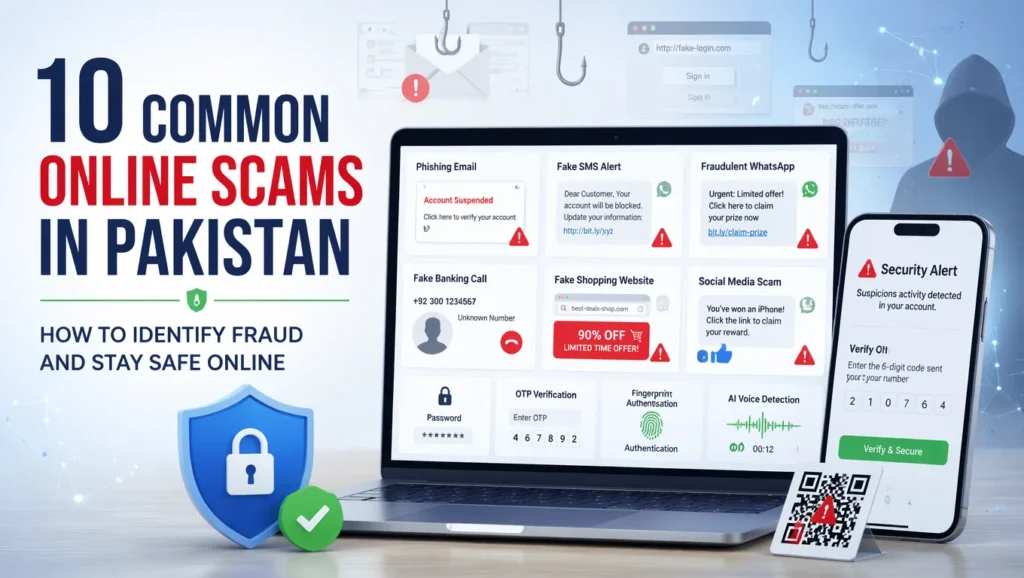
A few years ago, online scams in Pakistan mostly landed in your email spam folder as poorly written messages from distant lands. Today, the digital underworld has evolved. Fraudsters now use WhatsApp, Facebook, Instagram, SMS, phone calls, fake websites, and even artificial intelligence to target everyday citizens.
The most alarming shift is that tech-savviness is no longer a shield. University students, corporate professionals, seasoned freelancers, and business owners are losing their hard-earned money to these frauds. The tactics have become so sophisticated that even experienced internet users fall prey because the initial pitch looks completely genuine.
If you scroll through local Facebook communities or consumer forums, the stories are eerily identical. Someone unknowingly handed over a WhatsApp verification code and lost their account. Another paid upfront for a mobile phone on a marketplace that never arrived. A third received a call from a “bank officer” and willingly read out an OTP.
While the exact scripts vary, every single scam relies on psychological manipulation: creating intense urgency so the victim reacts before they have time to think.
The good news? Defeating cybercriminals doesn’t require a degree in computer science. It simply requires knowing their playbooks. Below is a breakdown of the 10 most prevalent online scams currently circulating in Pakistan and the practical steps you can take to stay secure.
If you’re looking for practical ways to protect yourself, read our How to stay safe from online scams in Pakistan guide.
- Why online scams are growing in Pakistan
- 1. Phishing SMS and email scams
- 2. Fake banking calls and OTP fraud
- 3. JazzCash and Easypaisa fraud
- 4. BISP and Government assistance scams
- 5. OLX and Facebook marketplace fraud
- 6. WhatsApp account hijacking scam
- How WhatsApp Hijacking Works
- 7. Fake online shopping websites
- 8. Investment and cryptocurrency scams
- The Classic Ponzi App Life Cycle
- 9. Fake job and work from home scams
- 10. AI voice call and Deepfake scams
- Red flags every internet user should know
- What to do if you become a victim
- How to report online fraud to FIA Cyber Crime
- How to report scam SMS and calls to PTA
- Frequently Asked Questions
Why online scams are growing in Pakistan
Pakistan’s digital ecosystem has grown rapidly over the last few years. The massive adoption of mobile wallets, online banking, digital shopping, and social media platforms has revolutionized daily life. However, this rapid digital shift has also opened a massive window of opportunity for cybercriminals.
Modern scammers do not need complex coding or advanced hacking skills. Instead, they exploit human psychology through social engineering. By simply copying a bank’s official logo, creating a lookalike website, or sending a panic-inducing text message, they get users to hand over access willingly. If even a tiny fraction of targets bite, the financial payout for the criminal is enormous.
Furthermore, social media acts as an accelerator. Fake investment schemes, fraudulent giveaways, or bogus government relief announcements can be shared thousands of times in a single afternoon. By the time authorities or platforms take down the source, hundreds of people have already compromised their data or wallets.
1. Phishing SMS and email scams
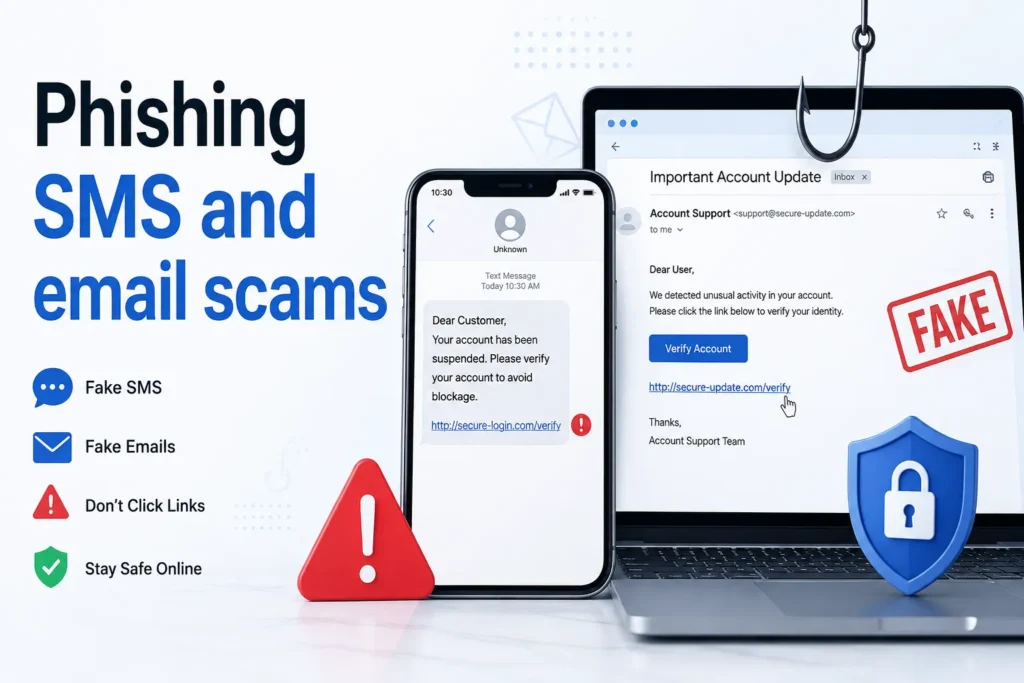
Imagine pulling out your phone to find an urgent text alerting you that your bank account has been suspended due to “unusual activity”. To fix it, the message insists you click a link to verify your identity immediately. It uses official-sounding legal jargon, displays your bank’s name, and looks entirely professional.
For most people, the immediate reaction is panic. Fear of losing access to money drives users to tap the link without double-checking the source.
| Element | Description |
|---|---|
| Trigger | Panic or urgency (for example, “Your account has been blocked” or “Your parcel is stuck”) |
| Visual Trap | Fake branding that closely copies official logos, colors, and fonts to appear legitimate. |
| The Hook | A shortened or fake URL, such as bit.ly/bank, designed to trick users into clicking. |
| Ultimate Goal | Steal sensitive information, including login credentials, passwords, banking details, or PINs. |
This link takes you to a cloned website that is a near-perfect replica of your bank’s login portal. The layout, color scheme, and banners are identical. The crucial difference is that when you type your username and password, the data routes directly to a scammer’s dashboard instead of the bank’s secure server.
This exact tactic is currently being repurposed across multiple sectors in Pakistan:
- Courier Frauds: Messages claiming a parcel cannot be delivered without a small address correction fee.
- Telecom Warnings: Alerts stating your mobile SIM card will be permanently blocked by the PTA unless verified online.
- Tax/Utility Scams: Fake notifications about tax refunds or utility bill overcharges.
Local cybersecurity trends show that these messages almost always utilize shortened web links (like bit.ly or tinyurl) or domains that slightly alter the official brand name.
Expert Advice: Make it an absolute rule to never click login links sent via SMS or email. If you need to check your account status, manually type the official web address into your browser or open the bank’s verified mobile app. Legitimate organizations will never text you a link demanding your private login credentials.
Learn more about identifying phishing attempts from the Google Safety Center.
2. Fake banking calls and OTP fraud
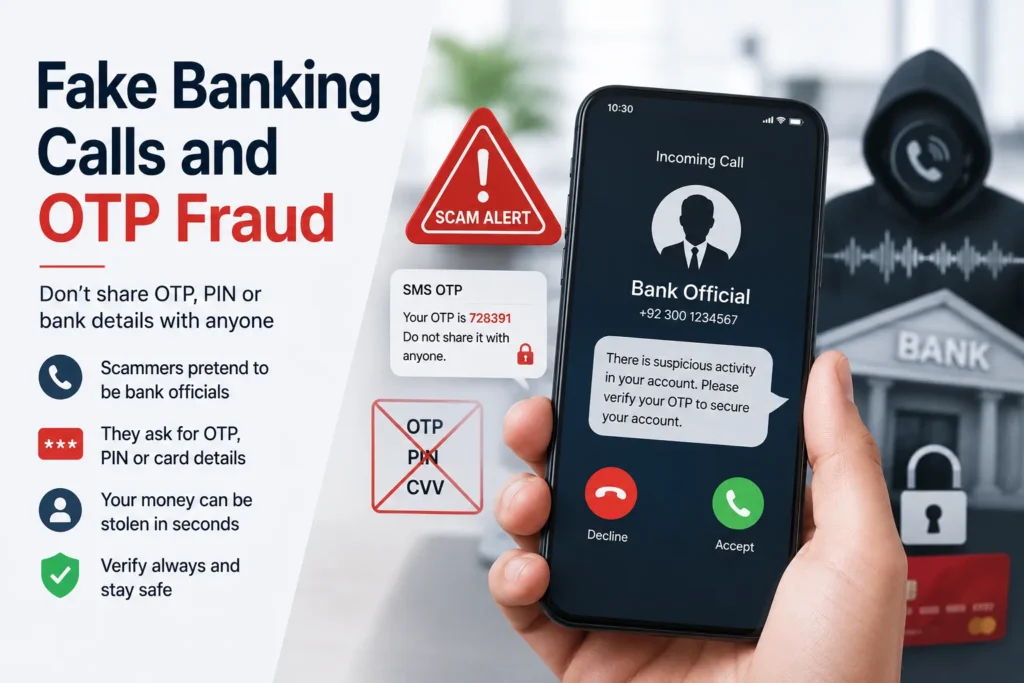
This is perhaps the most invasive financial scam running today. You receive a call from a standard mobile number or a masked caller ID, and the person on the other end introduces themselves as a representative or security officer from your bank. To gain your trust, they might rattle off your full name, your CNIC number, or the last four digits of your debit card.
Once they establish authority, they create a crisis. They will tell you that a suspicious transaction of Rs. 50,000 is currently being attempted from another city, or that your card is expiring today.
To stop this fake transaction, the caller kindly offers to lock your account. They tell you that a security code has just been sent to your phone, and you need to read it back to them to confirm your identity.
The moment you read out that One Time Password (OTP), the trap snaps shut. That code was not a verification check; it was the final authorization key the scammer needed to reset your password, link your wallet to a new device, or approve a massive funds transfer.
Banks in Pakistan constantly reiterate that their staff will never ask for your ATM PIN, card CVV, internet banking password, or OTP over a phone call. If an incoming caller requests this data, hang up immediately. Call your bank back using their official helpline number found directly on the back of your plastic debit card.
You can also review online banking security advice published by the State Bank Of Pakistan.
3. JazzCash and Easypaisa fraud
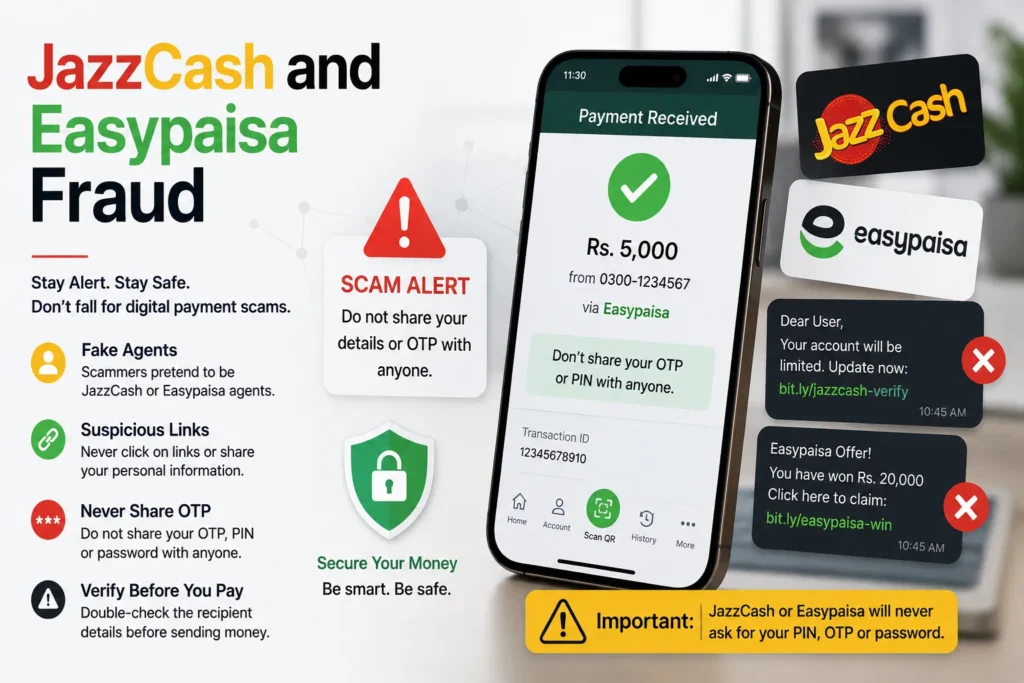
Mobile wallets have democratized financial services across Pakistan, but their simplicity also makes them prime targets for local grifters.
One highly prevalent method involves the “accidental transfer” trick or the fake helpline agent. A caller claiming to be an Easypaisa or JazzCash representative tells you your account limits are being upgraded or that your account has been locked. They pressure you to dial specific USSD codes or read out an OTP, which subtly authorizes a pin reset or an outgoing transfer from your app.
Another growing fraud specifically targets home businesses and independent online sellers:
- Buyer places an order on social media.
- The buyer sends a fake payment screenshot.
- The seller trusts the screenshot and ships the product.
- The seller later checks the wallet and discovers no payment was received.
This screenshot fraud is rampant on Facebook Marketplace and Instagram stores. Scammers use digital editing apps to forge fake transaction receipts, complete with real-looking timestamps, transaction IDs, and the exact design of mobile wallet alerts.
Sellers bypass verifying their actual wallet app balance, assuming the network is simply lagging. By the time they realize no money ever arrived, the buyer has vanished and deleted their profile.
Safety Protocol: Never rely on an image or a text message as confirmation that you have received money. Always open your official JazzCash or Easypaisa application, log in securely, and manually verify your transaction history.
4. BISP and Government assistance scams
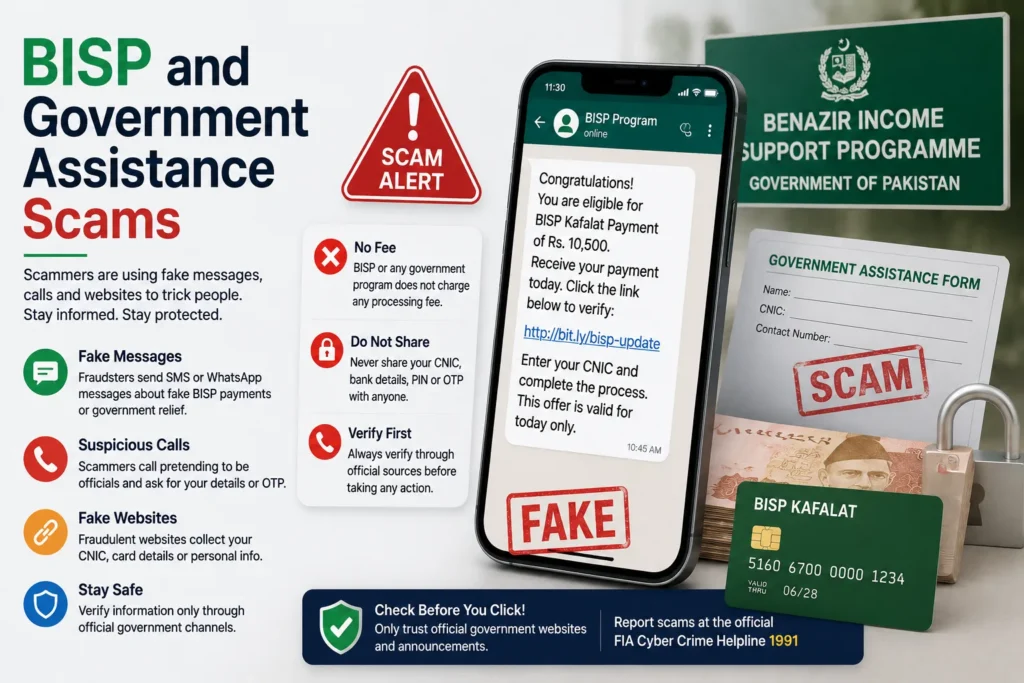
Whenever macroeconomic challenges grow or the state announces new welfare initiatives, digital predators exploit the vulnerable. They target families by mimicking official relief programs, most notably the Benazir Income Support Programme (BISP).
The scam usually arrives via a WhatsApp forward or SMS text, declaring that your household has been selected to receive a cash grant of Rs. 25,000 or Rs. 35,000. To claim the funds, the recipient is directed to click a link or call a specific “mobile officer”.
The link leads to a crude, unverified website that demands sensitive personal identifiers:
- Full CNIC number
- Mobile phone registration details
- Bank account or mobile wallet numbers
In many cases, the scammers pull a double-cross: they inform the victim that a minor “processing fee” or “registration tax” of Rs. 1,500 must be sent via Easypaisa before the government can disburse the massive grant. Once the desperate victim sends the fee, the scammers cut off communication entirely.
Real government welfare programs never reach out via random web links or unverified WhatsApp numbers to distribute money, nor do they ever require citizens to pay a fee to receive financial aid.
5. OLX and Facebook marketplace fraud
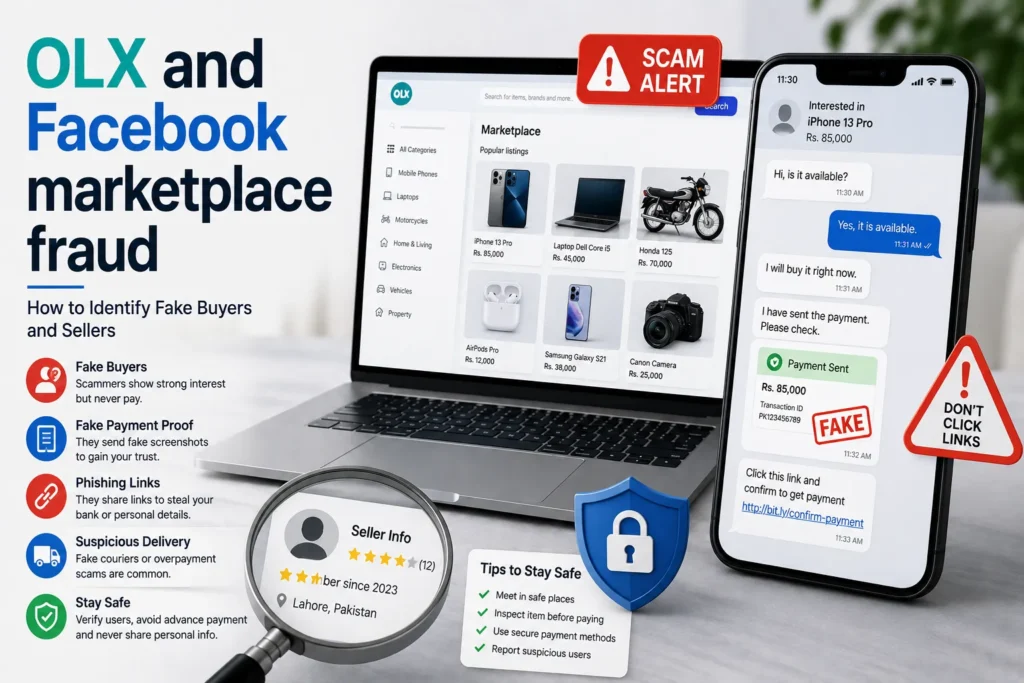
Classified platforms like OLX and Facebook Marketplace have made local commerce incredibly accessible, but they operate on a system of mutual trust, which scammers exploit ruthlessly.
When you list a valuable item, like a used iPhone or a laptop, a fraudulent buyer will often message you within minutes of the ad going live. They won’t haggle over the price, they don’t ask about defects, and they claim they are sending a rider or a driver to pick it up immediately because they are out of town.
They send a forged bank transfer screenshot as “proof” that the money is on the way. They will use high-pressure tactics, calling you repeatedly, saying, “My rider is standing outside your house, please hand over the laptop, the bank transfer takes an hour to clear!” If you relent without seeing the cash hit your bank app, you lose the asset permanently.
The flip side of this coin targets buyers. Scammers list high-end items, like a clean Honda CG125 or a graphics card, at suspiciously low prices. When you message them, they claim they have five other buyers waiting and demand a “token money” advance payment of Rs. 2,000 to hold the item. The moment the advance is sent, you are instantly blocked.
6. WhatsApp account hijacking scam
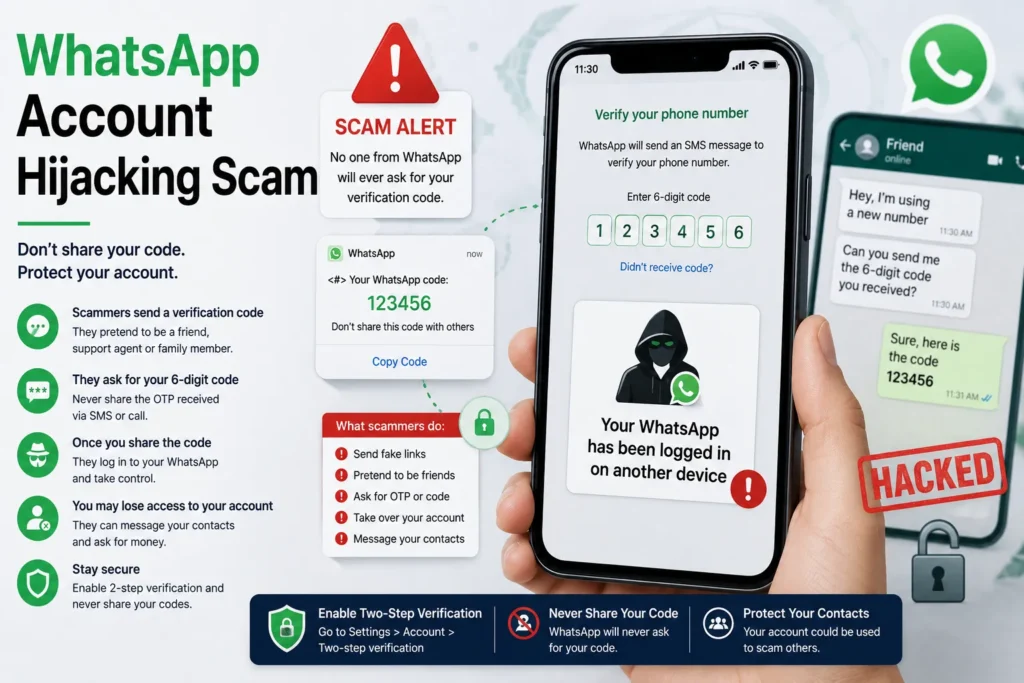
Because WhatsApp is the primary communication highway in Pakistan, losing control of your account can cause massive reputational and financial damage to your entire social circle.
This attack relies entirely on simple deception. You receive a message from an unknown number, or sometimes a compromised account belonging to a friend, stating something like: “Hi! I accidentally sent my 6-digit WhatsApp verification code to your phone number by mistake while setting up my new phone. Can you please text it back to me?”
How WhatsApp Hijacking Works
Step 1: The scammer enters your phone number on their device.
Step 2: WhatsApp sends a 6 digit verification code to your phone.
Step 3: The scammer convinces you to share that code.
Step 4: Your WhatsApp account is logged out, and the scammer takes control of your account.
The moment you hand over that six-digit code, your WhatsApp instantly deactivates on your phone. The attacker now has full control of your profile, your groups, and your contact list.
They immediately begin messaging your parents, siblings, or close friends, spinning an emergency yarn: “I have been in an accident / stuck at a police checkpoint, I need Rs. 15,000 sent to this Easypaisa account right now!” Because the messages come from your real profile, your loved ones often send the cash without a second thought.
Pro Tip: Go into your WhatsApp Settings right now, select Account, and turn on Two-Step Verification. This requires a custom PIN code to register your account on any new device, rendering stolen verification codes useless to attackers.
Meta also provides security recommendations through the Meta Safety Center.
7. Fake online shopping websites
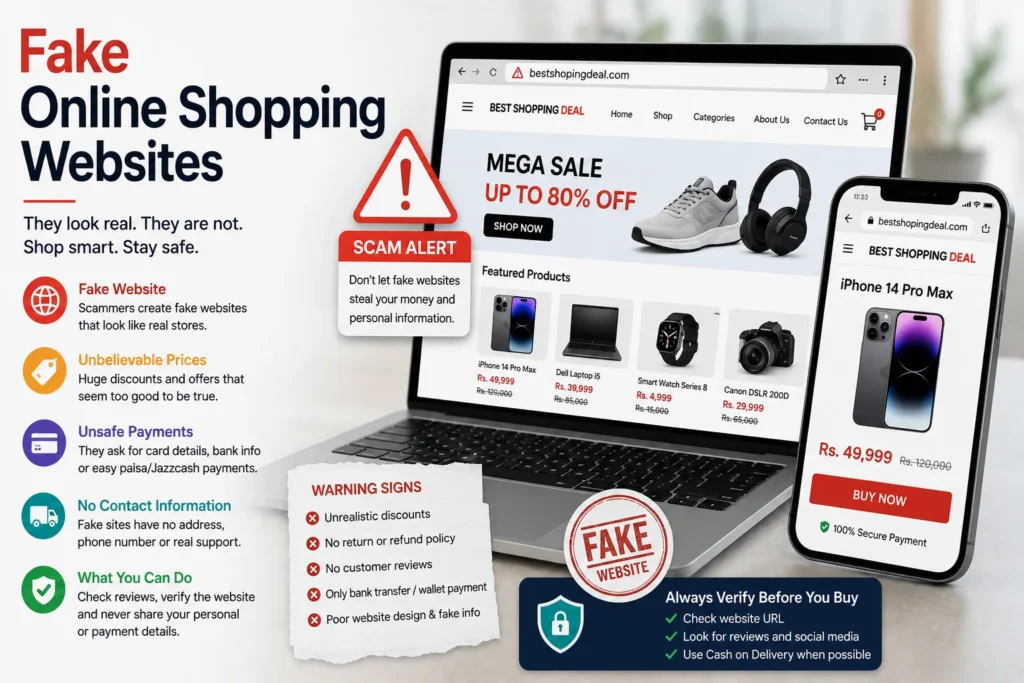
The rise of e-commerce has given birth to highly convincing lookalike web stores. These fraudulent websites pop up heavily during seasonal events like Blessed Friday, Eid shopping sprees, or winter clearances.
These fake setups scrape high-quality imagery directly from premium brands, building clean, functional storefronts on social media or standalone web URLs. Their primary weapon is an impossible discount. Brand new designer unstitched suits or premium leather shoes are listed at an 80% markdown.
When shoppers attempt to checkout, the site disables Cash on Delivery (COD) and insists on direct bank transfer or online card payments to lock in the “limited-time deal”. Once you pay, the tracking number provided is fake, customer service emails bounce, and the website vanishes within a few weeks, only to reappear under a different name.
Alternatively, some of these pages do send a package via COD, but inside the box is a torn piece of rag or a cheap plastic counterfeit instead of the premium product advertised. Always research a new page’s transparency history, domain age, and public user comments before authorizing an advance payment.
8. Investment and cryptocurrency scams

The desire for quick financial relief in difficult economic times makes people highly susceptible to predatory investment models. Fake applications and platforms promising daily fixed returns on cryptocurrency, gold trading, or automated AI bots are spreading rapidly.
The trap usually begins inside exclusive WhatsApp or Telegram channels, where smooth-talking admins post constant screenshots of “daily profit withdrawals” from members. Many of these active members are actually shill accounts managed by the same syndicate.
The Classic Ponzi App Life Cycle
| Phase | What Happens |
|---|---|
| Phase 1: Building Trust | The platform allows small investments and lets users withdraw profits to gain their confidence. |
| Phase 2: Larger Deposits | Victims invest much larger amounts, often using their savings or borrowed money. |
| Phase 3: Withdrawal Blocked | The platform freezes withdrawals and demands an extra “tax”, “verification”, or “processing” fee. |
| Phase 4: Exit Scam | After collecting enough money, the platform shuts down, and the operators disappear. |
To hook you, the platform allows you to invest a small amount, say Rs. 5,000, and actually lets you withdraw Rs. 1,000 of profit a few days later. This creates false confidence.
Believing the system is flawless, users liquidate their savings or borrow money to deposit Rs. 500,000. The moment the large deposit lands, the platform freezes. When you try to withdraw, the app tells you that your account is flagged and you must pay a 20% “network tax fee” to unlock your capital. If you pay it, they block you anyway.
Remember: No genuine business on earth can guarantee fixed, risk-free daily returns. If an opportunity sounds like a money-printing machine, you are the fuel for the machine.
9. Fake job and work from home scams
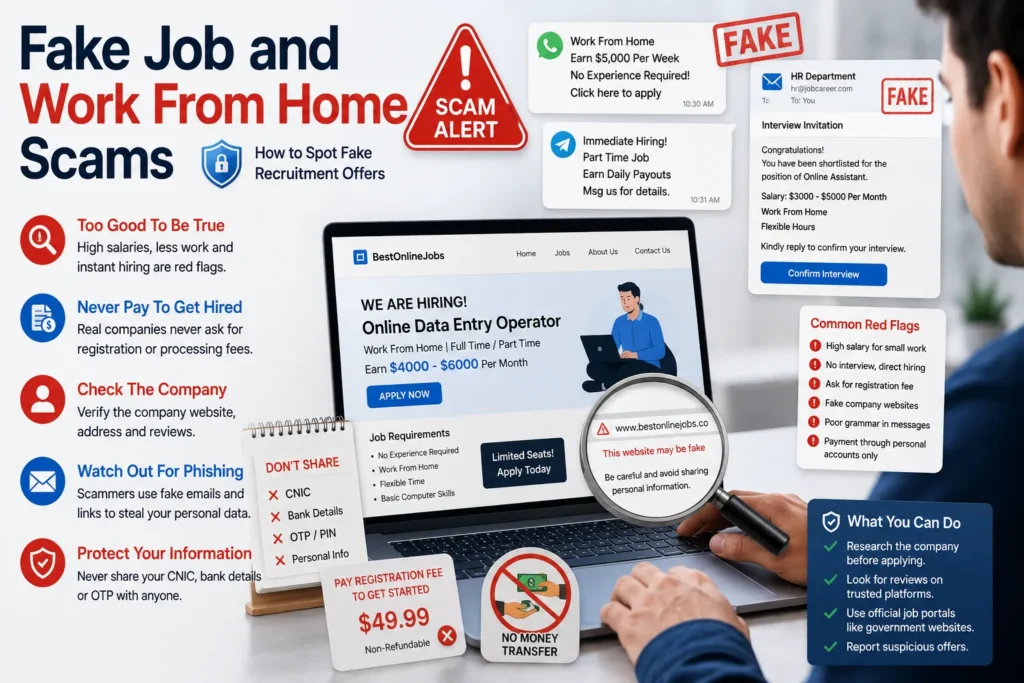
Finding a good job has become increasingly competitive, which is why job seekers are often targeted by scammers. They know people are actively searching for opportunities and may overlook warning signs if an offer sounds promising.
These scams usually appear on Facebook, WhatsApp groups, Telegram channels, or even professional networking platforms. The advertisement promises an attractive salary, flexible working hours, and little or no experience required. Sometimes the company name is real, while other times it’s completely made up.
Everything seems normal until the hiring process begins.
Instead of scheduling an interview, the recruiter asks for a registration fee, training charges, security deposit, or document verification payment. The amount isn’t usually very high, which makes many people think it’s a normal hiring requirement.
After the payment is made, communication becomes less frequent. Eventually, the recruiter stops replying altogether.
Another version of this scam targets freelancers and remote workers. The scammer pretends to be an international client and sends what looks like an official payment confirmation email. The email claims the payment is being held until the freelancer pays a small processing fee.
No genuine payment service works this way.
Across Pakistani social media communities, it’s common to see people warning others after losing money to fake recruitment agencies or work from home schemes. Many say they were attracted by the promise of earning easy money without realizing the company had no real online presence.
A genuine employer hires people because they need their skills, not because they want to collect registration fees. If a company asks you to pay before you’ve even started working, treat it as a serious warning sign and verify everything independently.
10. AI voice call and Deepfake scams
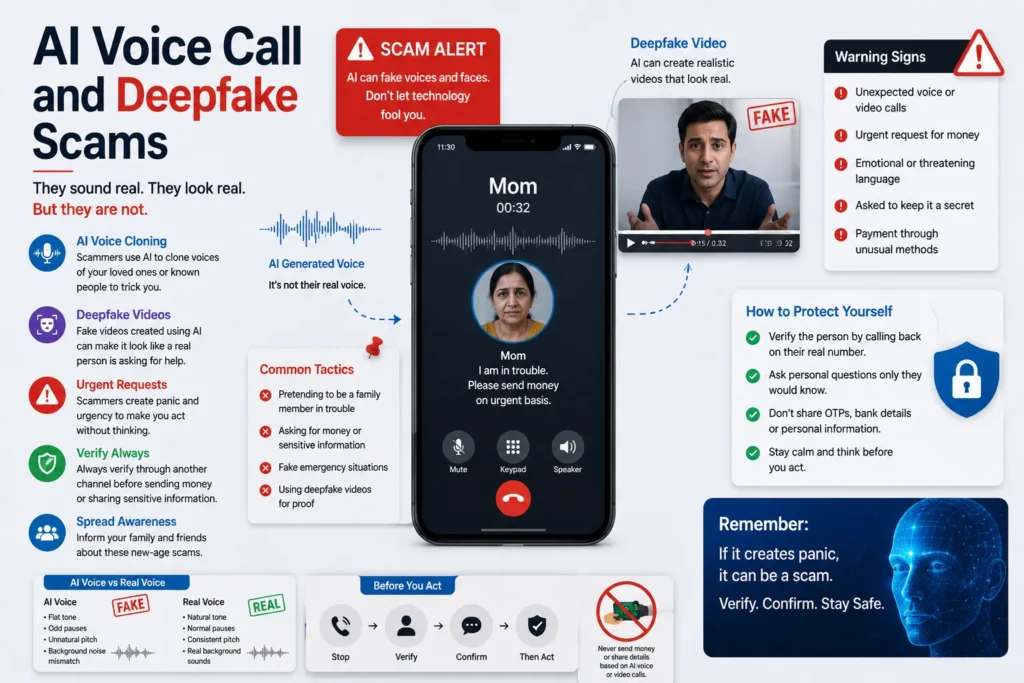
Artificial intelligence has made online scams far more convincing than they were just a few years ago. Instead of relying only on fake messages or edited screenshots, scammers can now create voices and videos that appear surprisingly real.
One scam that has started gaining attention involves AI generated voice calls. A victim receives a call from what sounds like a close family member. The caller claims they’ve been in an accident, arrested, or stranded somewhere and urgently need money.
Because the voice sounds familiar, many people react emotionally instead of stopping to verify the story.
Deepfake videos are another growing concern. Scammers use artificial intelligence to create realistic videos of celebrities, business leaders, or public figures appearing to promote investment platforms, giveaways, or miracle products. To someone scrolling quickly through social media, the video can look completely authentic.
While these scams are still less common than phishing or fake banking calls, cybersecurity experts expect them to become more widespread as AI tools become easier to access.
The safest response is to slow down whenever a message or call creates panic. If a family member asks for money unexpectedly, hang up and call them back on their usual number. If a public figure appears to recommend an investment opportunity, check their verified social media accounts or reliable news sources before believing the claim.
Scammers are constantly changing their methods, but they all rely on the same thing: making people react before they have time to think. Taking just a few extra minutes to verify a situation can often prevent a costly mistake.
Red flags every internet user should know
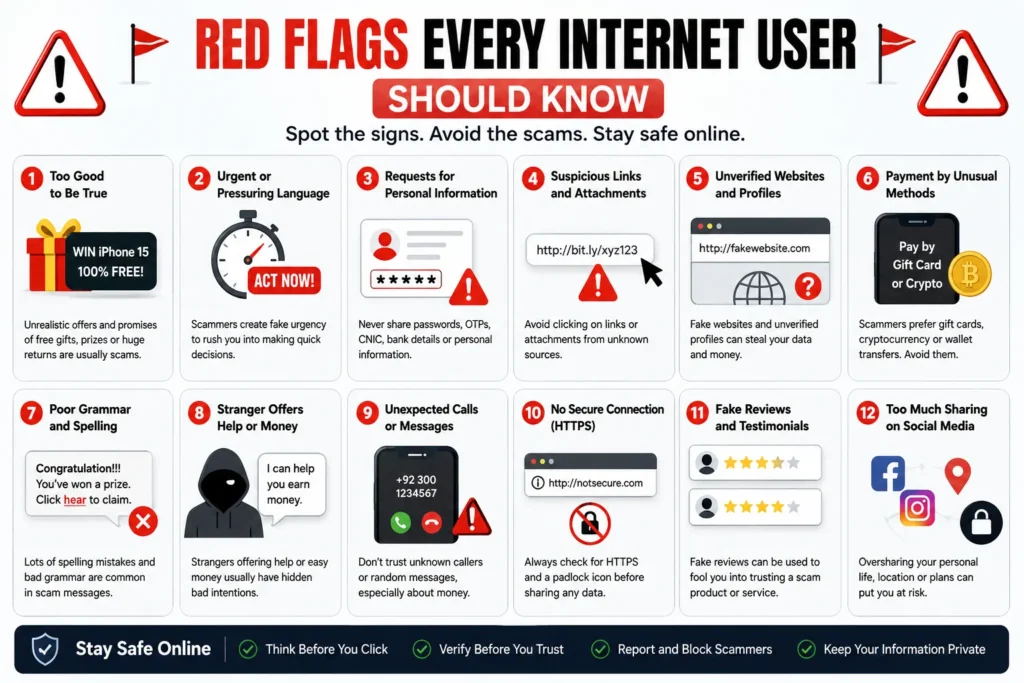
No matter what type of scam you are dealing with, most fraud attempts have a few things in common. Once you learn to recognize these warning signs, it becomes much easier to spot a scam before any damage is done.
One of the biggest red flags is unnecessary urgency. Scammers want you to make a decision before you have time to think. They may claim your bank account will be blocked within an hour, your parcel will be returned today, or your prize will expire if you don’t respond immediately.
Another warning sign is a request for confidential information. Whether it’s your ATM PIN, CVV, password, or OTP, legitimate banks and financial services do not ask customers to share these details through phone calls, WhatsApp messages, or emails.
Offers that seem too good to be true deserve extra attention as well. A brand new smartphone being sold for half its market price or an investment promising guaranteed daily profits should immediately make you question whether the offer is genuine.
Finally, trust your instincts. If something feels unusual, don’t let anyone pressure you into acting quickly. Taking a few minutes to verify the information can prevent a costly mistake.
What to do if you become a victim
If you realize you have fallen victim to a scam, panic will only slow you down. Follow these recovery steps immediately to minimize the damage:
Preserve the Evidence: Do not delete any chat threads out of anger or embarrassment. Save all chat logs, phone numbers, transaction IDs, links clicked, and bank receipts. These are vital for criminal tracking.
Freeze Your Accounts: Call your bank’s helpline instantly. Tell their emergency department that your credentials or card details have been compromised, and instruct them to block your cards, internet banking access, and mobile wallets immediately.
Secure Your Digital Footprint: Change the passwords for your primary email accounts, social handles, and banking applications. Ensure all accounts have multi-factor authentication active.
How to report online fraud to FIA Cyber Crime
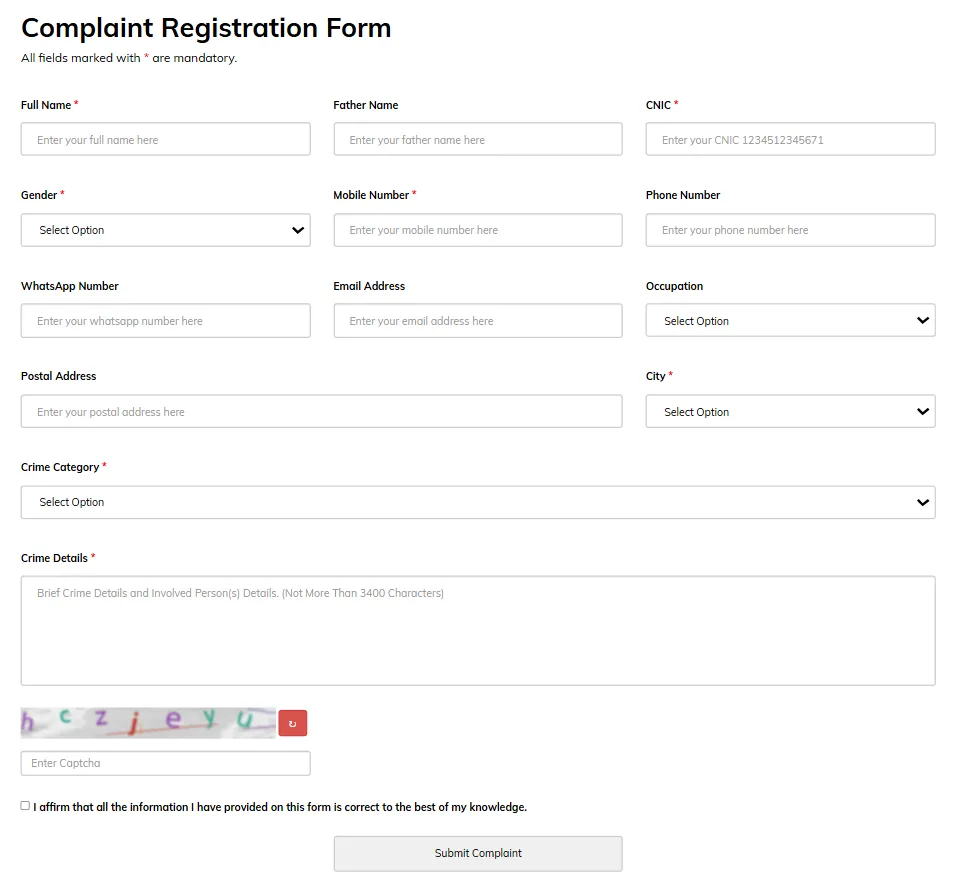
The Federal Investigation Agency (FIA) features a dedicated department built specifically to investigate online theft, identity hijacking, extortion, and phishing.
- Online Portal: You can file a formal digital complaint and upload your screenshots directly through the official FIA Cyber Crime Complaint Portal.
- Helpline: Dial 1991 for immediate official guidance on how to navigate a cybercrime scenario.
- Physical Offices: You can visit an FIA Cyber Crime Circle office located in major urban centers (Lahore, Karachi, Islamabad, Peshawar, etc.) to file an in-person application along with your printed evidence.
Victims can submit complaints through the FIA Cyber Crime Wing complaint portal or call 1991 for guidance.
How to report scam SMS and calls to PTA
If you are constantly targeted by fraudulent text messages or automated robotic spam calls, you can report the offensive mobile numbers directly to the Pakistan Telecommunication Authority (PTA) to have their SIM cards blacklisted.
- Toll-Free Helpline: Call 0800-55055 to report unsolicited fraudulent calls or masked SMS sources.
- PTA CMS Portal: Submit details through the PTA Complaint Management System.
Suspicious telecom related scams can also be reported through the Pakistan Telecommunication Authority (PTA).
Frequently Asked Questions
What Is The Most Common Online Scam In Pakistan?
Phishing scams are among the most common online scams in Pakistan. Scammers use fake SMS messages, emails, social media posts, or websites to steal banking details, passwords, OTPs, and personal information.
Can A Bank Ask For My OTP Or ATM PIN?
No. Legitimate banks never ask customers to share their OTP, ATM PIN, CVV, password, or other confidential information through phone calls, SMS, WhatsApp, or email.
Are JazzCash And Easypaisa Safe To Use?
Yes. JazzCash and Easypaisa are safe digital payment services when used properly. Most fraud occurs when users share their MPIN, OTP, or approve transactions requested by scammers.
How Can I Check If A Website Is Fake?
Check the website address carefully, make sure it uses HTTPS, verify it belongs to the official company, and avoid websites with unrealistic prices, poor design, or requests for unnecessary personal information.
Where Can I Report Online Fraud In Pakistan?
You can report cyber fraud to the FIA Cyber Crime Wing through its official complaint portal or by calling the 1991 helpline. Telecom and scam SMS complaints can also be reported through the official PTA complaint system.





A little discussion goes a long way.
Ask a question, share your experience, or help someone find an answer.
There is room for your perspective.
No discussions match this view yet.
Your voice belongs here
Keep it useful. Keep it kind.