Enterprise contract lifecycle management (CLM) has traditionally been evaluated like most enterprise software investments: upfront licensing, implementation costs, ongoing maintenance, and expected productivity gains. That model no longer reflects reality.
Agentic AI is transforming the CLM economy in 2026. The cost structure gradually shifts from a fixed investment-based model to a mix of fixed infrastructure and dynamic operating costs, with autonomous agents beginning to draft contracts, orchestrate negotiations, monitor obligations, and surface commercial risks. In parallel, there are new revenue streams that can add value in the fight against revenue leakage and can be generated through ongoing compliance and proactive risk management.
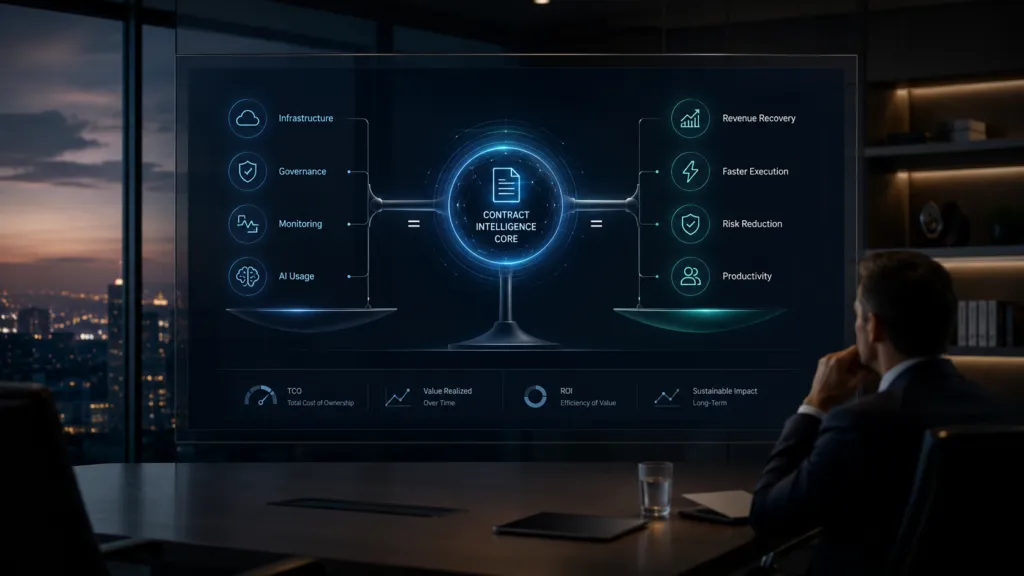
For CFOs, this changes how total cost of ownership should be evaluated. Traditional TCO models ignore the costs of AI governance, model orchestration, human oversight, continuous evaluation, and the impact of TCO enterprise-wide on business and AI contracts.
Industry research reveals that companies that implement end-to-end agreement platforms, equipped with agentic workflows, enjoy almost 30% ROAs, plus quantifiable efficiency and labor cost savings. The key for finance leaders to understand about the economics of CLM is that it is a continuous operating platform, not another software investment.
- How Agentic AI Reshapes CLM Economics
- The Four Financial Levers of Agentic CLM
- A Modern TCO Framework for Agentic CLM
- 1. Hidden Costs CFOs Should Model
- 2. Enterprise Value Drivers
- 3. Governance and Risk Controls
- 4. Scenario Planning and Sensitivity Analysis
- Sirion’s Full-Stack Approach: Unifying Complexity
- This integrated approach helps organizations strengthen both sides of the TCO equation:
- Questions Every CFO Should Ask Before Investing in Agentic CLM
- Conclusion
How Agentic AI Reshapes CLM Economics
The traditional CLM economics were relatively stable. Organizations allocated their funds for software licensing, implementation, infrastructure, and support. Productivity gains were anticipated to be greater in time, but costs were relatively constant.
Agentic AI is a game-changer in that regard. Each workflow is autonomous and uses compute resources, calls models, needs orchestration engines, accesses enterprise knowledge, and needs ongoing governance. The more that are adopted, the more value there is, but the more complexity there is as well. Hence, TCO evolves into a continuous process of operations, and not as a single procurement.
Agentic AI comes with both apparent and hidden costs, unlike traditional enterprise software. Model inference is just a part of the overall economics. Rather, the more significant investment is likely to be in infrastructure, governance, monitoring and organizational capabilities, designed to enable the responsible deployment of AI at enterprise scale. Finance leaders should therefore take a look at the entire operating model, rather than just the technology.
- Platform infrastructure: compute, memory layers, orchestrator layers, embeddings, vector search, storage. These scale non-linearly, as agents become more independent and are responsible for multiple workflows.
- Governance, compliance, legal oversight: audit trails, risk scoring, internal review, ethical guardrails. The “trust tax” costs – the costs that have been invested in explainability and auditability – are now significant, particularly in regulated industries.
- Change Management, Talent, Training: Premium for AI-talent; internal processes should be re-designed; business users have to be empowered under safe guardrails. These human and organizational costs are often understated.
- Failure provisioning, monitoring: agents will fail, changes in external data, model drift. There are on-going costs to detecting, correcting, and fixing errors. These are not optional, that’s part of TCO.
The Four Financial Levers of Agentic CLM
Agentic AI poses new operating expense items, but it also brings in new avenues of enterprise value. The best business cases are not necessarily just about saving on labour. Rather, returns are realized by recovering lost revenue, lowering operational risk, speeding up commercial execution, and allowing the legal and procurement teams to take time to focus on higher value work.
- Revenue Recovery: Misaligned terms, missed renewals, inconsistent clauses all erode margins. Platforms measuring leakage reductions post-agentic CLM deliver dramatic payback. Sirion’s benchmarks show that value leakage modeling, identifying baseline leakage and measuring its drop post-deployment, creates compelling financial justifications. (sirion.ai)
- Revenue Acceleration: By automating drafting, redlining, approvals and negotiation intelligence, agentic CLM platforms can cut contract cycle times by 40-60 percent in many use cases. Revenue recognition comes sooner; deals close more efficiently. (sirion.ai)
- Risk Reduction: With agents tracking regulatory changes, flagging non-compliant clauses, maintaining audit trails, and delivering proactive risk alerts, costs tied to litigation, fines, and contract disputes drop significantly. The benefit accrues especially for industries under rapid regulatory change (finance, healthcare, insurance).
- Workforce Productivity: AI shifts time spent from routine review and administration toward strategic tasks. Labor cost savings come, but more enduring value arrives when teams spend density-weighted time on higher-return work. Partial automation is more accessible than full human replacement.
A Modern TCO Framework for Agentic CLM
The following components and metrics should form the backbone of a modern TCO approach to agentic CLM, helping CFOs to better avoid under-estimating costs or overlooking high use value.
1. Hidden Costs CFOs Should Model
- Token usage + model‐licensing + orchestration infrastructure + subcontracted AI service fees
- Governance, human oversight, internal audit compliance costs
- Data storage, normalization, retrieval systems; embedding or vector store costs
- Change management and training; internal hiring or reskilling costs
- Monitoring, debugging, failure remediation; agent drift correction
2. Enterprise Value Drivers
- Baseline leak percentage × contract volume = potential savings from value leakage reduction
- Contract turnaround time improvements (drafting, negotiation, signature) tied to revenue recognition and deal pipeline velocity
- Improvement in compliance metrics: number of regulatory incidents avoided; cost of non-compliance historically x projected drop
- Labor cost savings weighted by redeployment; output per lawyer/procurement officer with agentic assistance
- Predictive insights: visibility into supplier performance, risk exposure, obligations met/missed
3. Governance and Risk Controls
No agentic model delivers sustainable ROI without trust. Explainable AI, audit trail, human-in-the-loop controls and policy-aligned playbooks are essential. It is important that the CFOs make sure that the vendor provides transparency in decision support, source attribution, capability to override agents, compliance with relevant regulation. Many enterprises cancel agentic AI initiatives when these aren’t in place.
4. Scenario Planning and Sensitivity Analysis
Agentic workflows are variable. One prompt could invoke a dozen model calls, retried steps, or fallback agents. Costs spread out as the amount of freedom given to the agents grows. Model the scenarios, what would be the best, likely and worst case, with sensitivity to token price, volume, error rate, governance overhead. Limits and quotas, model mix choices count.
Sirion’s Full-Stack Approach: Unifying Complexity
The economic management of agentic AI goes beyond merely integrating AI features into existing contract processes. Businesses require a one-stop contract intelligence, governance, automation and enterprise integration platform. This enables organisations to manage the hidden cost of AI adoption and reap the maximum value they can deliver throughout the lifecycle of a contract.
Sirion is one example of this AI-native approach. Its Contract Lifecycle Management (CLM) Software provides a unified platform that connects authoring, negotiation, execution, obligation management, compliance, and renewal with AI-powered contract intelligence. Sirion is not about black-box AI, but rather embeds autonomy across the lifecycle and preserves enterprise-grade governance and explainability of AI.
This integrated approach helps organizations strengthen both sides of the TCO equation:
- Reduce operating costs through intelligent automation. AI-powered drafting, contract review, obligation tracking, invoice matching, and workflow orchestration reduce manual effort while improving productivity across legal, procurement, and commercial teams.
- Recover enterprise value through continuous contract intelligence. Real-time obligation monitoring, renewal forecasting, value leakage analysis, and supplier performance insights help organizations improve commercial outcomes long after contracts are signed.
- Strengthen governance without increasing complexity. Built-in explainability, audit trails, policy enforcement, and AI governance capabilities enable organizations to deploy agentic AI responsibly while meeting enterprise compliance requirements.
For organizations evaluating the next generation of enterprise CLM, the objective is no longer simply to automate contracting. It is to invest in a platform that improves financial performance by reducing hidden operating costs, recovering enterprise value, and governing AI throughout the contract lifecycle.
Questions Every CFO Should Ask Before Investing in Agentic CLM
- Can the platform explain every AI recommendation?
- How will operating costs scale as AI adoption grows?
- What governance capabilities are built into the platform?
- How will the platform integrate with ERP, finance, and procurement systems?
How will ongoing contract intelligence and governance investments be measured over time?
Conclusion
The economics of enterprise CLM are no longer defined solely by software licenses, implementation costs, or productivity improvements. Agentic AI transforms CLM into a continuously operating system whose financial performance depends on how effectively organizations balance infrastructure, governance, and operational intelligence against measurable business outcomes.
For CFOs, this requires a broader view of total cost of ownership one that accounts for variable AI operating costs alongside new sources of enterprise value such as revenue recovery, faster commercial execution, stronger compliance, and improved risk management. Organizations that model these economics accurately will make better investment decisions and realize greater long-term returns from AI-powered contracting.
AI-native platforms such as Sirion help bring these elements together by combining contract intelligence, lifecycle automation, governance, and measurable business outcomes within a single operating model. As agentic AI becomes a core enterprise capability, the question is no longer whether CLM delivers ROI but whether organizations are measuring its full economic impact.