

Many teams assume regulation is something you add after a product is built. Security reviews, compliance checklists, and documentation get layered on top once the core functionality is stable. That approach works until the product enters a regulated environment and suddenly the foundations feel unstable.
Regulation does not sit on top of a product. It reshapes how the product is engineered from the start. Architecture decisions, release cycles, feature design, and data handling all changes in ways that are not always visible to users but deeply affect how the system evolves.
The most important shifts happen under the hood.
- Engineering for auditability, not just functionality
- Data architecture becomes a long-term commitment
- Release cycles become deliberate rather than slow
- Features become compliance surfaces
- Infrastructure choices become product decisions
- Why products struggle when they enter regulated markets
- What mature product engineering looks like in regulated environments
- Regulation changes the engineering mindset
Engineering for auditability, not just functionality
In most software products, the primary goal is functionality. In case the feature is functional and the user is able to do the task, the requirement is achieved. That is not sufficient in controlled conditions. This system should also be in a position to answer what, when, and why it has occurred.
Auditability is made a fundamental engineering requirement. Logs should be designed as well as dependable. The modification of data should be tracked. Behavior within a system should be reproducible when being investigated. These needs do not depend on security incidents only. They go up to routine operations, customer actions and automated processes.
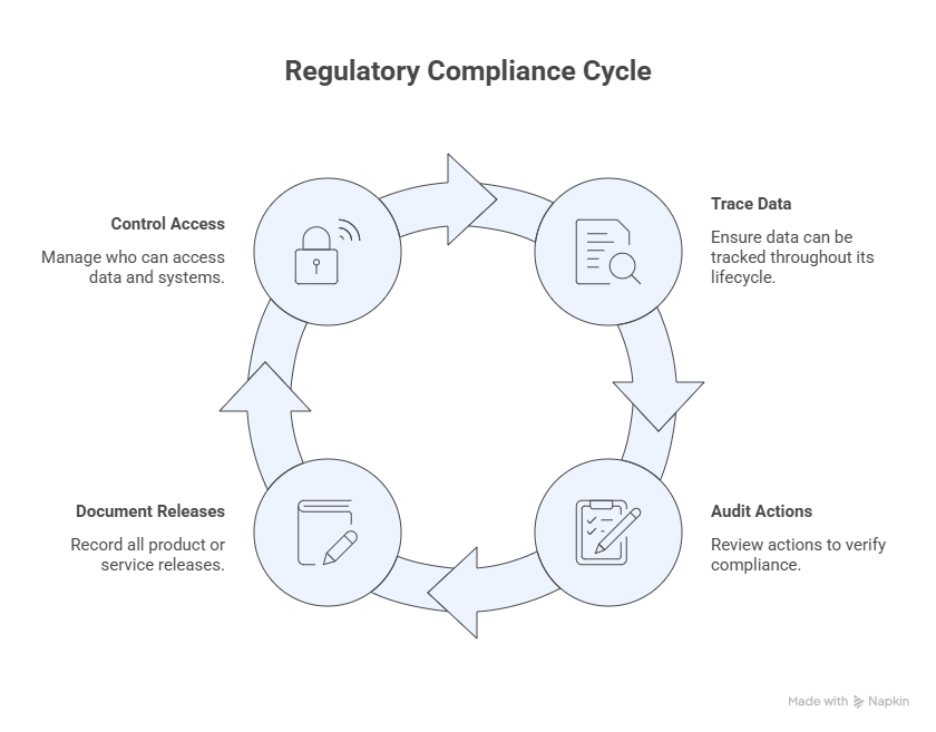
This changes how features are implemented. Logging has ceased as a secondary consideration. It becomes integrated in the design of the product. Context should not be lost when handling errors. The debugging should be able to operate in the environments where the access to the production systems is limited. Engineers should take the responsibility that whatever they have made might be questioned in the future.
The product is expected not only to function correctly but also to demonstrate that it did.
Data architecture becomes a long-term commitment
Data is where regulation exerts its strongest influence. The decisions regarding storage, access policies and retention policies all determine what a product will be able to safely do. The decisions on encryption limits, tenant isolation, and region data locality have implications on performance, feature design, and more.
Patient data in the healthcare system can require a firm access control and audit trails. In financial systems, the records of transactions have to be permanent and verifiable. In SaaS on an enterprise level, customer information can be required to be located within a particular area. All these requirements come with limitations which may not be reversed easily in the future.
Models that are suitable in early prototypes are often the liability later on when the regulatory requirements grow. It is costly and dangerous to retrofit compliance to an existing data architecture. Consequently, the teams that operate under controlled conditions would treat data decisions as long-term obligations, but not short-run commitments.
This changes how systems are designed. Data boundaries become explicit. Access patterns are defined carefully. The product is built with the assumption that data handling rules will only become stricter over time.
Release cycles become deliberate rather than slow
There is a common belief that regulation slows development. In reality, it changes how speed is achieved. Releases must account for validation, documentation, and risk assessment. Testing becomes broader and more structured. Rollback strategies are planned in advance rather than improvised under pressure.
These steps add discipline, but they do not necessarily eliminate momentum. Mature teams design workflows that maintain delivery rhythm while meeting regulatory expectations. They automate validation where possible. They maintain clear deployment procedures. They treat documentation as part of the engineering process instead of an administrative burden.
The result is a different kind of speed. Changes are introduced with more confidence because their impact is understood. The system evolves steadily rather than unpredictably.
Features become compliance surfaces
In regulated products, even small features carry compliance implications. A change to login behavior may affect identity management rules. A notification system may need to respect privacy constraints and consent preferences. Reporting tools must produce results that can be audited and explained.
These requirements do not always appear in early specifications. They emerge as the product grows and interacts with real users, auditors, and regulatory frameworks. Features that seemed straightforward become sensitive because they touch data, permissions, or decision-making processes.
This does not mean feature development becomes impossible. It means engineering decisions must account for more than functionality. Each feature is evaluated not only for what it does but also for how it behaves under scrutiny.
Infrastructure choices become product decisions
Infrastructure is no longer merely one of the matters of work in the controlled setting. The posture of compliance is influenced more by decisions relating to cloud regions, dependencies with vendors, and disaster recovery than by performance. The place where the data is stored, the existence of the backup, and the openness of the system behavior are also impacting on whether a product can satisfy the expectations of the regulatory type.
This brings the infrastructure planning nearer to product engineering. The teams should know the impact of operational decisions on the customer trust and legal requirements. The aspects of reliability of the product that can be seen include redundancy, monitoring, and access control. The infrastructure is not only Uptime-friendly but also accountable.
Why products struggle when they enter regulated markets
Many products are built without regulatory constraints in mind and only later move into regulated sectors. At that point, teams often discover that existing architecture does not support auditability, data controls, or predictable change management. Retrofitting these capabilities is rarely straightforward.
Systems may need new logging frameworks. Data models may require restructuring. Access controls may need to be redesigned. Release processes may need formal governance. Each of these changes introduces risk because they affect core behavior.
This challenge is especially visible in SaaS platforms that were not originally designed for strict data isolation, where architectural changes such as tenant restructuring or migration become necessary to meet regulatory expectations, a scenario explored in depth when examining how multi-tenant migrations fail and what teams must account for early.
The challenge is not that compliance requirements are unreasonable. It is that the product was not engineered to accommodate them from the beginning. Teams must then decide whether to patch existing systems or redesign them for long-term stability.
What mature product engineering looks like in regulated environments
Teams that build regulated industries from the outset approach engineering differently. They design with auditability in mind. They define data boundaries carefully. They build logging and monitoring into the product’s core. They create release processes that are predictable and well-documented.
This does not mean over-engineering for every feature. It means anticipating that requirements will evolve and ensuring the system can evolve with them. When regulation is treated as an integral part of product engineering rather than an external constraint, the product becomes more resilient overall.
Products built in this way often prove easier to maintain and extend, even outside regulated contexts. The discipline required to meet compliance expectations tends to improve reliability, transparency, and long-term stability.
Regulation changes the engineering mindset
Regulation introduces constraints, but it also introduces clarity. It forces teams to think about how systems behave under scrutiny, how data moves through the product, and how changes affect users over time. These considerations lead to more deliberate engineering decisions and more resilient systems.
The visible impact of regulation may be documentation or approval of workflows. The deeper impact is a shift in how products are designed, tested, and evolved. When teams account for these realities early, they avoid expensive rewrites and operational friction later. This is why organizations operating in regulated environments increasingly rely on structured software product engineering solutions that treat compliance, scalability, and adaptability as foundational rather than reactive concerns. Products built this way are not just compliant. They are easier to maintain, extend, and trust over the long term.




A little discussion goes a long way.
Ask a question, share your experience, or help someone find an answer.
There is room for your perspective.
No discussions match this view yet.
Your voice belongs here
Keep it useful. Keep it kind.