
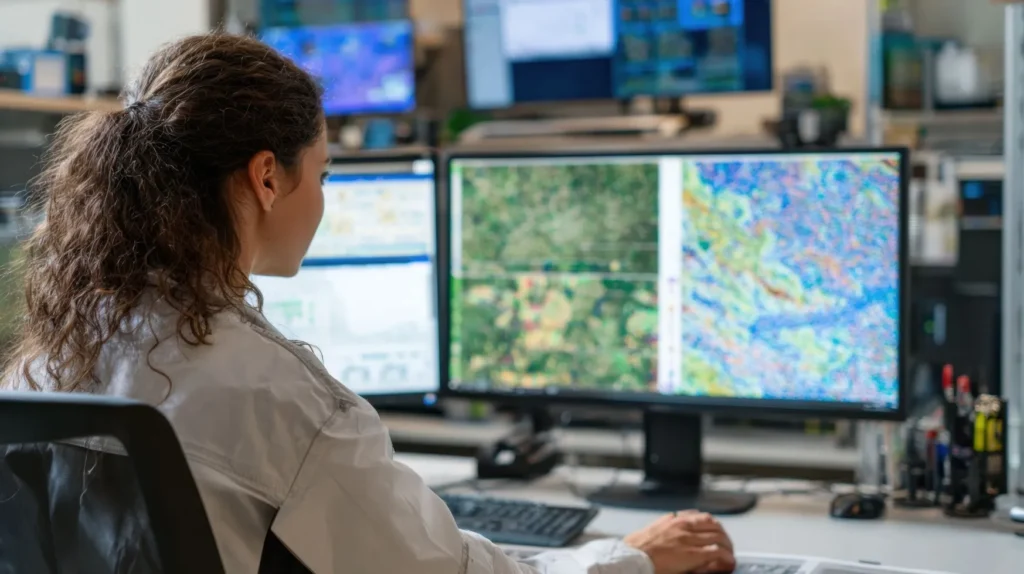
From checking the weather to ordering food delivery, location-based data has become a crucial element in modern activities. A map with geospatial technologies doesn’t just help you find your way into a new city. It can provide you with a wealth of additional information, including where people live and how traffic flows.
But helpful information doesn’t just appear out of thin air. It’s geospatial data analytics that provides researchers with an in-depth understanding of a certain geographical area.
Before delving deeper, let’s explore the basics of this powerful field and examine its relevance across various sectors.
How It Works
Geospatial analysis is the process of collecting, analyzing, and visualizing data that’s tied to a specific location. It combines various studies to give you a complete, location-based understanding of the world.
Geospatial analysts begin by gathering data from multiple sources, including satellite images and volunteered geospatial data. They primarily use Geographic Information Systems (GIS) and sensing technologies to uncover relationships and patterns within geography data types. Data analysis and 3D modeling tools, along with remote sensing and Global Positioning Systems (GPS), are likewise staple tools in their arsenal.
Some advanced software can predict trends using various sources, including AI-enabled big data analytics. As a business owner, for example, you can study where your target customers gather frequently to identify the best place to build your new store. As an environmental organization, you can utilize interpolated spatial data to study how deforestation affects air quality in nearby communities.
Regardless of the purpose, processing geospatial big data analytics can be complex and require special tools. Instead of making costly investments, consider hiring Pointerra spatial data services and similar providers to understand the full context and activities of a certain location—and use them to your advantage.
How Geospatial Analytics Can Supercharge Your Activities
Collecting and exporting data, as long as it’s done ethically, is an essential task for organizations hoping to enhance their operations. Many sources indicate that about 80% of all data generated today has a location component. Whether true or not, ignoring location data can lead to missed opportunities.
Apart from enterprise and research applications, we’re also seeing geospatial data analytics in public sector activities. Many governments use it to enhance service delivery and improve resource allocation, among other things.
Promotes Smarter Decision-Making
Geospatial analysis works great in uncovering the whys, making it an important component of data-driven decisions. Imagine a marketing team launching a new product. Instead of advertising across the region, they can use geospatial data science to study customer demographics and proximity to competitors to make more targeted and effective ads.
One of its many tools, object modeling, is also highly useful in traffic management. With it, public officials can simulate traffic movements within roads and bridges and consider building placements to determine the best routes for public transit expansion.
A city planning officer can similarly use population density maps and existing infrastructure coverage when expanding Wi-Fi networks. Doing so enables them to establish hotspots in communities that need them the most.

Optimizes Logistics and Efficiency
Have you ever wondered how your favorite ride-sharing apps can match you with nearby drivers? Or have you noticed how your navigation apps aren’t just giving you directions? You have geospatial analytics to thank for.
With modern satellite navigation systems, you can find the fastest route based on current traffic flow data. It’s the same for logistics companies that rely on advanced geospatial algorithms to calculate the most efficient route.
On top of saving operational costs, the technology helps individuals and businesses to reduce their carbon footprint. For consumers, this also means cheaper and faster deliveries.
Understanding Environmental and Health Issues
Standard healthcare data analytics helps service providers personalize treatments and improve hospital operations. But it can be more remarkable when integrated with geospatial data. With this tool, scientists can track the spread of diseases.
Geospatial big data analytics played a crucial role in managing and containing the global pandemic about five years ago, as countries shared multidimensional data that included location analytics, monitoring and predicting infections.
At the same time, researchers use surface modeling, a three-dimensional representation of a landscape feature like temperature or elevation, for monitoring environmental changes and tracking natural disasters. They also create hazard maps and predict future scenarios to identify vulnerable populations who may be asked to migrate or implement adaptation strategies.
Policy makers can use the information to approach and tackle regional and global challenges more effectively.
Aids in Planning for Resilience
Geospatial analytics enables organizations to anticipate potential challenges and build defenses. It’s an essential exercise considering the range of natural and man-made threats lurking around the corner.
Urban planners can use geospatial tools, including remote sensing software and time-series data analysis, to study population growth and predict strain on infrastructure or basic services. Disaster resilience groups can use geospatial analytics to model the impact of climate change to predict which areas will be most affected.
To enhance resilience, emergency services are loading data and using the analysis to pre-position resources and plan evacuation routes. This proactive step is key to more efficient responses that save lives and billions of dollars in damages.
Simply put, geospatial analytics is a thriving industry. From USD$ 32.97 billion in 2024, its market value will likely reach USD$ 55.75 billion by 2029, driven by the increasing popularity of location-based services and real-time data visualization across all industries.
It’s Not Just for Scientists
Geospatial data analytics helps you see the world through a smarter lens. It turns location information into actionable insights that add depth to your decisions. Beyond understanding what’s happening, you learn the “whys” and move on to the next phase.
It’s not an exaggeration to say that geospatial analytics helps shape government policies, business decisions, and individual comfort. So, whether you’re rushing to get home, designing smart cities, or expanding your business, geospatial analytics provides you with an edge.







A little discussion goes a long way.
Ask a question, share your experience, or help someone find an answer.
There is room for your perspective.
No discussions match this view yet.
Your voice belongs here
Keep it useful. Keep it kind.