
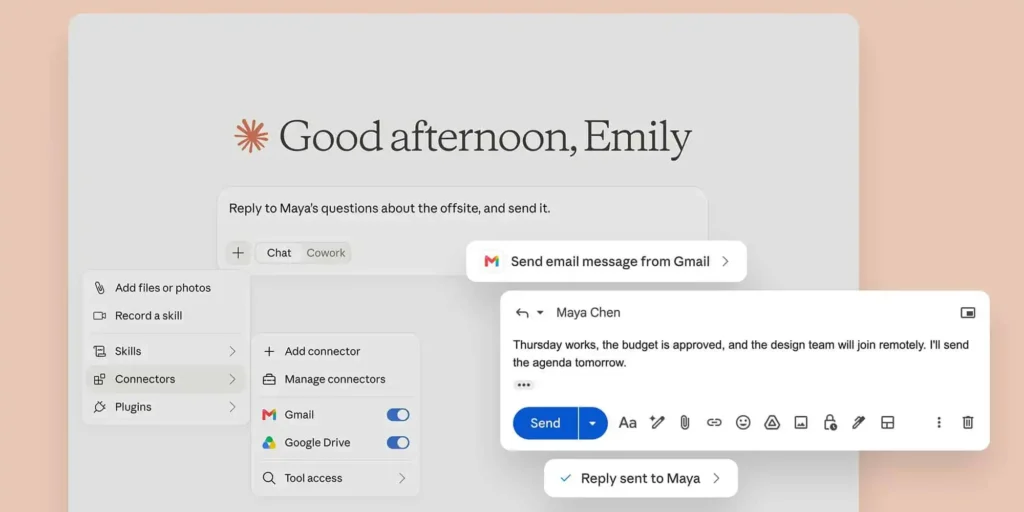
Anthropic has updated Claude’s Gmail integration, giving the AI assistant the ability to draft, send, reply to, and forward emails on behalf of the user. This takes the tool beyond manually creating drafts for someone to send.
By default, Claude still asks for permission before sending anything through Gmail. But users can turn off this requirement, letting Claude send messages without checking in first.
Anthropic spells it out on X, saying that when someone asks Claude to reply to a thread, the assistant drafts and sends the reply. The person still has to signal Claude to do the work, but that one instruction could result in the email never being reviewed.
It’s not available to everyone right away. This feature only works on paid Cloud plans, and on Team and Enterprise accounts, organization owners get to decide whether their members are even allowed to turn off approval requirements in the first place.
Anyone who doesn’t want Cloud to have this kind of access can turn it off directly from the chat interface. Organization owners also have a similar option, via the organization settings, under Connectors.
Google Workspace connectors for Cloud, covering Gmail, Calendar, and Drive, have been around for a while now. But sending actual emails was one thing that was missing, until this update filled that gap.
Along with the email update, Cloud is also improving file handling within Google Drive, working in a similar free-form manner to how Gmail’s new actions behave.
Reaction to the announcement hasn’t been entirely positive. Many of the responses to X came from users who are nervous about the AI sending messages they’ve never seen before.
There’s also a security angle worth noting. Once Claude gets full write access and runs without any approval prompts, questions arise around instant injection, where a message hidden within an incoming email could potentially trick the AI into taking an action the user never intended.
For now, this is something that users and organizations choose to enable on every account rather than forcing default behavior. Whether more people opt for full autonomy or stick with manual approval will become clear as we see the feature become more widely used.







A little discussion goes a long way.
Ask a question, share your experience, or help someone find an answer.
There is room for your perspective.
No discussions match this view yet.
Your voice belongs here
Keep it useful. Keep it kind.