
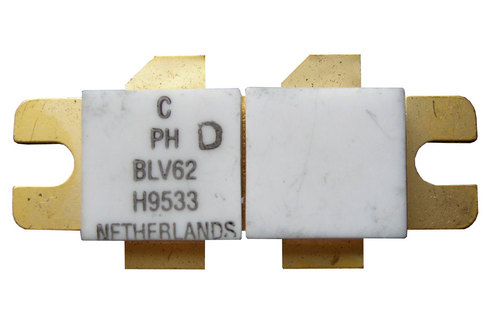
- From Device Physics to High-Power RF Applications Above 1 MHz
- 1. What Makes an RF Transistor Different from an Ordinary Transistor?
- 2. Why GaNonSiC HEMTs Define Modern HighPower RF Design
- 2.1 Why GaNonSiC Excels in Pulsed RF Applications
- 2.2 Advantages of 100 V+ Drain Supply Voltages
- 3. Engineering Limits: What Restricts Maximum RF Power Output?
- 3.1 Electrical Limits
- 3.2 Thermal Limits
- 4. Scaling Beyond a Single Device: Combining HighPower RF Transistors
- Common RF Power Combining Methods
- 5. RF Transistors in Practical Engineering Context
- 6. Engineering Takeaway
From Device Physics to High-Power RF Applications Above 1 MHz
In modern wireless and RF systems, ranging from smartphones and WiFi routers to radar, satellite communications, and electronic warfare, the RF transistor is not just another active component. It is the performance bottleneck that defines output power, efficiency, linearity, thermal reliability, and ultimately system feasibility.
Unlike encyclopedia-style introductions, this engineering-focused guide explains why RF transistors are fundamentally different from ordinary transistors, how modern GaNonSiC HEMTs enable very highpower RF operation above 1 MHz, and what practical limits engineers face when scaling RF output power.
1. What Makes an RF Transistor Different from an Ordinary Transistor?
At the schematic level, RF transistors and ordinary transistors may appear similar. Both can amplify and switch signals. The real difference emerges when frequency exceeds 1 MHz and power levels increase.
Ordinary transistors are optimized for low-frequency switching, linear analog amplification, or digital logic. When pushed into RF operation, they quickly encounter fundamental limitations:
- Excessive parasitic capacitance and package inductance
- Insufficient carrier transit speed
- Poor thermal dissipation under RF power stress
- Instability, oscillation, or catastrophic failure
An RF transistor, by contrast, is engineered from the material level upward to operate simultaneously at high frequency, high voltage, and high power. Device geometry, epitaxial structure, packaging, and thermal paths are all optimized for RF behavior, not just DC performance.
Recent advances in very highpower RF transistors and amplifiers operating above 1 MHz have pushed RF power levels far beyond what traditional silicon BJTs or MOSFETs can safely deliver.
2. Why GaNonSiC HEMTs Define Modern HighPower RF Design
Among all RF transistor technologies, GaNonSiC HEMTs represent the most important breakthrough for highpower RF systems.
2.1 Why GaNonSiC Excels in Pulsed RF Applications
GaNonSiC HEMTs dominate pulsed RF applications such as radar, highpower transmitters, and electronic warfare due to a unique combination of properties:
- Wide bandgap GaN enables very high breakdown voltage
- SiC substrates provide excellent thermal conductivity
- High electron mobility supports RF and microwave operation
- High current density enables compact, highpower devices
A critical advantage is the ability to operate with drain supply voltages of 100 V and above, which fundamentally changes RF power amplifier design.
2.2 Advantages of 100 V+ Drain Supply Voltages
Operating RF transistors at high drain voltage offers several system-level benefits:
l Higher RF output power with lower drain current
- Reduced conduction and interconnect losses
- Improved power density and efficiency
- Easier impedance matching at high power levels
- Lower current stress on bond wires and metallization
For pulsed RF systems, this directly translates into higher peak power, improved reliability, and smaller amplifier size, advantages unattainable with conventional GaAs or silicon devices.
3. Engineering Limits: What Restricts Maximum RF Power Output?
Even with advanced GaNonSiC RF transistors, output power is not unlimited. Several interacting constraints determine the true RF power ceiling.
3.1 Electrical Limits
- Breakdown voltage limits maximum drain swing
- Gain rolloff at frequency reduces usable RF output
- Stability margins shrink as device size and power increase
3.2 Thermal Limits
In real RF amplifiers, thermal resistance and junction temperature are often the dominant constraints:
- Excessive junction temperature reduces lifetime
- Pulsed operation increases thermal cycling stress
- Inadequate heat extraction limits duty cycle
Long before absolute electrical limits are reached, thermal constraints usually define safe operating power.
4. Scaling Beyond a Single Device: Combining HighPower RF Transistors
When a single RF transistor cannot meet system power requirements, engineers rely on power combining techniques rather than pushing a device beyond safe limits.
Common RF Power Combining Methods
- Corporate (Wilkinson) combiners
- Hybrid couplers and balanced amplifiers
- Distributed and waveguide combining for extreme power levels
By combining multiple GaNonSiC RF transistors, systems can reach kilowattlevel RF output while maintaining manageable voltage, current, and thermal stress per device. This approach is standard in radar transmitters and highpower RF amplifiers above 1 MHz.
5. RF Transistors in Practical Engineering Context
From an engineering standpoint, RF transistor selection is never about headline parameters alone. The correct device choice balances:
- Operating frequency and bandwidth
- Required RF output power
- Drain voltage and current capability
- Thermal design and cooling strategy
- Stability, reliability, and lifetime
This is why GaNonSiC RF transistors have become the default solution for modern highpower RF systems, while GaAs, LDMOS, and silicon devices continue to serve welldefined lowerpower or costsensitive roles.
6. Engineering Takeaway
An RF transistor is fundamentally different from an ordinary transistor not because it switches faster, but because it is designed to survive and perform under high frequency, high voltage, high power, and high thermal stress at the same time.
Modern GaNonSiC RF transistors, operating at drain voltages of 100 V and above, have redefined RF power amplification for applications above 1 MHz, enabling higher output power, better efficiency, and more compact, reliable RF systems.
In practical RF engineering, understanding these differences is not optional, it is the foundation of successful highpower RF design.





A little discussion goes a long way.
Ask a question, share your experience, or help someone find an answer.
There is room for your perspective.
No discussions match this view yet.
Your voice belongs here
Keep it useful. Keep it kind.