
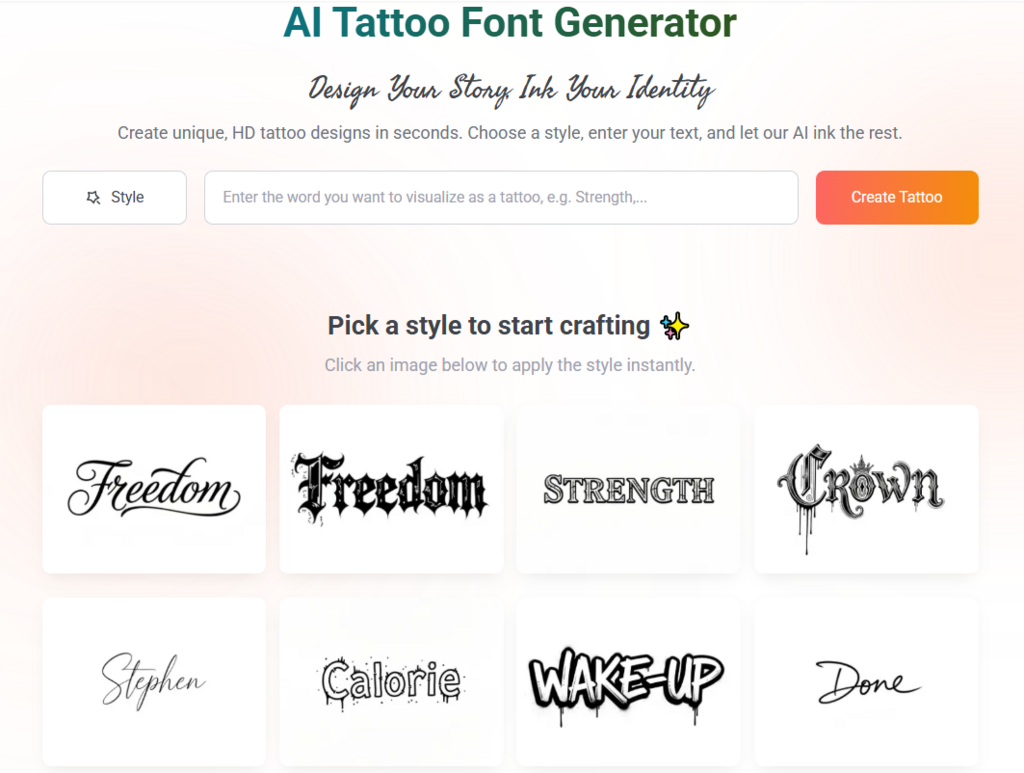
Body art is moving away from flat, two-dimensional placements and toward dynamic, anatomical flows. One of the most sought-after styles today is the “wrapped” tattoo—lettering or imagery that circles an arm, a thigh, or a torso. While these pieces look incredible in motion, they present a significant technical nightmare for both the wearer and the artist: perspective distortion. When a straight line of text is wrapped around a cylindrical limb, the font can appear warped, stretched, or pinched depending on the viewing angle. To ensure a design remains legible from every direction, using a professional tattoo font generator to preview and select high-flow typefaces is no longer optional; it is a fundamental part of the design process.
- The Physics of Skin: Why Wrapped Text Warps
- Selecting Typefaces for Dynamic Flow
- 5 Essential Design Guides for Wrapped Body Art
- Perspective Correction via the Tattoo Font Generator
- The Logic of “Fluidity” in Modern Typography
- Technical Standards for Wrapped Ink
- Mapping the Narrative: The “Beginningless” Tattoo
- The Intersection of AI and Skin Anatomy
- Conclusion: Mastering the Wrap
The Physics of Skin: Why Wrapped Text Warps
The human body is composed of interlocking cylinders and spheres. Unlike a flat canvas, skin moves and rotates. When you place a long sentence around a bicep, the viewer never sees the whole message at once. Furthermore, because of the curvature, the letters at the “edges” of the viewer’s line of sight will naturally look compressed. This is known as perspective distortion.
For the tattoo enthusiast, the pain point is clear: you spend hours picking the perfect quote, only for it to look like an unreadable smudge when your arm is in a relaxed position. To combat this, the typeface must possess specific “flow” characteristics. It needs to be elastic enough to handle the curve but structured enough to remain recognizable. A specialized tattoo font generator allows users to visualize how different weights and slants interact with the concept of a “360-degree wrap.”
Selecting Typefaces for Dynamic Flow
Not all fonts are created equal when it comes to wrapping. A rigid, blocky font might work for a flat chest piece, but on a forearm, it can look “broken” at the points where the arm curves away. Designers and collectors are now turning to “Streamlined Calligraphy” and “Neo-Tribal Scripts.” These styles are characterized by elongated terminals and fluid transitions that guide the eye around the limb rather than forcing it to stop at a flat edge.
5 Essential Design Guides for Wrapped Body Art
- The Geometry of Movement: How to align text with muscle fibers for minimal distortion.
- Kerning for Curvature: Why wider letter spacing is essential for tattoos that wrap.
- Contrast and Visibility: Using varying line weights to create a sense of depth on a limb.
- Anatomical Anchoring: Selecting the “start” and “end” points of a 360-degree script.
- Digital Pre-Visualization: The role of AI tools in mapping 2D text onto 3D body shapes.
Perspective Correction via the Tattoo Font Generator
When planning a wrap-around piece, the selection process must be more rigorous than a standard placement. You aren’t just looking for a “cool font”; you are looking for a visual solution. Using a tattoo font generator allows the user to simulate how a typeface handles elongation.
For example, “Italicized” or slanted scripts are naturally better for wrapping because their diagonal lean works with the natural spiral of the limb’s anatomy. By testing these slants in a generator, you can find the exact angle that “cancels out” the perceived distortion caused by the curve of your leg or arm. This level of preparation is what separates a professional-grade tattoo from a DIY mistake.
The Logic of “Fluidity” in Modern Typography
In the world of SEO and digital content, we often talk about “User Experience” (UX). In the tattoo world, the “User” is anyone looking at the art. A wrapped tattoo with poor font choice has a high “bounce rate”—the eye gives up because it’s too hard to decode the message.
To improve the UX of your body art, focus on “Visual Guidance.” This means choosing a font where the letters seem to “lean” into the next curve. When you utilize a tattoo font generator, look for scripts that have “connected flow” (ligatures). Ligatures create a literal line that the viewer’s eye follows around the arm, making the 360-degree experience feel like a single, cohesive narrative rather than a series of disconnected letters.
Technical Standards for Wrapped Ink
If you are a digital marketer or a creative professional looking to branch into the tattoo niche, understanding the technical standards of ink durability is vital for E-E-A-T. Here are the core technical constraints for wrapped fonts:
- Uniform Stroke Weight: On a curve, variable thickness can make parts of a letter “disappear” into the shadow of the limb. A consistent weight ensures visibility.
- Open Counters: Letters like ‘e’, ‘a’, and ‘o’ must have clear internal space. Curvature naturally pinches these spaces, so starting with an “open” font is a must.
- Terminal Length: Long, flowing tails on letters like ‘y’ or ‘g’ act as “connectors” that bridge the gap between the front and back of the limb.
- Scalability: A font that looks good at 12pt on a screen needs to be tested for how it expands over a 10-inch circumference.
Mapping the Narrative: The “Beginningless” Tattoo
One of the most artistic ways to use a tattoo font generator for wrapped limbs is to create a “looping” script—where the end of the sentence meets the beginning. This requires incredible precision in font scaling. If the font is even 5% too wide, the words will overlap; 5% too narrow, and there is an awkward gap.
By using digital tools to generate the text string, you can accurately measure the “length” of the design against the “circumference” of your limb. This data-driven approach to tattooing ensures that the “360-degree script” is mathematically perfect before the first drop of ink touches the skin. It removes the guesswork for the artist and provides the client with a blueprint that respects their anatomy.
The Intersection of AI and Skin Anatomy
We are entering an era where AI doesn’t just generate text; it understands the canvas. The future of body art lies in tools that can predict how a specific font will stretch over a moving muscle. For now, the most advanced way to reach that goal is through the manual manipulation of high-quality fonts within a generator.
When you find a font that balances aesthetic appeal with functional durability, you are doing more than just picking a style. You are ensuring that your message—whether it’s a name, a mantra, or a piece of code—remains a clear reflection of your intent, regardless of the angle from which it is viewed.
Conclusion: Mastering the Wrap
Wrapped tattoos are the ultimate test of a tattoo artist’s skill and a collector’s vision. They are bold, ambitious, and deeply integrated into the body’s natural form. However, without the right typographic foundation, they are prone to visual failure.
By leveraging a tattoo font generator, you gain the ability to troubleshoot perspective issues in the digital realm, long before they become permanent on your body. Choose a font that embraces the curve, respects the anatomy, and maintains its integrity through every twist and turn. In the 360-degree world of modern ink, legibility is the highest form of art. Make sure your script is ready for the challenge by testing, measuring, and visualizing with the best tools available. Your skin is a three-dimensional masterpiece—it’s time your typography caught up.



A little discussion goes a long way.
Ask a question, share your experience, or help someone find an answer.
There is room for your perspective.
No discussions match this view yet.
Your voice belongs here
Keep it useful. Keep it kind.