
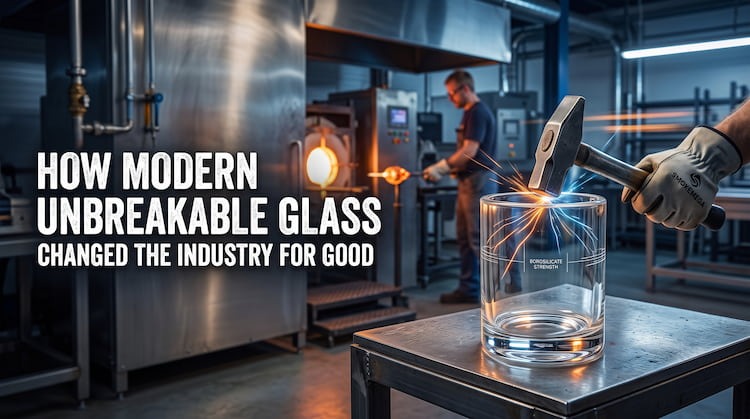
We all know the sound. You drop a cup, and it shatters into a hundred pieces. For a long time, that was just how glass worked. Standard soda-lime glass expands quickly when heated or physically stressed, making it highly fragile.
But in the late 19th century, frustrated scientists needed better equipment. This led to the invention of a completely new material that permanently changed how the world manufactures and uses glass. The secret is borosilicate, a material that uses boron trioxide to lock its atomic structure in place and resist extreme temperature shifts.
The Laboratory Revolution
Back in the 1880s, German scientists Otto Schott and Ernst Abbe were tired of regular glass ruining their chemistry experiments. The heat from their burners kept cracking the test tubes.
They developed a new type of glass with a very low coefficient of thermal expansion. In plain English, this just means the glass does not warp or crack when moved quickly from extreme cold to extreme heat. It immediately became the absolute gold standard for scientific beakers, medical syringes, and telescope lenses.
Leaving the Lab
It did not take long for this technology to solve real-world problems outside the laboratory. In the early 1900s, American companies like Corning used this exact science to fix railroad lanterns. Before this, the hot glass on the lanterns would shatter the second cold rain hit them.
Then came a famous kitchen experiment. A Corning scientist brought home a sawed-off battery jar made of this tough glass, and his wife used it to bake a sponge cake. That single moment proved the glass could handle an oven, leading to the invention of durable consumer ovenware like the original Pyrex. Suddenly, people realized household items did not have to be fragile.
The Modern Era of Heavy-Duty Hardware
Today, advanced manufacturing techniques allow creators to build heavy-walled, incredibly thick glass structures for daily use. This material is now vital for everything from 3D printer beds and solar panels to specialized fluid dynamics and functional glass art.
People who require precision heating rely on this exact same lab-grade science. Whether the glass is used for advanced culinary torches or a durable oil burner, the ability to withstand direct, repeated heat without structural failure is entirely thanks to this 19th-century engineering.
The Environmental and Economic Impact
There is also a major financial and environmental benefit to this shift. The old model of constantly replacing broken, cheap glass just wastes money and creates unnecessary trash.
Heavy-duty borosilicate is designed so you only have to buy it once. It is fully recyclable, contains no harsh chemicals, and leaves a much smaller environmental footprint simply because it lasts for years under heavy use.
The Bottom Line
A material designed to solve a few specific chemistry problems ended up raising the standard for durability across the entire globe. The next time you see a piece of glass survive a serious drop or handle intense heat, you are looking at over a century of perfected material science.





A little discussion goes a long way.
Ask a question, share your experience, or help someone find an answer.
There is room for your perspective.
No discussions match this view yet.
Your voice belongs here
Keep it useful. Keep it kind.