
When people talk about music creation, they often focus on the final layer: polishing, mixing, mastering, and distribution. But the real struggle usually begins much earlier, at the moment when an idea exists only as a mood, a lyric fragment, or a vague scene in someone’s head. That gap between imagination and audible form is where many projects lose momentum. In that sense, AI Music Generator tools are not interesting merely because they are fast. They matter because they shorten the distance between intention and feedback, allowing creators to hear possibilities before doubt takes over.
That shift changes more than workflow. It changes creative behavior. When the first draft becomes easier to produce, people become more willing to test alternatives rather than cling to a single fragile concept. A creator can explore a softer arrangement, a stronger chorus feel, or a more cinematic tone without committing hours to one direction too early. In my view, that is the deeper value of this kind of platform. It helps people make earlier decisions with more confidence, even when the output still needs revision.
- Why Early Draft Speed Matters More Now
- Audible Feedback Improves Judgment Faster
- Lower Friction Encourages More Exploration
- How The Official Creation Flow Works
- Step One Chooses A Starting Method
- Step Two Adds Musical Context
- Step Three Selects The Generation Model
- Step Four Generates And Compares Results
- Why Language Has Become A Stronger Musical Interface
- Prompts Can Capture Mood Before Structure
- Lyrics Can Move Earlier In The Process
- What Seems Most Practical About The Product
- Prompt And Lyric Inputs Coexist Naturally
- Instrumental Mode Expands Use Cases
- Examples Help Set Realistic Expectations
- Where This Workflow Fits In Actual Work
- A More Useful Way To Compare Key Functions
- What Users Still Need To Understand
- Prompt Quality Still Influences Coherence
- Iteration Is Part Of The Normal Process
- Taste Still Determines Final Value
- Why This Shift Will Likely Continue
Why Early Draft Speed Matters More Now
Creative work increasingly happens under fragmented conditions. A songwriter may be collecting lines on a phone. A video editor may need a temporary soundtrack before the visual cut is finished. A small brand team may need a musical reference before commissioning a final asset. In all of these cases, the first requirement is not perfection. It is audible direction.
That is why the early-draft stage matters so much. If creators can hear a version quickly, even an imperfect one, they can judge whether the concept is emotionally valid. If they cannot, the idea stays theoretical for too long. The result is hesitation, overthinking, or abandonment.
Audible Feedback Improves Judgment Faster
It is easier to assess a song once it exists in sound rather than in description. A lyric may look elegant on the page but feel too dense once voiced. A prompt that seems cinematic may produce something flatter than expected. Hearing an output immediately creates a more honest evaluation loop.
Lower Friction Encourages More Exploration
When each test takes less effort, users naturally try more directions. This does not guarantee better taste, but it does improve the odds of finding a stronger version. The process becomes less about defending one early guess and more about comparing several workable drafts.
How The Official Creation Flow Works
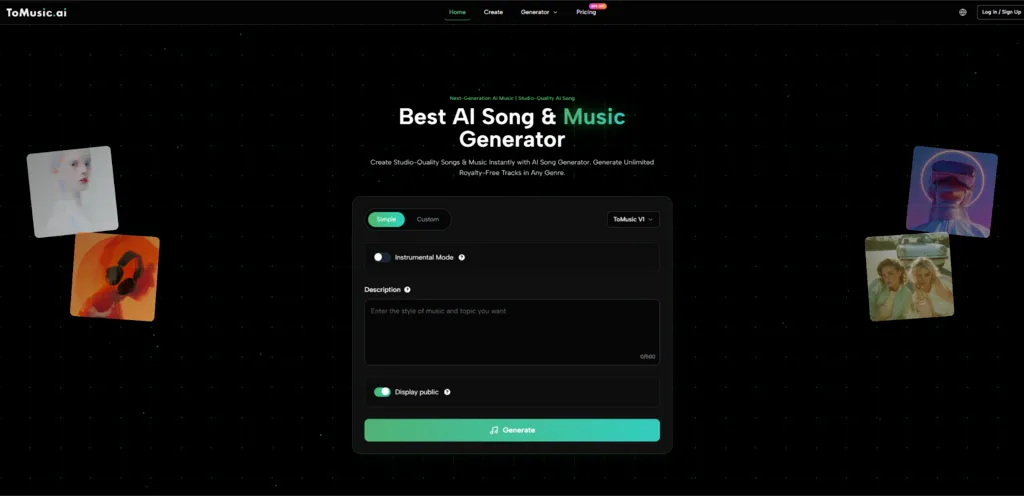
Based on the public interface, the platform is structured around a relatively direct generation path. It does not ask users to begin inside a traditional production environment. Instead, it starts from language and choice fields that guide the model toward a musical result.
Step One Chooses A Starting Method
The creation area shows two main paths: a simple mode and a custom mode. The simple path is built around a description field, which is useful for users who want to turn a short musical idea into audio quickly. The custom path appears more suitable for users who already have a stronger concept and want more control over what gets generated.
Step Two Adds Musical Context
The visible fields include title, styles, and lyrical content, alongside an instrumental option and a display-public setting. This matters because the system is not only reacting to a general text prompt. It is also allowing users to specify whether they want a song with vocal structure or a purely instrumental result. That distinction affects how people use the platform in practice.
Step Three Selects The Generation Model
The homepage visibly shows a model selector, and the public product language suggests multiple model versions exist within the system. That implies generation is not one fixed engine producing one type of result. Instead, the platform appears to support different balances of speed, detail, and musical character depending on the chosen model.
Step Four Generates And Compares Results
After the prompt or custom fields are prepared, the user generates the track. From there, the workflow naturally becomes iterative. A creator can revise the description, change styles, switch between instrumental and lyric-led directions, or try another version. In practical terms, this is where the tool becomes genuinely useful. It supports decision-making through comparison rather than pretending the first output must be final.
Why Language Has Become A Stronger Musical Interface
One of the most important changes in AI-assisted creation is that language itself becomes a usable production surface. Users no longer have to begin by manipulating notes, timelines, or complex interfaces. They can begin with intent.
For many people, this is a more natural entry point. They may know they want “melancholic but warm,” “uplifting with a clean female vocal,” or “slow atmospheric instrumental for a product montage,” even if they do not know how to build that manually. A system that can interpret such intent lowers the threshold for participation.
Prompts Can Capture Mood Before Structure
At the earliest stage, users often have atmosphere before arrangement. They know the emotional direction but not yet the exact structure. Prompt-based generation fits this reality well because it lets people test the feeling first.
Lyrics Can Move Earlier In The Process
Many songs begin as isolated written lines. Without a way to hear them, writers may delay evaluation for too long. Once lyrics can be placed into a generated musical frame, weaknesses become easier to spot. Repetition, pacing, and phrasing all become more visible once the words are audible rather than silent.
What Seems Most Practical About The Product
The usefulness of a platform like this is not that it replaces composition in every context. It is that it organizes early creation into something people can actually use without deep technical setup.
Prompt And Lyric Inputs Coexist Naturally
The platform does not force users into one kind of starting material. Someone can begin from a simple text description, while someone else can begin from structured lyrics and style hints. That flexibility makes the product more relevant across different creative roles.
Instrumental Mode Expands Use Cases
The visible instrumental setting is important because not every user wants a sung track. Some need background music for video, presentation work, short-form content, or general mood exploration. Keeping that option visible makes the workflow more practical.
Examples Help Set Realistic Expectations
The homepage displays recent generations with durations and visible stylistic labels. In my view, this matters because it frames the platform as a drafting and output environment rather than an abstract promise. Users can see that tracks vary in tone and runtime, which makes the product feel more concrete.
Where This Workflow Fits In Actual Work
The strongest value of this kind of tool often appears outside traditional music production. It helps people who need music-like results as part of a broader creative process.
Video Teams Need Direction Before Final Scoring
A video editor often needs to test pace and emotional tone before a soundtrack is finalized. A generated draft can help determine whether the visual cut wants tension, lift, warmth, or restraint.
Writers Need Fast Feedback On Lyrics
A lyric draft can remain convincing on paper while failing in sound. Once sung or framed musically, awkward phrasing becomes obvious. This makes the platform useful even when the first result is not meant to be the final performance.
Small Teams Need Shareable References
In collaborative settings, vague language slows feedback. One person says modern, another says emotional, another says cinematic. An actual generated draft gives the team something concrete to react to, which improves discussion quality.
A More Useful Way To Compare Key Functions
| Creative Area | What The Public Interface Shows | Why It Matters |
| Input Options | Simple mode and custom mode | Supports both quick ideation and more directed creation |
| Lyric Handling | Dedicated lyrics field in custom flow | Helps writers move from text into audio faster |
| Style Guidance | Visible styles input | Gives users a clearer way to guide genre and mood |
| Output Type | Instrumental mode available | Useful for both songs and background music drafts |
| Model Choice | Model selector shown on page | Suggests different generation behaviors are possible |
| Iteration Logic | Generate after adjusting inputs | Encourages comparison rather than one-shot expectations |
| Public Display Setting | Visibility option present | Indicates some control over how creations are shown |
What Users Still Need To Understand
Tools like this reduce friction, but they do not eliminate creative judgment. That is an important distinction. In my testing of similar systems, the best results usually come from clear intent, realistic expectations, and willingness to regenerate more than once.
Prompt Quality Still Influences Coherence
A vague request often produces a vague track. The more clearly a user expresses mood, style, pacing, and vocal intention, the more likely the result will feel usable.
Iteration Is Part Of The Normal Process
The first generation may reveal direction more than perfection. That should not be treated as failure. In many cases, the real value lies in using one output to improve the next one.
Taste Still Determines Final Value
The platform can accelerate possibility, but it does not decide what is emotionally convincing or strategically useful. Human selection remains the most important part of the process.
Why This Shift Will Likely Continue
AI music systems are becoming more relevant because they do not merely automate sound. They reorganize the beginning of creative work. They let people move from idea to audition with less friction, which makes more concepts survive the fragile first stage.
Seen this way, the platform is best understood as a bridge between language and listenable drafts. It gives creators a structured way to test mood, lyrics, style, and direction without starting from a full production setup. Not every result will be worth keeping, and some prompts will need several attempts before they feel right. But even with those limits, reducing the distance between thought and sound is already a meaningful change in how music ideas become real.



A little discussion goes a long way.
Ask a question, share your experience, or help someone find an answer.
There is room for your perspective.
No discussions match this view yet.
Your voice belongs here
Keep it useful. Keep it kind.