
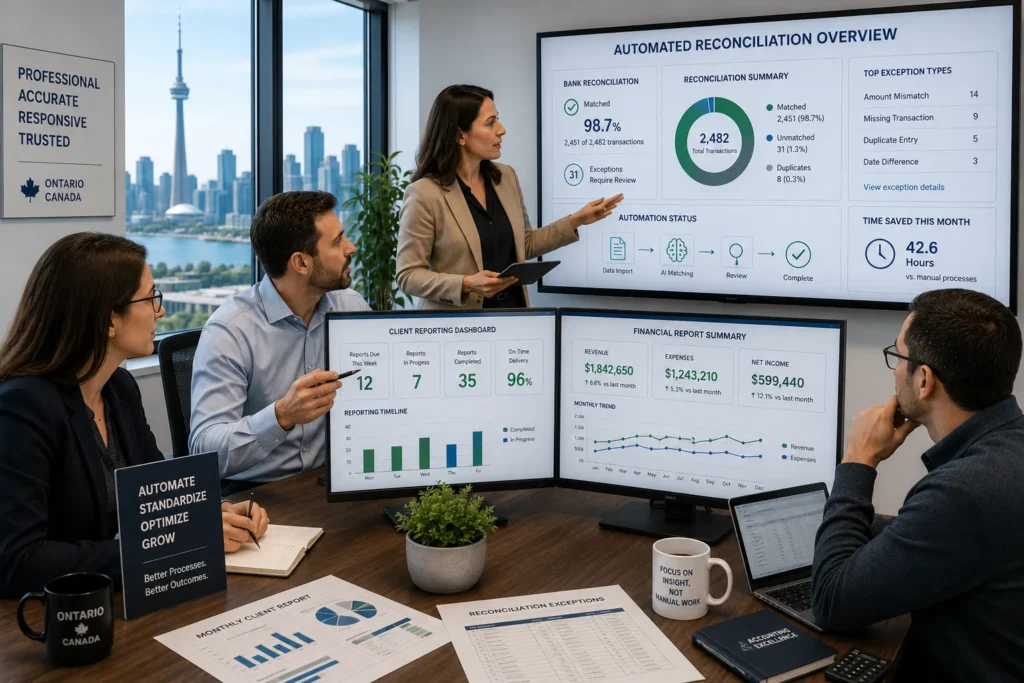
Accounting firms are still under pressure to report accurately, process jobs quickly, and communicate with clients promptly and effectively, all while handling mounting administrative duties.
Many organizations are processing more complex instances of recurring financial information in more clients, on various platforms, and on various reporting cycles. Meanwhile, expectations for responsiveness and efficiency are continually increasing.
This has led many companies to delve into the potential of AI in accounting firms to eliminate repetitive tasks, streamline reporting, and optimize their internal processes for greater efficiency and scalability.
AI and workflow automation aren’t designed to replace manual roles; instead, they are leveraging to cut down on repetitive, time-consuming tasks within bookkeeping, reconciliation, and reporting operations.
- Reconciliation Workflows Are Becoming More Automated
- Reporting Delays Often Begin With Manual Processes
- Accounting Workflow Automation Supports Scalability
- AI Systems Work Best Alongside Professional Oversight
- Structured Systems Improve Operational Consistency
- Operational Efficiency Is Becoming a Competitive Advantage
Reconciliation Workflows Are Becoming More Automated
Reconciliation is one of the most time-intensive operational tasks within accounting and bookkeeping environments.
Many companies continue to use legacy transaction matching processes, spreadsheet reviews and tedious cross-checking that can bog down monthly close procedures and cause administrative stress during peak times.
Automated reconciliation products are assisting companies to cut down this task load by enabling them to identify matching transactions, flag inconsistencies, and organise monetary data for review more efficiently.
This does not mean that accounting oversight is no longer required. Rather, automation is used to enhance the productivity of accounting and the visibility of the workflow, to eliminate repetitive verification activities.
For example, firms may use automation systems to:
- identify duplicate transactions
- flag missing entries
- organize bank reconciliation workflows
- monitor reporting exceptions
- trigger review notifications
- standardize approval processes
These changes can help reduce time, while keeping finances accurate and the reporting process consistent across client accounts.
Reporting Delays Often Begin With Manual Processes
Many administrative procedures need to be performed in order for client reporting to happen. Reports may require information to be taken from various systems, manually reviewed, approved internally, and then formatted for reporting.
Delays are more likely to occur when these workflows are dependent on significant manual coordination.
In client reporting automation, the company automates the routine reporting responsibilities by simplifying the flow of financial information through operational systems.
For example, firms may automate:
- recurring financial summaries
- internal review notifications
- report generation scheduling
- document routing
- client communication triggers
- data synchronization between platforms
These systems can lower down repetitive administrative work, as well as enhance the turnaround time on recurring client work.
Standardized reporting processes also minimize the inconsistencies between departments and ensure better coordination within the company during hectic reporting periods.
Accounting Workflow Automation Supports Scalability
An accounting firm’s complexity can escalate rapidly as their practice expands.
Manual workflows can cause administrative challenges when new clients are added or new reporting or service requirements are introduced.
Workflow automation of accounting makes it easier for companies to develop their operations and systems more structured, allowing them to scale without scaling their administrative workloads.
This is important for firms managing:
- recurring bookkeeping workflows
- multi-client reporting schedules
- invoice approvals
- payroll coordination
- compliance documentation
- internal task management
Automation systems can help to increase operational consistency by allowing for repeatable processes that lessen the need for follow-up processes and disconnected communication.
Some companies find that standardizing processes can be as beneficial as saving time for them.
AI Systems Work Best Alongside Professional Oversight
An issue that some companies have with automation is that they feel like it takes the place of bookkeepers and accountants.
AI bookkeeping systems are mostly effective when used as a support system, rather than a replacement for human bookkeepers.
There are other tasks that still rely heavily on experienced accounting professionals, such as financial judgment, compliance interpretation, client advisory services, and exception handling.
It’s more likely to be effective when it’s applied to repetitive administrative coordination tasks like:
- transaction categorization
- reconciliation preparation
- recurring reporting workflows
- deadline notifications
- document organization
- operational tracking
This allows accounting teams to spend more time focusing on review processes, client communication, and higher-level financial analysis.
Firms that implement automation strategically often improve administrative efficiency while maintaining strong professional oversight standards.
Structured Systems Improve Operational Consistency
Many accounting firms already use multiple financial platforms, bookkeeping systems and reporting tools that many accounting firms are already using. But in the case of disconnected systems, there is a risk of duplication of effort and communication loops between operational processes.
Firms can benefit from structured automation systems to create more effective connections between workflows in reporting, reconciliation and administrative coordination.
For example, firms implementing AI systems for accounting firms may focus on improving workflow visibility, reducing repetitive manual coordination, and integrating operational reporting systems. Companies such as Convex Systems help accounting and bookkeeping firms implement automation frameworks designed to support reporting consistency, bookkeeping workflows, and administrative process optimization.
The goal is not simply to add more technology. Typical focus for effective operational automation is on improving workflow reliability and minimizing the friction between repetitive accounting workflows.
Operational Efficiency Is Becoming a Competitive Advantage
There is a growing expectation from clients that the accounting firms will provide quick reporting cycles, improved communication, and responsive financial operations.
Meanwhile, companies have to be precise, meet compliance requirements, and keep providing control for increasing workloads.
AI and workflow automation are aiding in the optimization of the accounting process, which is enhancing the professional oversight of accounting processes while ensuring consistency and efficiency.
This simplifies the reporting process and streamlines workflows, enabling firms to complete these tasks more quickly and efficiently while enabling accountants to dedicate more time to advisory and financial review roles.
Structured workflow systems could be advantageous for firms looking to scale efficiently without compromising on service quality or reporting accuracy as it becomes increasingly demanding for the accounting industry to run their operations.



A little discussion goes a long way.
Ask a question, share your experience, or help someone find an answer.
There is room for your perspective.
No discussions match this view yet.
Your voice belongs here
Keep it useful. Keep it kind.