
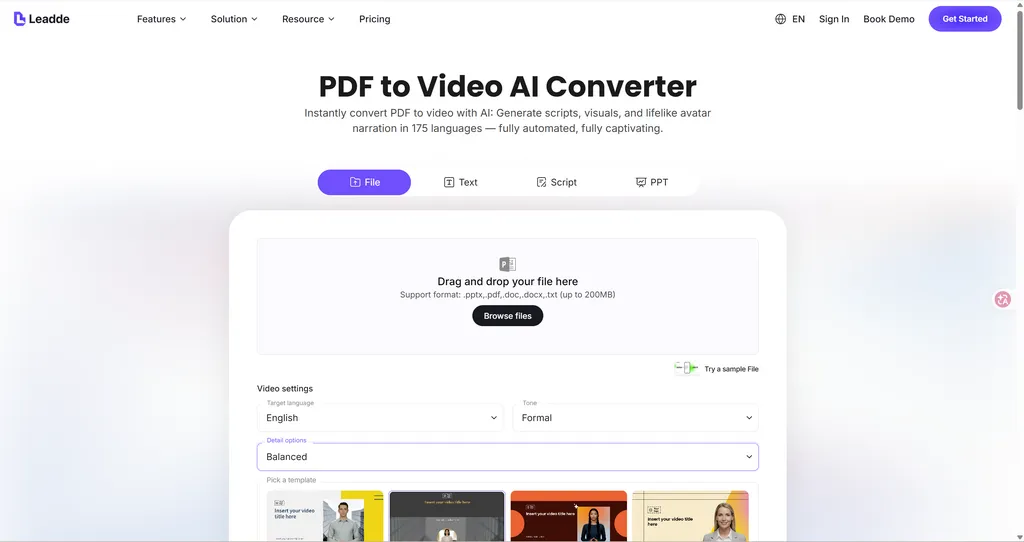
If you are fighting a losing battle against declining audience attention spans, publishing another text-heavy report isn’t the solution. To truly engage modern professionals, you need to create interactive content, and the most effective method is transitioning your PDF to video.
Using an AI-driven platform like Leadde, you can upload a static document, and the system’s deep learning algorithms will automatically synthesize a professional voiceover, render a lifelike digital presenter, and integrate advanced conversational Q&A features.
Early in my content strategy career, “interactive content” meant hiring specialized developers to build branched, expensive elearning modules. We would spend months creating SCORM-compliant courses based on 50-page compliance PDFs.
The cost, time, and required technical skills were astronomical. Today, the landscape is unrecognizable. Artificial intelligence has fundamentally democratized multimedia and interactive creation. The ability to seamlessly convert PDF to video using these advanced generative platforms completely removes the technical barrier, allowing anyone to produce dynamic, two-way communication tools instantly.
- The Paradigm Shift: From Passive to Active Consumption
- Deep Tech: Driving the Conversational Engine
- Semantic Parsing and Contextual Grounding
- Conversational Video Interfaces
- The Expressive IV Engine: Fostering Genuine Connection
- Addressing Frequent Concerns Regarding Interactivity
- Strategies for High-Impact Interactive Content
- Establishing a New Era of Digital Learning
The Paradigm Shift: From Passive to Active Consumption
The traditional document model is inherently flawed because it is built on passive consumption. With a thick PDF, the viewer receives the whole cognitive load of pacing, comprehension and value extraction. This is bound to result in scanning, skimming, and abandonment in an era of unrelenting digital trouble.
When you shift to a video format you will gain control of the pacing of thinking at once. The presentation is highly structured, which uses audio-visual materials to direct the attention of the viewer to the main lessons of the presentation.
But it is the conversational layer that will be developed on top of the video that will transform a video into an interactive learning experience. With the assistance of a high level of AI, the content is no longer a monologue; it requires entry, feedback, and active involvement of a viewer, which means that the message will not only be heard, but a profound understanding will be achieved.
Deep Tech: Driving the Conversational Engine
You need to know the complicated underlying technologies that will enable this change in order to have faith in an automated platform with your proprietary interactive content. Leadde AI is a highly automated system relying on a collection of neural networks that organize this interactive layer under the oversight of absolute accuracy and authority.
Semantic Parsing and Contextual Grounding
The foundation of genuine interactivity is accuracy. When you post a manual or training paper, the Natural Language Processing (NLP) engine of the system analyzes all the text. It does not merely read the words but constructs a database, which is really secure and highly contextual and constructed solely out of what you have used as your source material.
This makes the interactive content to be true and real. The chat AI can read through the defined limitations, terms, and guidelines of your PDF. Being the viewer who interacts with a video created, you ask a certain question, which is then cross-referenced by the AI to a context of your approved documents. It creates a timely, accurate reaction, totally negating the threat of the AI hallucinating a generalized information of the open web.
Conversational Video Interfaces
The interactive magic occurs on the interface of this video player. Since the digital avatar presents the presentation, the viewers will be able to take a break and ask questions in an inbuilt chat system.
The response is fast and correct since the AI is contextually based on your proprietary PDF. This attribute breaks the conventional wall of e-learning and business communication. The viewer is also participating, instead of passively listening and leaving issues to be addressed in a later email or a follow up meeting. They identify their knowledge deficiencies in real-time and get instant and trusted feedback, scaling the provision of expertise level knowledge dynamically within an organization-wide sense.
The Expressive IV Engine: Fostering Genuine Connection
For interactive Q&A to feel authentic, the primary delivery mechanism must feel human. An aggressive, stiff avatar is subverting the trust of the viewer and the authority of the answers. Leadde has an Expressive IV Engine that applies hyper-realistic digital avatars.
This sentiment renderer is used to analyze the sentiment of the generated script (deep learning). The AI predicts exact mouth shapes (visemes) onto the phonetics of the synthesized voice in real-time to make lips match perfectly. Moreover, it activates natural micro-expressions and body kinematics, which are all in line with the emotional purpose of the story.
This extremely coordinated physical acting makes the presenter look professional and accessible, which would greatly decrease the reluctance that viewers have to approach to talk to the conversational AI module.
Addressing Frequent Concerns Regarding Interactivity
When organizations adopt the interactive AI video, the stakeholders often raise certain questions about reliability, synchronization, and privacy.
The primary operation question is the origin of the truth. As has been stressed, the kind of reactions the conversational video player will produce is directly limited by the quality and completeness of the source materials provided. The AI does not produce solutions out of external internet information. This is a closed loop system and your corporate messages are under tight control.
The other point of misunderstanding is at the drafting stage. The voice and the lips seem to be out of sync at times when users are using the script editor. This is not by chance; in preview mode, the avatar has not gone through the intensive and final process of inference needed to achieve perfect synchronization, and this saves the creator time. After creation of the final output, the audio track and the viseme mapping would coincide perfectly.
In addition, these interactive modules are usually questioned on their security by IT departments. Enterprise-quality solutions address this issue by creating the ability of creators to fully protect shared proprietary videos. By choosing the option of protecting the video link with a password, you are assured that even should a link be shared in a different channel other than the designated channel, the interactive content is still safeguarded.
Strategies for High-Impact Interactive Content
To ensure your transition from static formatting to interactive learning yields the highest possible engagement metrics, follow these core strategies:
- Prioritize the Informational Context: When formatting your source PDF, include a robust FAQ section, clear definitions, and comprehensive policy statements. The richer your source document, the more accurate and helpful the conversational AI’s responses will be for your viewers.
- Define the Training Objective: Before generating the video, clearly define the “Tone” (e.g., ‘Explanatory’ or ‘Analytical’) and the targeted “Audience.” This context radically improves the AI’s ability to tailor the generated script’s complexity and vocabulary.
- Utilize Component Layouts: Don’t let the video remain visually static. Use the automated layout engine to shift the avatar’s position on the canvas. If interpreting a complex process diagram from your PDF, ensure the AI highlights specific sections of the diagram using on-screen text boxes, continuously stimulating the viewer’s eye.
Establishing a New Era of Digital Learning
We have surpassed the era where distributing a massive, text-heavy manual is acceptable. By leveraging deep semantic parsing, highly intelligent expressive rendering, and instant AI-driven conversational Q&A, transforming complex documentation into an interactive video experience is now an effortless reality. Embracing this intelligent automation ensures your corporate knowledge is not merely distributed, but actively interrogated, retained, and understood across your entire global organization, establishing a new gold standard for interactive multimedia communication.




A little discussion goes a long way.
Ask a question, share your experience, or help someone find an answer.
There is room for your perspective.
No discussions match this view yet.
Your voice belongs here
Keep it useful. Keep it kind.