
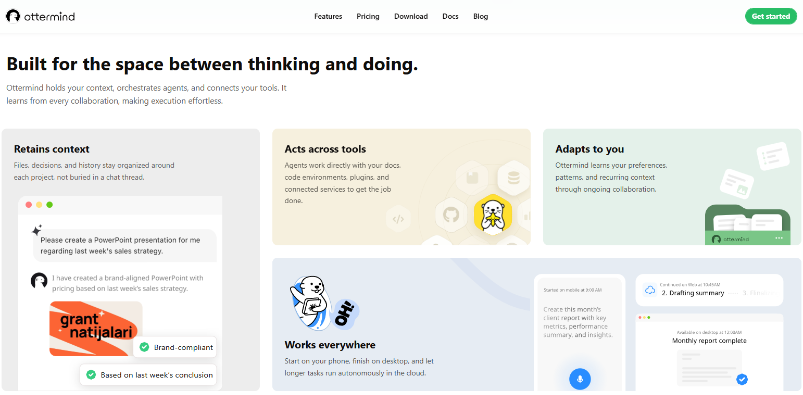
Budget owners keep solving agent work with the wrong purchase. When deliverables stall, the instinct is to add another chat seat or a higher model tier inside a thread tool. The invoice grows. The restart problem stays. Multi-step work , decks, research packs, spreadsheet cuts, long cloud runs , fails less from “not enough people typing prompts” and more from thin execution capacity: credits that run out mid-batch, and sandboxes too small for the jobs you actually schedule. OtterMind is interesting here only because it publishes those floors in the open , credits, storage, and Cloud Sandbox cores , so a buyer can test capacity instead of guessing.
Plan choice here is a capacity decision, not a branding exercise. The claim worth testing is narrow: if you buy against Solo, Squad, and Colony floors, you can predict whether a workload fits. If you buy against chat-seat folklore, you cannot. Model names in the footer are noise until the ledger and the sandbox match the jobs already on the calendar.
- The Wrong Purchase Looks Rational In A Thread Tool
- Score Plans On Credits Storage And Sandbox Floors
- Map Three Workloads To The Published Floors
- Solo For Light Packs And Honest Trials
- Squad When Jobs Overlap Or Files Grow
- Colony When Throughput Is The Real Product
- A One-Week Capacity Test Beats Seat Counting
- Pick The Floor That Matches The Jobs You Already Run
The Wrong Purchase Looks Rational In A Thread Tool
Chat seats scale conversation. They do not automatically scale autonomous runs that need CPU, memory, storage, and a credit ledger. A team can look “AI enabled” on the org chart while every serious job still dies in the same place: the run pauses for top-ups, or the environment is too small, or someone pastes the brief into a fresh thread because nothing held the project.
The buyer’s fear is quiet and expensive. You renew a stack that feels modern, then watch operators burn an afternoon babysitting jobs that should have finished in the cloud. The observable result is not a poetic failure, it is a paused queue, a half-finished deck, and a message asking who has credits left. That wasted afternoon is the cost signal you should put in the procurement note, not another slide about “AI transformation.”
Seat counting also hides a second mistake: treating every stall as a prompt-quality problem. Sometimes the prompt was fine. The job simply needed more sandbox headroom or a credit floor that survives a real pack. If you keep rewriting adjectives while the environment is the bottleneck, you will never see the true fail.
Score Plans On Credits Storage And Sandbox Floors
Ignore marketing animals for a minute and read the published floors. Ottermind’s monthly plans (yearly billed options save 20%) look like this:
| Plan | Price | Monthly credits | Cloud storage | Cloud Sandbox |
| Solo | $20 / month | 2,000 | 10GB | Standard (1 Core / 2GB RAM) |
| Squad | $49 / month | 5,500 | 50GB | High-Speed (2 Cores / 4GB RAM) |
| Colony | $200 / month | 25,000 | 200GB | Elite (4 Cores / 8GB RAM) |
All three list unlimited Skill access. Add-ons are published the same way across tiers: +1,000 credits for $10, or +2,500 credits for $20. That add-on line is part of the decision, not an afterthought , it tells you whether a short burst should upgrade the plan or just buy credits for the month.
Terms also note that credit cost can vary with complexity, model type, resource usage, file size, and processing time, and that unused credits may expire under plan rules. So treat the monthly credit number as a ceiling you must manage, not as infinite runway. Ottermind is explicit enough here that a buyer can build a simple ledger: planned runs × expected heaviness, then compare to 2,000 / 5,500 / 25,000 before the card is charged.
Map Three Workloads To The Published Floors
Use workloads, not job titles. Titles lie. Packs do not. Match the pack you already run to the floor that can finish it.
Solo For Light Packs And Honest Trials
One operator building decks, summaries, and occasional research fits Solo’s shape: 2,000 credits and a 1-core / 2GB sandbox. If you only need to learn whether agent workflows beat chat paste, Solo is the honest trial of capacity , not a second chat seat pretending to be infrastructure.
Squad When Jobs Overlap Or Files Grow
When two serious jobs overlap, or file packs grow, Squad’s 5,500 credits, 50GB storage, and 2-core / 4GB sandbox are the published step up. The question is not “are we a team on paper?” The question is whether concurrency and file weight already break Solo’s floor in a normal week. If operators already queue behind each other, Squad is a capacity fix, not a culture upgrade.
Colony When Throughput Is The Real Product
Colony’s 25,000 credits, 200GB storage, and 4-core / 8GB sandbox are for desks that treat agents as production capacity. If your calendar is full of scheduled runs and large packs, buying another chat login will not move the bottleneck. You are shopping for throughput, not for another place to type.
OtterMind ai still needs sane work habits , Tasks with uploads, Agents with Role boundaries , but this article’s exclusive question is whether the plan’s sandbox and credit floor match the jobs you already run. Features without floor math are just a nicer place to get stuck.
A One-Week Capacity Test Beats Seat Counting
Borrow a pressure-test mindset from buyers who distrust slogans. Keep the asset fixed: the same weekly deck pack and the same research brief. Change only the capacity context you are judging , Solo versus the next floor , and write pass rules before you start. In my testing protocol, the week is disqualified if anyone “helps” the run by hopping back into a chat tab to finish the job by hand; that contaminates the capacity read.
Pass rules that matter:
- The job finishes without an emergency credit panic in the middle of the pack.
- The sandbox does not become the reason you babysit the run.
- Storage does not force you to delete yesterday’s inputs to make room for today’s.
- Soft misses are about content judgment, not about the environment dying mid-task.
If Solo fails rules 1–3 in a normal week, do not “solve” it with another chat seat. Move to Squad, or use the published add-ons if the miss was a short burst. If Squad fails because throughput is the real product, Colony is the floor to evaluate , not a larger prompt window in a different tab.
Track discards that came from capacity, separately from discards that came from bad instructions. A draft you deleted because the run stalled is a capacity signal. A draft you deleted because it invented a metric is a briefing signal. Mixing those two ledgers is how teams renew the wrong thing. The moment you see a half-built deck that looked fine until the queue paused mid-export, treat that version as a capacity discard , do not argue about adjectives.
Also watch device reality. Ottermind ships across web, desktop, and mobile, with longer tasks able to continue in the cloud. That only helps the capacity story if the job was allowed to keep running instead of being killed because someone thought the laptop lid ended the work. A capacity test should include at least one handoff: start on desktop, check progress elsewhere, confirm the run did not depend on a single open window.

Pick The Floor That Matches The Jobs You Already Run
Stay with chat seats when the work is truly conversational: drafting replies, asking questions, one-shot paragraphs. Stay there when nobody will upload source files or pin recurring Tasks. An agent workspace with idle sandbox capacity is still waste if operators refuse to put the brief into the project.
Also stay skeptical of upgrading to Colony because the logo animals feel serious. If your measured week never approaches Squad’s concurrency or storage, Colony is vanity headroom. Buy the next floor only when a recorded fail matches that floor’s reason for existing. Procurement theater , buying the top tier to look committed , is still the wrong purchase, just with a higher number.
Seat count answers “how many people can talk to a model.” Credit and sandbox floors answer “can the jobs finish.” Read Ottermind’s Solo / Squad / Colony numbers against your real pack size, then run one fixed workload week with explicit pass rules. Upgrade only when capacity , not prose style , is what failed. That purchase discipline keeps agent budgets from becoming another chat renewal in disguise, and it gives finance a ledger they can audit without translating slogans.



A little discussion goes a long way.
Ask a question, share your experience, or help someone find an answer.
There is room for your perspective.
No discussions match this view yet.
Your voice belongs here
Keep it useful. Keep it kind.