
Slow internet costs you money. Every invoice, video call, and card swipe rides on that connection, and in Auburn, traffic spikes on game days push weak lines over the edge.
We pulled FCC maps, plan sheets, and real-world complaints to rank the seven business ISPs that truly serve local companies. You’ll see who offers the best value, who wins on raw speed, and which wireless options make the safest backup.
Ready? Let’s plug in.
- How we scored each provider
- At-a-glance comparison
- 1. WOW! Business – best overall value for Auburn SMBs
- 2. AT&T Business Fiber – fastest symmetrical speeds and rock-solid uptime
- 3. Spectrum Business – widest footprint and contract-free flexibility
- 4. EarthLink Business – fiber speed with concierge support
- 5. Point Broadband – local fiber challenger with community cred
- 6. Verizon 5G Business Internet – higher wireless speeds with a decade-long price lock
- 7. T-Mobile Business Internet – plug-and-play backup or budget primary
- Decision checkpoints: pick the right pipe in three quick questions
- Conclusion
How we scored each provider
Before we picked a winner, we built a clear, transparent scorecard.
We started by listing every business-class ISP that serves Auburn addresses. Coverage data from the ISP Reports Auburn database showed footprint and advertised speeds.
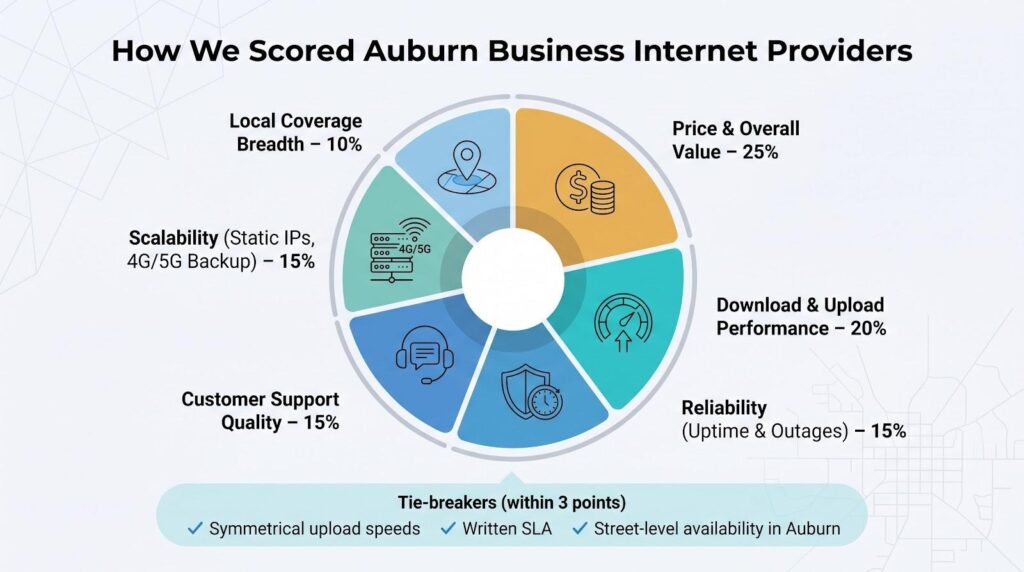
Then we graded each company on six factors:
- Price and overall value (25 percent)
- Download and upload performance (20 percent)
- Reliability: stated uptime targets and recorded outages (15 percent)
- Customer support quality (15 percent)
- Scalability features such as static IPs and 4G/5G backup (15 percent)
- Local coverage breadth (10 percent)
With 100 points on the table, any tie within three points triggered a closer look at symmetrical uploads, a written SLA, and street-level availability.
The final ranking mirrors what you feel in the office: speed, stability, and real support, not just brochure numbers.
At-a-glance comparison
You asked for quick answers, so here’s a concise snapshot before we review each provider. We pulled the numbers from ISP Reports’ Auburn database and confirmed starting prices on every business page.
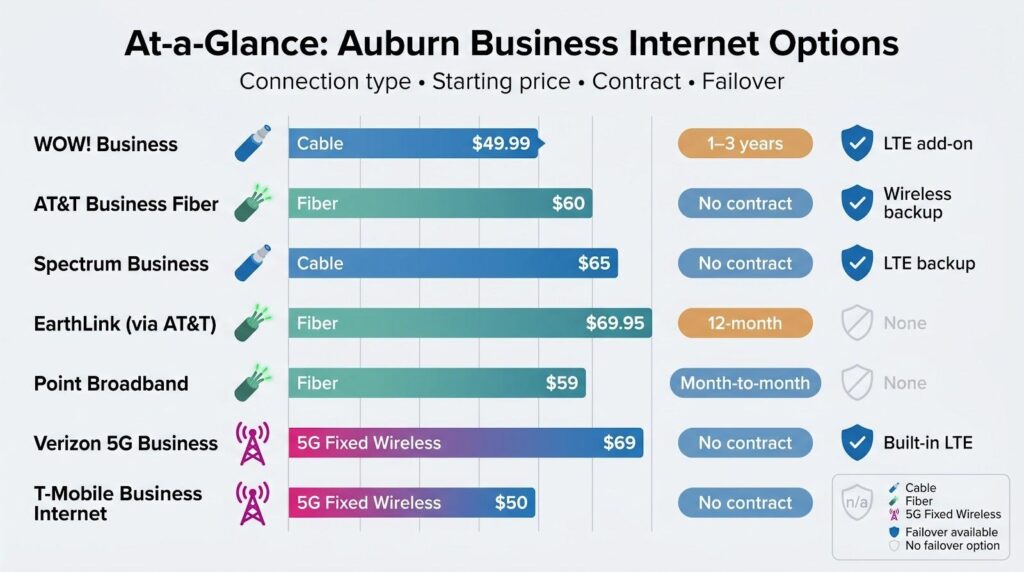
Use the table to match a tier to your budget, upload needs, and contract tolerance. Watch the “Fail-over” column; automatic 4G or 5G backup is the simplest insurance against downtime.
| Provider | Connection | Speed tiers (down / up) | Starting price | Contract | Static IP | Fail-over option | Advertised uptime |
| WOW! Business | Cable (DOCSIS 3.1) | 300/20 → 1.2 Gb/50 Mb | $49.99 | 1–3 years | Yes | LTE add-on | 99.9 percent |
| AT&T Business Fiber | Fiber | 300/300 → 5 Gb/5 Gb | $60 | None | Yes | Wireless backup | 99.95 percent |
| Spectrum Business | Cable | 500/20 → 1 Gb/35 Mb | $65 | None | Yes | LTE backup | 99.9 percent |
| EarthLink (via AT&T) | Fiber | 50/50 → 5 Gb/5 Gb | $69.95 | 12 months | Yes | None | 99.9 percent |
| Point Broadband | Fiber | 200/200 → 1 Gb/1 Gb | $59 | Month-to-month | Yes | None | 99.9 percent |
| Verizon 5G Business | 5G fixed wireless | 100/20 → 400/40 Mb | $69 | None | Limited | Built-in LTE | 99 percent |
| T-Mobile Business Internet | 5G fixed wireless | 50–300/10–25 Mb | $50 | None | Limited | n/a | 99 percent |
Prices reflect current Auburn offers and assume autopay when required. Providers adjust promotions often, so treat these figures as guidelines and request a written quote before signing.
1. WOW! Business – best overall value for Auburn SMBs
If every dollar counts, WOW! should be your first quote. Its own business internet provider Auburn, AL page promises a three-year price-lock on 300 Mbps plans, 99 percent network reliability, and a 60-day satisfaction guarantee, benefits that align with HighSpeedInternet.com’s $49.99 entry tier and make budgeting simple. That price gives enough headroom for cloud POS, security cameras, and about a dozen Zoom meetings without congestion.
Download speeds reach 1.2 Gbps, and, more important, uploads climb to 50 Mbps on the top tier. While not fiber-grade, that upstream still tops Spectrum’s local ceiling, so backups finish sooner and video calls stay clearer.
Reliability averages 99.9 percent. For added resilience you can attach an LTE fail-over modem for a small fee. Static IPs are available for cameras or VPNs, giving you a full-featured connection that costs 15–25 percent less than the national brands.
Coverage is the one limiter. The coax network touches about 40 percent of Auburn addresses, so run an availability check early. If your suite is in the green zone, you’ll be hard-pressed to find a cheaper, contract-protected line that still leaves room to grow.
2. AT&T Business Fiber – fastest symmetrical speeds and rock-solid uptime
When uploads matter as much as downloads fiber is the clear pick. AT&T Business Fiber starts at 300 Mbps up and down and scales to 5 Gbps where infrastructure allows.
The 300 Mbps plan runs about $60 per month before bundle discounts. AT&T frequently includes free installation and cuts $30 off the bill when you add a business mobile line, so gig-grade reliability stays within reach of most offices.
Performance is only half the draw. AT&T posts a 99.95 percent uptime target and a four-hour repair window, the strongest SLA among Auburn’s mainstream options. Many IT managers pair this fiber with a cheaper cable or 5G link for backup, but plenty run single-homed on AT&T and sleep just fine.
Coverage reaches about 50 percent of city addresses, concentrated in newer buildings and commercial corridors. If your suite already has an AT&T hand-hole, activation is quick; if not, plan on a week or two for splicing. Once the light turns green you get low-teens latency, static IP choices, and upgrade headroom that should last the length of your lease.
3. Spectrum Business – widest footprint and contract-free flexibility
Sometimes you just need reliable bandwidth today, with no paperwork drama tomorrow. Spectrum meets that need. Its coax network reaches about 70 percent of Auburn addresses, the largest wired footprint in town. A technician can usually light up your suite within three business days. That speed matters when a move date sneaks up.
Plans stay simple: 500, 750, or 1,000 Mbps down. Uploads top out at 35 Mbps because cable divides bandwidth unevenly, but for cloud apps and card readers that is enough headroom. Pricing starts around $65 per month for the 500 tier, and every plan is month-to-month. No early-termination fees, no legal gymnastics if your lease ends early.
The optional Wireless Internet Backup adds a cellular modem for about $20. One Auburn retailer told us they barely noticed a recent outage, as the POS system switched over automatically and sales kept ringing.
Spectrum trails fiber rivals on upload speed. Designers pushing gigabyte files or firms mirroring off-site servers will feel the squeeze. For restaurants, clinics, and professional offices that want fast installs and zero-contract headaches, Spectrum Business remains the most practical “everywhere” choice in town.
4. EarthLink Business – fiber speed with concierge support
EarthLink does not own fiber in Auburn, yet it still delivers symmetrical service to about 55 percent of addresses. The company wholesales AT&T’s last-mile network and layers its own billing and customer care on top. You can order 50 Mbps to 5 Gbps circuits, and when you call, you reach an EarthLink rep, often the same person each time.
That human focus stands out. Local firms say tickets feel “white-glove” compared with big-telco queues. One marketing agency told us EarthLink guided them through static-IP setup and even coordinated with the building contractor to rerun patch panels, help well beyond a standard install.
Fiber 50 starts at $69.95 per month; Fiber 300 sits near $105. EarthLink often offers short introductory discounts. Contracts last 12 months, landing between Spectrum’s month-to-month freedom and WOW!’s multi-year locks.
Because the glass is the same, latency stays in the low teens and uptime targets 99.95 percent. The one drawback is three-party troubleshooting: when a splice fails, EarthLink schedules AT&T field techs. Outages remain rare, but firms that cannot tolerate a delay may prefer ordering from the carrier directly.
Choose EarthLink if you want fiber speed plus a single, familiar voice on the support line, even if it costs a little more than managing AT&T yourself.
5. Point Broadband – local fiber challenger with community cred
Point Broadband is Auburn’s hometown startup. Its crews have pulled new fiber since 2022, targeting business parks and neighborhoods that national carriers skipped. Coverage now reaches about 15 percent of city addresses; if your building is in that zone, you can order symmetrical speeds up to 1 Gbps with no contract.
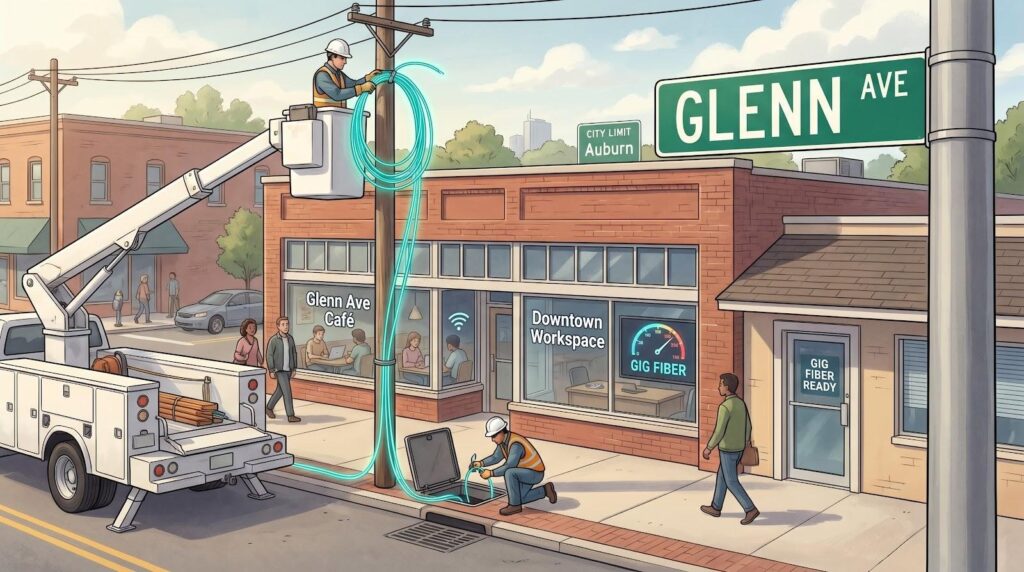
Performance matches the marketing. Speed tests hover near 1,000 Mbps both ways, and latency stays in single digits thanks to a short hop to Atlanta peering points. Several cafés on Glenn Avenue report faster Wi-Fi on Point than on the university network.
Prices start near $59 per month for entry tiers and $79 for Gig, plus a small fee for static IPs. Rates stay flat, and you can cancel anytime, a perk for startups that may soon outgrow their current space.
Support reflects Point’s regional roots. The help desk sits in nearby Opelika, and field techs often arrive the same day. Early builds elsewhere saw a few growing-pain outages in 2023, but Auburn lines appear steadier. We still suggest pairing Point with an inexpensive 5G backup if every minute counts.
Pick Point if you prefer to buy local, want symmetrical gig speeds, and fall inside its expanding fiber footprint. In Auburn’s cable-heavy market, that freshness is a welcome change.
6. Verizon 5G Business Internet – higher wireless speeds with a decade-long price lock
Fixed wireless used to be a last-ditch option. Verizon 5G Business turns it into a credible primary line or a solid backup thanks to C-band spectrum that covers about 90 percent of Auburn. When the signal is strong, the 400-Mbps tier often tests around 300 Mbps down and 40 Mbps up, beating entry cable uploads.
Plans begin at $69 for 100/20 Mbps and rise to $199 for the 400-Mbps package. Verizon freezes those rates for ten years, a budgeting gift no wired provider matches. The company also pays up to $1,500 in early-termination fees when you switch.
Installation is quick. A technician mounts a compact 5G receiver, runs one Ethernet cable, and you are online, usually within three business days. The hardware falls back to LTE if 5G hiccups, so outages are rare.
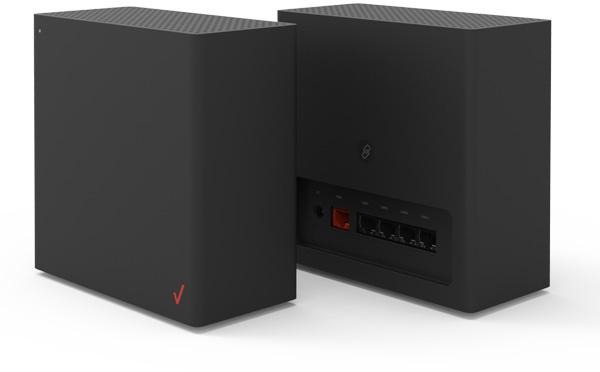
Wireless still brings caveats. Peak-hour congestion can trim speeds, and carrier-grade NAT means you need a special plan or tunnel for public static IPs. For retailers, field offices, or anyone who hates contract fine print, Verizon’s mix of strong throughput, fast install, and decade-long price stability is tough to beat.
7. T-Mobile Business Internet – plug-and-play backup or budget primary
T-Mobile makes getting online simple. Order a gateway, unbox it, place it near a window, and you are surfing in ten minutes with no trenching, appointment, or contract. At $50 per month for unlimited data, it is the least expensive path to triple-digit download speeds in Auburn.
Performance depends on signal strength. Inside city limits, most users see 70 to 150 Mbps down and 10 to 25 Mbps up. Latency hovers near 30 ms, fine for video meetings and cloud apps.
Flexibility is the headline feature. Need a temporary line while fiber is built? Done. Want automatic fail-over? Pair the gateway with a dual-WAN router and stay online for pocket change. If the service disappoints, T-Mobile’s 30-day Test Drive lets you return the device for a full refund.
There are limits. The connection uses carrier-grade NAT, so hosting servers needs workarounds. Speeds drop at busy towers, especially on football Saturdays. Still, for small teams watching every dollar keeping a magenta 5G box on the shelf is smart insurance.
Decision checkpoints: pick the right pipe in three quick questions
- Do you upload large files daily or host live databases?
If the answer is yes, you need symmetrical fiber. Start with AT&T; try EarthLink or Point if they serve your street. Cable and wireless options will choke on uploads. - Is flexibility more valuable than raw speed?
Month-to-month terms and zero exit fees point to Spectrum cable or T-Mobile 5G. They switch on quickly, switch off just as easily, and skip auto-renew headaches. - Would an outage cost more than a second line?
If a single drop stops revenue, run two connections. A common Auburn mix is AT&T fiber for primary service plus WOW! or a 5G gateway as fail-over. Spending an extra $50–$70 each month often saves far more in lost sales and reputation.
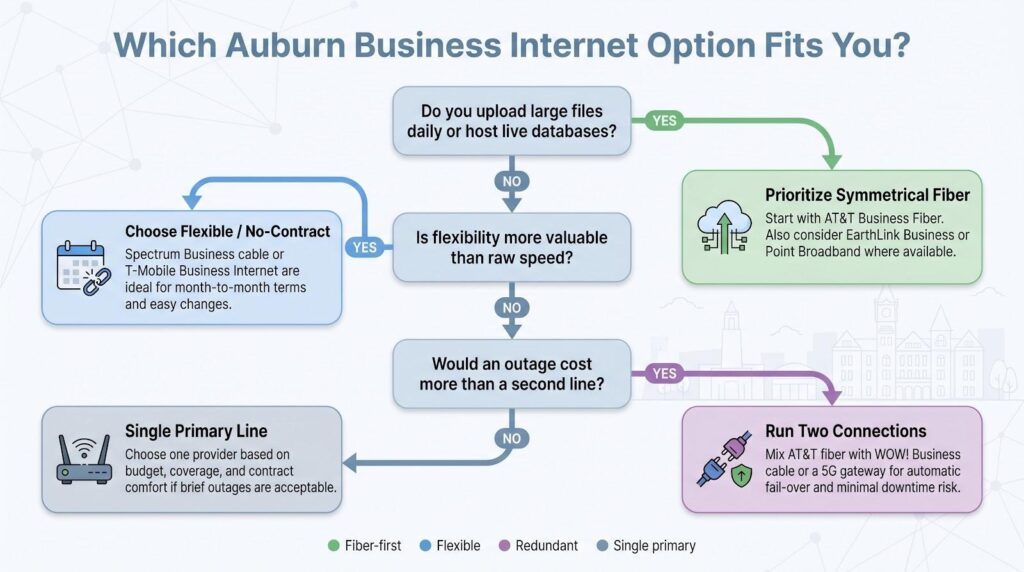
Work through these answers and you will know which providers deserve a quote request and which you can safely skip.
Conclusion
Choosing an internet service for an Auburn business comes down to balancing speed, uptime guarantees, contract terms, and budget. Use the scorecard, at-a-glance table, and decision checkpoints above to match a provider to your specific needs, then request written quotes before signing.




A little discussion goes a long way.
Ask a question, share your experience, or help someone find an answer.
There is room for your perspective.
No discussions match this view yet.
Your voice belongs here
Keep it useful. Keep it kind.