
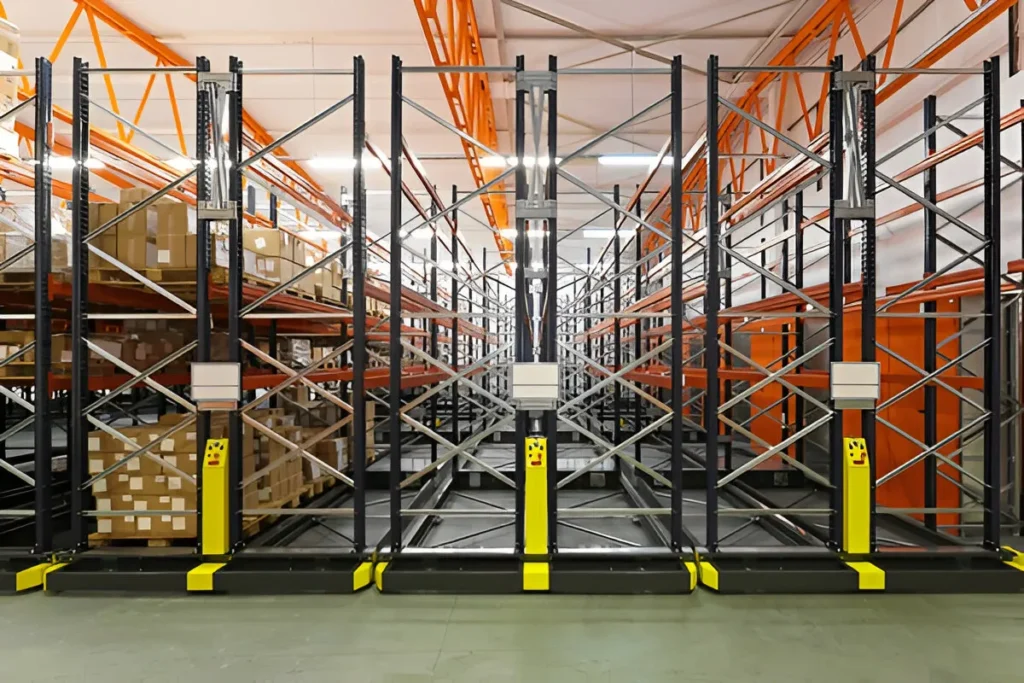
Efficiency and optimization are major success factors in the fast-paced world of warehouse management. At the forefront of this revolution are automated racking systems, which have brought about automation and efficiency on an unprecedented scale in warehouse operations.
Systems are installed to handle the storage and retrieval of materials so that the processes can be optimally productive and hence allow for maximum storage space. With passing time, technological improvements keep changing and enhancing automated racking systems to meet the modern requirements of warehousing dynamically. For more in-depth information you should view from automated racking system Manufacturer – T Racking
- Introduction to Automated Racking Systems
- Definition of Automated Racking Systems
- Importance in Modern Warehousing
- Overview of Warehouse Automation Trends
- Types of Automated Racking Systems
- Pallet Shuttle Systems
- Automatic storage and retrieval systems (ASRS)
- Mobile Robots and Conveyor Systems
- Benefits of Automated Racking Systems
- Increased Productivity and Efficiency
- Maximizing Storage Capacity
- Enhanced Accuracy and Safety
- Case Studies of Successful Implementations
- Industry Examples of Automated Racking Systems
- Benefits Realized by Companies
- Implementations: Lessons Learned
- Comparison with Traditional Racking Systems
- Operational Differences
- Cost Analysis: Automated vs. Traditional
- Long-term Benefits of Automation
- Future Trends in Automated Racking Systems
- Robotics and Automation
- Integration with IoT and AI Technologies
- Future Predictions for Warehouse Automation
Introduction to Automated Racking Systems
Definition of Automated Racking Systems
These systems constitute several automated storage technologies that put through processes to automate and manage the placing and retrieval of goods in warehouses. The integration of instances from various components allows these systems to flawlessly move and place pallets and other unit loads. They include:
- Cranes
- Conveyors
- Automated guided vehicles
Central to an automated racking system is the ASRS (Automated Storage and Retrieval Systems), which optimize storage density and throughput by managing the storage locations and order fulfillment with great efficiency. With minimal human intervention, this inventories storage and retrieval task, hence improving warehouse operations.
Importance in Modern Warehousing
The prevailing industry today is highly competitive; hence, one can hardly understate the need for automated racking systems in modern warehousing. These systems gain strategic advantage by substantially augmenting storage capacity and optimizing the use of warehouse space.
Less dependence on forklifts and manual systems is therefore introduced, minimizing errors and enhancing safety measures. Hence, by providing tracking and managing inventory with pinpoint accuracy through sensor and robotic systems, these warehouses become more efficient in fulfilling orders, reduce lead-time, and ultimately provide increased levels of customer satisfaction in the market that demands so much.
Overview of Warehouse Automation Trends
The growth of warehouse automation has resulted from the need to improve operational efficiency and remain competitive. The automated racking system is among the major components of these setups that provide high-density storage and utilizing the storage space vertically to the maximum. Some of the important advances introduced here are:
Pallet shuttle and shuttle racking systems that can be flexibly applied and scaled for various warehousing requirements.
Integration with advanced Warehouse Management Systems and Automated Guided Vehicles that smoothen the automation terrain.
This set of developments is ushering in fully automated warehouses, wherein the storage and retrieval processes are redefined.
Types of Automated Racking Systems
Pallet Shuttle Systems
Pallate shuttle systems weigh among the highest developments under automated racking solutions. Such uses of automated shuttles are for moving pallets in high-density storage, optimizing storage space, and increasing throughput.
These systems become more favorable when warehouses set a large emphasis on the efficient use of space. By employing automation to store and retrieve pallets, shuttle systems reduce forklifts and idle labor; thus reducing incidences of human error while also making the place safer.
The presence of inventory tracking sensors within an automated control stock management system makes ordering easy and quick, fitting the option for a warehousing operation that is modern and wishes to improve its process.
Automatic storage and retrieval systems (ASRS)
Depending on how fast a warehouse is automated, an and retrieval system will attempt to manufacture a certain solution of storage-and-retrieval while keeping intervention to a minimum. In a remote-0o automated warehouse, racks and crates are filled and emptied with automated cranes built with conveyance and vehicle-guided systems.
ASRS provides the densest form of storage in a vertical setting so that warehouses optimize space given to them. Standard warehouse studs with storage locations and inventory management provide a preceding level of productivity and efficiency.
Minimal human intervention means that customer fulfillment processes will be improved greatly by these systems, allowing warehouses to meet market demands at high speed.
Mobile Robots and Conveyor Systems
When it comes to automated racking systems, mobile robots and conveyor systems are the tools used to increase the efficiency and flexibility of warehouse operations. The mobile robot’s advanced navigation and sensing aids it in transporting unit loads around the warehouse autonomously, thus improving the agility of storage and retrieval processes.
Conveyors would then be in charge of expediting the movement of goods from and to various different storage locations, minimizing travel time, and ensuring an efficient workflow. Hence, in the full automated environment that these technologies create, manual handling is greatly reduced and maximum productivity realized.
Together, by interfacing with the warehouse management system, the mobile robots and conveyor systems facilitate task coordination to gainful accuracy and efficiency.
Benefits of Automated Racking Systems
Increased Productivity and Efficiency
Auto racking systems immensely drive the efficiency and productivity of warehousing operations, focusing majorly on the storaging and retrieval processes. Automated processes here diminish the usual hard labor, lessen dependence on forklift trucks, or human interfacing-giving greater throughput capacity and lesser chances for error.
With automated storage and retrieval systems working with advanced technologies such as sensor technologies and robotic systems, inventory is managed with high accuracy and orders get fulfilled quickly, optimizing the entire return warehouse operations to enable businesses to meet demand in a fast-growing market environment.
Maximizing Storage Capacity
One of the major benefits of an automated racking system is to optimize storage space. High-density storage could involve pallet shuttle system and automated storage and retrieval system (ASRS), which utilizes vertical space to maximize its working area.
Such methods make the location of storage more efficient in return for accommodating more pallets within the same footprint. This helps increase storage density so the businesses can manage their inventory effectively without worrying about expanding warehouse space. This gain in space utilization becomes a measure of how well the warehouse operations have improved.
Enhanced Accuracy and Safety
From automation racking systems’ perspective, they raise the accuracy and safety factor of warehouse operations by bringing down human interference in storage and retrieval systems. Technologies have been integrated through sensors, AGVs, and conveyor belts to record and handle inventories with complete accuracy and, finally, to bring down the chances of human error.
They also provide less risks at work when manual lifting of pallets is involved. Automaticization of some of these warehouse activities hence ensures a high level of accuracy in the area of order fulfillment and inventory retention, consequently leading to a particular aspect of efficiency and safety enhancement.
Case Studies of Successful Implementations
Industry Examples of Automated Racking Systems
Several industries have benefited from their introduction: in other words, industries have implemented automated racking systems that revolutionize warehouse operations. Consider the retail industry, where automated storage solutions are employed to manage high inventory turnover for swift order fulfillment processes.
The automotive sector uses these systems for the efficient storage and retrieval of complex parts. These examples portray automated racking systems as highly adaptable across a broad range of sectors and capable of being tailored to meet specific industry requirements that in turn enhance warehouse productivity. It is the utilization of such advanced automated systems that binds companies to compete and deliver into an increasingly automated global atmosphere.
Benefits Realized by Companies
Companies that have integrated automated racking systems into their warehouse operations have realized numerous benefits, including higher throughput, optimized storage space, better inventory control, and more.
These systems allow businesses to automate repetitive tasks, cut down operational costs, and ensure accurate order dispatches. The adjustment dimension of automated systems also enables companies to scale operations in tune with market demands.
Businesses can hence enjoy a big reduction in order fulfillment time, improved customer satisfaction, and competitive advantage in their respective industries. Thus, automated racking systems are a strategic investment that considerably pays off in the long term.
Implementations: Lessons Learned
Each term of successful automated racking execution has its lessons to be learned for companies pondering warehouse automation. The primary ingredients include thorough planning and analysis of warehouse operations to pinpoint the most appropriate automation solutions.
Optimal efficacy cannot be ensured if systems introduced cannot therefore be integrated with the already existing warehouse management system. The other concern, IT training for people, becomes equally mandatory: train them to manage and operate the installation.
Through these lessons, businesses avoid pitfalls and maximize benefits of automation to finally gain operational efficiency and productivity in warehouse operations.
Comparison with Traditional Racking Systems
Operational Differences
Upon comparison between automated racking systems and traditional racking systems, the very nature of operations turns out to be different. Traditional systems tend to be highly manual, using forklifts in storing and retrieving pallets-a method prone to inefficiency and increasing labor costs.
Automated systems leverage the modern technologies themselves to make the storage and retrieval process seamless. Some salient advantages include the following:
Technology, such as cranes, conveyors, and automated guided vehicles.
Enhanced throughput and minimized human error, ensuring precision in inventory management.
Such automated systems allow warehouses to make the most of their operations by maximizing storage capacity and providing greater efficiency in order fulfillment.
Cost Analysis: Automated vs. Traditional
A cost analysis of an automated racking system and a traditional one reveals that there are both short-term and long-term financial implications. Automated racking systems require a greater up-front investment, with advanced technologies and infrastructure constituting the major part of costs.
Thereafter, they generate massive cost savings. For instance, automation systems decrease labor costs by limiting human interaction and the movement of forklifts. This also reduces the chances of workplace accidents.
Increasing storage densities and better utilization of space through automation lowers the cost associated with expanding the warehouse. All these combine to give the injection of capital involved in automation systems a great ROI for the upwardly mobile business.
Long-term Benefits of Automation
The integration of automation with racking systems would provide a host of benefits in the long run for warehousing activities. It enhances the productivity of storage and retrieval through speed and accuracy, which would otherwise be required of the ever-changing market. It integrates with the warehouse management system to track inventory in real-time and to fulfill orders efficiently.
Over time, these systems take less manual labor, implying lesser operational costs and higher safety standards. Therefore, automation provides scalability to accommodate the increased storage needs without the need for a massive redesign of the infrastructure, which further promotes sustainable growth for business.
Future Trends in Automated Racking Systems
Robotics and Automation
The future of automated racking systems will somehow be influenced by the advancement in robotics and automation technologies. The use of robotic arms to assist autonomous mobile robots in racking systems will offer better efficiency in storing and retrieving materials and accuracy during the operation.
Such advances will move warehouses toward full automation, functioning 24 hours a day to maximize throughput and productivity. As the robotics technology matures, more sophisticated solutions will come into play to organize warehouse operations, eliminate human intervention, and maximize all storage systems’ capacity and flexibility, disrupting the logistics scene.
Integration with IoT and AI Technologies
Humanity has its destiny, and the integration of Artificial Intelligence and the Internet of Things is sure to take automated racking systems into a different paradigm. With the help of IoT gadgets, such as sensors and smart tags, inventory would be monitored and managed in real-time to ensure high warehouse operation standards in terms of accuracy and efficiency.
However, AI algorithms would assist predictive analytics in choosing the best storage locations and best paths to retrieving goods in order to smooth the operations even further. This advanced and smart warehouse management system, interwoven with the changing requirements and conditions, will bring improvements to inventory management and order fulfillment. This, in turn, will evolve automated racking systems based on demand and change.
Future Predictions for Warehouse Automation
In the future, warehouse automation will see considerable improvements in efficiency and innovation. Automated racking systems will perhaps turn more intelligent with some learning machineries, meaning the systems would be getting better and better at their operation.
Warehouses will employ big data analytics so they could predict changes in demand and store capacity accordingly. The green technologies and sustainable practices are to gain more prominence in the pipeline, as companies want to reduce their carbon footprints.
With the amalgamation of these trends, the up-and-coming automated racking systems will set new benchmarks for the industry by being more operationally efficient and contributing to sustainability and supply chain resilience.





A little discussion goes a long way.
Ask a question, share your experience, or help someone find an answer.
There is room for your perspective.
No discussions match this view yet.
Your voice belongs here
Keep it useful. Keep it kind.