
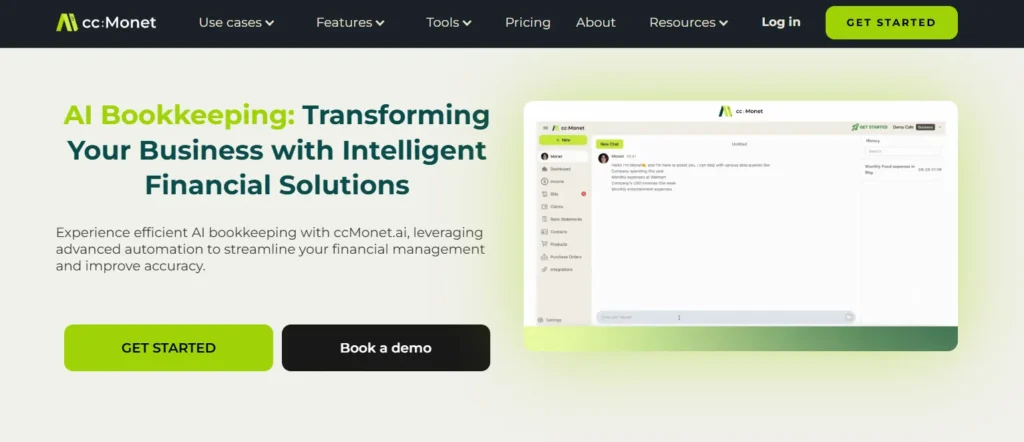
Are you tired of spending endless hours managing business finances? AI bookkeeping is here to change that. It offers a powerful solution to streamline accounting processes and boost efficiency.
AI-powered software like ccMonet automates tasks like receipt scanning and expense claim management. Advanced algorithms simplify financial record-keeping, freeing up time for business growth.
AI bookkeeping brings major improvements in accuracy and productivity. Small businesses can cut operational costs by up to 30%, and these tools also reduce human error rates by about 90%.
Ready to transform your financial management? Let’s see how AI bookkeeping can automate your records. It also provides real-time insights into your business’s financial health.
- AI bookkeeping automates financial record-keeping tasks
- Reduces operational costs by up to 30% for small businesses
- Improves accuracy by reducing human errors by 90%
- Provides real-time financial insights for better decision-making
- Saves time on manual data entry and reconciliations
- Enhances fraud detection rates by 40%
- AI Bookkeeping and Its Revolutionary Impact
- AI Bookkeeping vs Traditional Methods
- Financial Record-Keeping Evolution
- Benefits of AI-Powered Financial Management
- Essential Features of Modern AI Bookkeeping Solutions
- Smart Document Data Extraction
- Automated Transaction Categorization
- Real-Time Financial Reporting
- Integration Capabilities
- Top AI Bookkeeping Tools for Business Success
- Bookeeping.ai: Comprehensive Automation Solution
- Zeni: End-to-End Financial Services
- Vic AI: Specialized Accounts Payable Processing
- Docyt: Document Management Excellence
- Streamlining Your Workflow with AI Technology
- Cost-Benefit Analysis of AI Bookkeeping Implementation
- Initial Investment Considerations
- Long-Term Financial Benefits
- Time and Resource Savings
- Security and Compliance in AI Bookkeeping
- Integration Strategies for Existing Financial Systems
- Compatible Software Solutions
- Data Migration Best Practices
- Training and Implementation Guidelines
- Future Trends in AI Bookkeeping Technology
- Conclusion
- FAQs
- What is AI bookkeeping?
- How does AI bookkeeping differ from traditional methods?
- What are the key benefits of using AI bookkeeping?
- Is AI bookkeeping secure and compliant with financial regulations?
- Can AI bookkeeping integrate with existing financial systems?
- What features should I look for in an AI bookkeeping solution?
- How much does AI bookkeeping cost?
- Is AI bookkeeping suitable for small businesses?
- How does AI bookkeeping handle complex financial transactions?
- What’s the future of AI bookkeeping?
AI Bookkeeping and Its Revolutionary Impact
AI-powered bookkeeping is changing how we handle money records. Businesses are now using new ways to manage their finances. This change is a big step in how companies do their books.
AI Bookkeeping vs Traditional Methods
AI bookkeeping is faster and more accurate than old methods. It automates data entry and analysis, unlike manual processes. This saves time and cuts down on mistakes.
Businesses can now focus more on growing their company. AI systems make this possible by handling the financial tasks.
Financial Record-Keeping Evolution
Financial record-keeping has come a long way. We’ve moved from paper to digital spreadsheets, and now to AI platforms. Each step has made things more efficient.
Today’s AI tools offer real-time insights and can predict trends. These features were unthinkable in the past.
Benefits of AI-Powered Financial Management
AI bookkeeping offers many perks:
- Enhanced accuracy in financial reporting
- Time savings through automation
- Real-time financial insights
- Reduced operational costs
- Improved decision-making with data-driven insights
These benefits make AI bookkeeping great for all types of businesses. As the tech grows, it keeps changing how we handle money.
“AI adoption in accounting is projected to improve efficiency by up to 40% in firms that integrate these technologies.”How AI Transforms Financial Record Management
AI is changing how businesses manage financial records. It automates tasks, making bookkeeping faster and more efficient. Imagine a system that reads invoices and receipts in any language or currency while you easily customize fields.
AI-powered accounting can cut manual bookkeeping by 80%. This frees up time for strategic planning instead of data entry. AI systems can also reduce errors by 90% compared to old methods.
Precision is key for clean books and smart decisions. AI bookkeeping tools learn from your transactions and coding entries like experts. These tools offer many benefits beyond basic bookkeeping.
- Rapid data processing speeds exceeding human capabilities
- Enhanced transaction categorization through Natural Language Processing
- Improved cash flow forecasting accuracy by approximately 75%
- Fraud detection with up to 95% accuracy
AI can cut operational costs by 30-50% for financial record management. This leads to faster reporting and better-informed choices. Ultimately, it can boost revenue growth for businesses.
Essential Features of Modern AI Bookkeeping Solutions
AI bookkeeping tools are changing how we manage finances. They offer powerful features that make operations smoother and more efficient. Let’s look at what makes these tools a must-have for today’s businesses.
Smart Document Data Extraction
AI-powered extraction turns piles of papers into organized data quickly. It can process invoices and receipts in any language or currency. Studies show that AI-driven optical character recognition (OCR) technology can process invoices in seconds, compared to manual entry which can take hours.
Automated Transaction Categorization
Automated categorization is a huge time-saver. The system learns from your financial history to sort transactions accurately. AI bookkeeping solutions can automate up to 80% of repetitive tasks, cutting down manual work.
Real-Time Financial Reporting
Real-time reporting gives instant insights into your business’s financial health. This feature allows for faster decision-making processes. Some AI systems can process millions of transactions daily.
AI-powered predictive analytics can accurately forecast cash flow trends up to 85%.
Integration Capabilities
Smooth integration with existing financial systems is key. 75% of businesses say AI integration leads to better alignment of financial and business goals. This connection ensures a smooth shift and maximizes the benefits of AI bookkeeping tools.
- Receipt scanning and expense claim management
- Customizable fields with drag-and-drop functionality
- Multi-currency and multi-language support
- Advanced fraud detection and compliance checks
Using these key features, businesses can greatly improve their financial management. They can reduce errors and free up time for strategic planning.
Top AI Bookkeeping Tools for Business Success
AI bookkeeping tools are revolutionizing business finances. These solutions save time, boost accuracy, and offer valuable insights. Let’s explore some top-rated options for better financial management.
Bookeeping.ai: Comprehensive Automation Solution
Bookeeping.ai excels in automation capabilities. It automates 95% of accounting tasks, saving businesses up to 57 hours monthly. This tool streamlines financial processes effectively.
Zeni: End-to-End Financial Services
Zeni provides a complete package for startups. It handles daily bookkeeping and creates investor-ready reports. With a 4.7/5 rating, Zeni proves its worth in AI bookkeeping.
Vic AI: Specialized Accounts Payable Processing
Vic AI simplifies accounts payable with a 4.8/5 user rating. It achieves up to 90% accuracy in data extraction. This marks a big improvement over manual methods.
Docyt: Document Management Excellence
Docyt excels in expense tracking and document management, boasting a 4.6/5 user rating. Its AI features can reduce manual data entry by 50%.
These AI tools offer various features for different business needs. They range from comprehensive solutions to specialized services. Every company can find an option to improve their financial management.
Streamlining Your Workflow with AI Technology
AI technology is changing how businesses handle finances. It streamlines operations and boosts efficiency in bookkeeping. AI-powered tools automate repetitive tasks, saving up to 2 hours daily.
AI algorithms analyze data to spot patterns and trends. This helps with forecasting and budgeting. They can also flag unusual transactions, aiding in fraud detection.
Bookkeeping workflow automation leverages advanced tech to streamline finances. It cuts manual tasks and errors while improving accuracy.
Implementing AI in your workflow involves five steps:
- Identifying opportunities for automation
- Choosing suitable AI solutions
- Preparing your financial data
- Implementing and testing the new system
- Expanding and refining the process
AI-powered tools can help streamline your workflow. Vic.ai automates invoice processing. Sage Intacct offers real-time financial insights. These solutions free up time for strategic tasks.
Cost-Benefit Analysis of AI Bookkeeping Implementation
AI bookkeeping solutions require careful cost-benefit analysis. This evaluation helps businesses grasp financial impacts and potential returns on investment.
Initial Investment Considerations
Upfront costs for AI implementation can be hefty. Businesses must budget for software, hardware, and setup expenses. Pricing varies widely, from $50 to $549 monthly.
Staff training for new AI tools adds to the initial investment. These costs are crucial to consider before implementing AI bookkeeping.
Long-Term Financial Benefits
AI bookkeeping offers substantial long-term benefits despite upfront costs. Companies report up to 75% reduction in routine accounting task processing times.
This efficiency leads to a 30% decrease in labor expenses. Over time, these savings can significantly outweigh the initial investment.
Time and Resource Savings
AI-powered bookkeeping creates significant resource savings:
- Reduction in bookkeeping time by up to 75%
- Improvement in financial report accuracy by reducing human error
- Ability to handle more clients without proportional staff increases
These savings allow businesses to focus on growth and strategic planning, allowing routine bookkeeping tasks to be delegated to more important activities.
The analysis shows AI implementation in bookkeeping leads to substantial long-term gains. Businesses of all sizes can benefit from this technology.
Security and Compliance in AI Bookkeeping
AI bookkeeping boosts financial management efficiency while raising security and compliance questions. Protecting sensitive financial data is vital as businesses adopt these advanced tools.
Modern AI bookkeeping solutions offer strong security measures. They use encryption and access controls to protect your financial information. Many platforms regularly audit their security to find and fix vulnerabilities.
Compliance with financial rules is crucial in AI bookkeeping. These systems follow laws like GDPR and CCPA to keep your data safe. AI-powered tools lead in responsible AI development. They maintain trust through ongoing governance and ethical practices.
Some security features of AI bookkeeping include:
- Automated transaction tracking for full transparency
- User authentication to prevent unauthorized access
- Regular data backups and recovery procedures
- Audit trails for every financial action
AI bookkeeping streamlines your finances and gives peace of mind. These security measures protect your data and follow the latest rules. You can focus on growing your business with confidence.
Integration Strategies for Existing Financial Systems
When integrated with current financial systems, AI bookkeeping can streamline operations and boost efficiency. Studies show that well-planned integration can cut implementation time by 25%. Let’s explore key strategies for a smooth AI-powered financial management transition.
Compatible Software Solutions
Finding compatible software is crucial for seamless integration. Look for AI tools that work with your existing accounting software and ERP systems. API integrations help data flow between platforms, enhancing overall system performance.
Data Migration Best Practices
Effective data migration is vital for AI success. High-quality data can improve AI performance by 20%. Follow these steps for smooth data transfer:
- Assess your current data
- Clean and organize information
- Test migration in small batches
- Verify data integrity post-migration
Training and Implementation Guidelines
Proper training boosts AI adoption rates by 60%. Develop a thorough training program that covers user onboarding, system customization, and the establishment of new workflows.
Engaging key stakeholders throughout the process can increase implementation success by 70%. Successful integration can also cut time spent on repetitive tasks by 30%.
This lets your team focus on strategic activities, improving overall productivity and efficiency.
Future Trends in AI Bookkeeping Technology
AI bookkeeping will transform financial management by 2025. It will boost speed, accuracy, and efficiency in handling finances, changing how businesses manage their money.
Predictive analytics is a key feature in AI bookkeeping. It helps businesses forecast financial outcomes with great accuracy. AI software analyzes past data to improve budgeting and forecasting.
Blockchain integration will enhance security in financial transactions. It will reduce fraud and errors. AI tools can automate 70% of account reconciliation, cutting manual work.
- AI can achieve up to 90% transaction auto-match with out-of-the-box matching rules
- Organizations can reduce days to close by 30% with detailed checklists for month-end close
- AI can resolve 80% of anomalies with auto-suggested actions
Future AI bookkeeping will use advanced machine learning algorithms. This will lead to more automation and accuracy. Natural language processing will make financial queries easier to understand.
Businesses that adopt AI bookkeeping will lead the pack. The AI accounting market may grow 45% yearly, reaching $16 billion by 2028. Embracing this tech is key for long-term financial success.
Conclusion
AI bookkeeping is changing how businesses manage finances. It automates tasks, saving 80-90% of time spent on routine work. This frees up hours for strategic planning and growth.
AI solutions offer more than just time savings. They reduce data entry errors and cut costs by up to 30%. This leads to better accuracy and financial benefits.
Platforms like ccMonet are at the forefront of this change. They use APIs to connect with banks and credit cards. This allows for automatic transaction updates.
The future of AI in finance looks bright. 87% of practices see the benefits of AI bots. This shows it’s not just a trend, but a major shift in business operations.
Using AI bookkeeping helps businesses stay competitive. Review your current financial processes and consider how AI can help your business grow.
AI tools can forecast cash flow, provide round-the-clock help, and offer real-time insights. These features are key to efficiency and growth in today’s fast-paced market.
FAQs
What is AI bookkeeping?
AI bookkeeping uses artificial intelligence to automate financial record-keeping tasks. This includes automated data entry and smart transaction categorization. This technology improves accuracy and significantly reduces manual work.
How does AI bookkeeping differ from traditional methods?
AI bookkeeping is faster and more accurate than traditional methods. It processes data continuously and learns from past entries to improve categorization. Traditional methods rely more on manual input and periodic reporting.
What are the key benefits of using AI bookkeeping?
AI bookkeeping saves time and reduces errors. It provides real-time financial visibility and automates data entry. The technology also offers intelligent transaction categorization and improves decision-making.
Is AI bookkeeping secure and compliant with financial regulations?
Reputable AI bookkeeping solutions prioritize security and compliance. They use encryption, access controls, and regular security audits. Many comply with regulations like GDPR and CCPA and provide audit trails.
Can AI bookkeeping integrate with existing financial systems?
Yes, many AI bookkeeping tools offer integration with popular accounting software. This includes ccMonet, which integrates with ERP systems and other financial platforms. These integrations ensure smooth data flow between different systems.
What features should I look for in an AI bookkeeping solution?
Look for smart document data extraction and automated transaction categorization. Real-time financial reporting and integration capabilities are also important. Multi-currency support and user-friendly interfaces are additional key features.
How much does AI bookkeeping cost?
Costs vary depending on the solution and your business needs. There’s an initial investment in software and possibly training. However, many businesses find long-term savings through reduced errors and faster processes.
Is AI bookkeeping suitable for small businesses?
AI bookkeeping is very beneficial for small businesses. Tools like ccMonet are designed for small to medium-sized companies. They offer powerful features that save time and provide valuable insights.
How does AI bookkeeping handle complex financial transactions?
AI bookkeeping uses machine learning to understand complex transactions. It learns from historical data and user corrections to improve accuracy. The system can handle multi-currency transactions and intricate financial scenarios with increasing skill.
What’s the future of AI bookkeeping?
AI bookkeeping’s future includes more advanced predictive analytics. Integration with blockchain for better security is also expected. More sophisticated machine learning and improved natural language processing are on the horizon.




A little discussion goes a long way.
Ask a question, share your experience, or help someone find an answer.
There is room for your perspective.
No discussions match this view yet.
Your voice belongs here
Keep it useful. Keep it kind.