
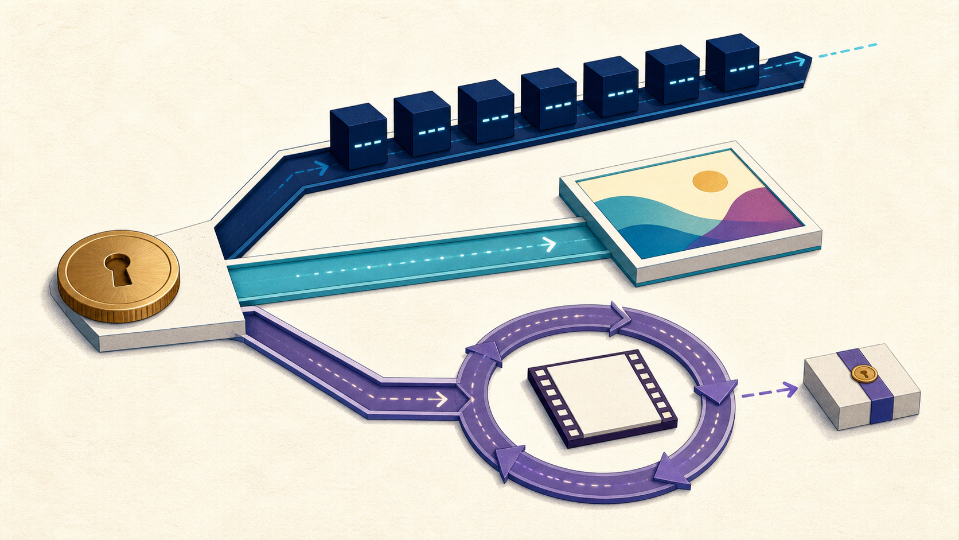
A single API key can remove three credential screens from a prototype, but it cannot make every model behave like chat. Text may stream token by token. An image route may return encoded media inside a completed message. A video route may return only a task identifier and require later polling. Treating those lifecycles as one generic response is how a clean demo becomes brittle production code.
The practical advantage of APINEED is a common account and interface across a growing model catalog. The integration still needs a boundary for each response family. One credential belongs in configuration; text, image, and video handling belong in separate adapters with their own types, timeouts, storage rules, and tests.
- One Key Does Not Mean One Response Contract
- Give Text And Images Different Completion Handlers
- Validate Text Controls Per Selected Model
- Parse Image Content Before Declaring Success
- Treat Video Creation As A Persisted Job
- Make Polling Idempotent And State Aware
- Keep Media Jobs Outside Request Threads
- Limits One Shared Credential Cannot Remove
- Test The Boundaries Before Combining The Routes
- Share Observability Without Flattening Adapter Semantics
One Key Does Not Mean One Response Contract
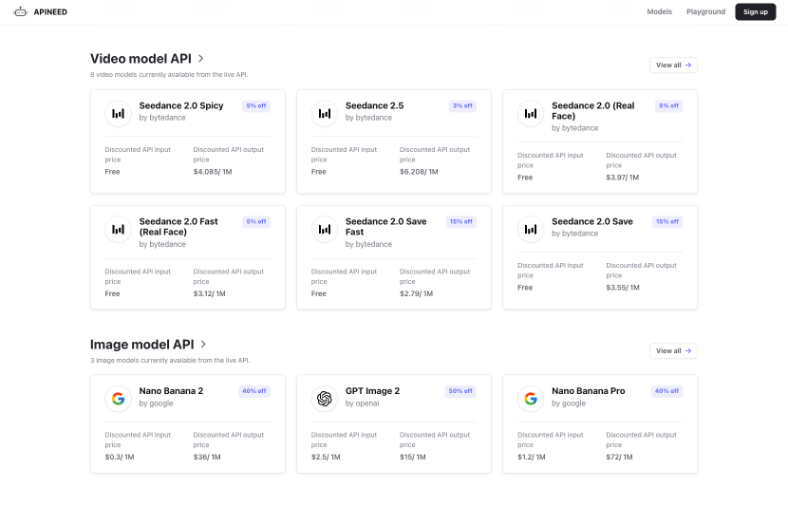
APINEED currently groups text, image, and video models under one balance and key. That unifies authentication and purchasing. It does not promise that every route uses the same endpoint or reaches completion in the same request. The individual model page remains the contract a developer must implement.
A useful application architecture splits the work into two layers. The gateway client owns the base URL, authorization header, request identifiers, error normalization, and basic usage logging. A modality adapter owns the request body and interprets a successful response.
The caller should ask for a domain result rather than raw provider data. A text feature may request a completed answer or a stream. An image feature may request an image asset. A video feature may request a durable job handle. Each return type tells the rest of the application what can happen next.
| Adapter | Immediate result | Completion signal | Persistent record |
| Text | Tokens or completed message | Stream closes or response completes | Prompt version, model, usage, final text |
| Image | Completed message content | Expected image data is present | Prompt, model, asset checksum, stored file |
| Video | Task identifier | Polled task reaches a final state | Request, model, task state, stored file |
The table is not a universal promise for every model. It reflects three current route patterns. A newly listed model should enter only after its page and test response match an existing adapter or justify a new one.
Give Text And Images Different Completion Handlers
A text adapter can expose two deliberate operations: complete and stream. Both can use the OpenAI-compatible chat-completions shape when the chosen route supports it. The completed form resolves to a text result. The streaming form emits partial events and a final usage record. Hiding both behind a function that sometimes returns text and sometimes returns an iterator makes errors hard to reason about.
Validate Text Controls Per Selected Model
Do not assume that a common endpoint gives every model the same parameters. A current Grok 4.6 page lists structured output, tool definitions, reasoning controls, and streaming, but another route may publish a narrower set. Store allowed controls with the model configuration and reject unsupported options before sending a billable request.
For schema-constrained output, validate the returned object again in application code. A response can satisfy JSON syntax while carrying an unacceptable enum, an oversized string, or content that contradicts the source input. The adapter should report parsing and validation failures distinctly from transport errors.
Parse Image Content Before Declaring Success
An image model may share the chat-completions endpoint without returning chat text as its real product. The current Nano Banana 2 page fixes streaming to false and instructs callers to inspect the completed message content for image data URLs. The image adapter must therefore find the media payload, decode or fetch it safely, verify the file, and move it to controlled storage.
A 200 response without an image is not an image success. It may contain explanatory text, a refusal, or an unexpected format. Through APINEED, the HTTP request can look familiar while the post-processing remains modality-specific. Return a typed failure when the expected asset is absent instead of passing raw content to a gallery.
Reference images add another boundary. The adapter should accept only approved URLs or data inputs, record what was submitted, enforce application size limits, and avoid logging private binary content. Model capability does not remove the team’s responsibility to handle source files and rights appropriately.
Treat Video Creation As A Persisted Job
Video belongs to a different lifecycle. A current Seedance 2.5 route creates a task with a POST request and tells the application to poll a task-specific GET endpoint until it completes or fails. The initial success therefore means “accepted for processing,” not “video ready.”
The adapter should write the task identifier before returning control to the caller. Store the selected model, normalized request, creation time, current state, and last polling attempt. A background worker can resume after a process restart because it has durable state; an open browser tab or in-memory promise cannot provide that guarantee.
Make Polling Idempotent And State Aware
Poll only known task identifiers. A page refresh must not submit a second generation. The worker should stop on completed or failed states, slow down according to application policy, and preserve the last upstream error. If a status response is temporarily unavailable, keep the task pending rather than creating a replacement automatically.
When completion returns a video location, copy the file to owned storage and record its checksum. Remote delivery locations can be temporary. The domain result becomes a stored asset reference, not the upstream URL. That small distinction prevents a video from disappearing after the task was marked complete.
Keep Media Jobs Outside Request Threads
A web request should enqueue the durable generation job and return its local identifier. It should not wait for the entire render or poll in a tight loop. The user interface can ask the application’s job endpoint for progress, while the worker alone communicates with the external task route.
This design also makes cancellation and retry rules explicit. A failed transport check may be retried against the same task. A failed generation may require a new task. The adapter can distinguish those cases because it retains both the local job and the upstream identifier.
Limits One Shared Credential Cannot Remove
One key does not standardize model quality, input rights, media retention, latency, parameter support, or output review. APINEED can simplify access and routing, but each listed model still needs representative tests and budget controls. Production code must also survive an absent media payload, a failed task, and a capability change without converting them into silent success.
Test The Boundaries Before Combining The Routes
Build a contract suite around each adapter. Text tests should cover completed and streaming responses, invalid structured output, and unsupported parameters. Image tests should include a valid media response, text-only completion, corrupt data, and oversized input. Video tests should cover accepted, processing, completed, failed, missing-task, and repeated-poll states.
Run the suite against a small set of catalog models before exposing them in the product. Record the model slug and the tested capabilities rather than inferring behavior from category labels. When a model page or adapter changes, rerun the corresponding cases and compare stored fixtures with the live shape.
Share Observability Without Flattening Adapter Semantics
All adapters can emit a common envelope containing request ID, selected model, start time, end time, status, and usage when available. Add modality fields beneath it: stream event count for text, decoded bytes for images, and queue duration for video. Dashboards stay consistent while engineers retain the information needed to diagnose each route.
Set budgets at the feature level as well as the account level. A short text completion, a generated image, and a video task have different cost units and failure costs. The application should show users the operation they are starting and prevent an automatic retry policy from multiplying expensive media requests.
APINEED is most useful here as a common front door. Keep that front door small: credentials, request identity, error normalization, and access to listed routes. Behind it, let each adapter tell the truth about how its output arrives.
Clean integrations do not erase meaningful differences. They name those differences and contain them. With separate text, image, and video contracts, a team can add models without teaching the rest of the application to guess whether a response is a sentence, a file, or merely a receipt for work still underway.



A little discussion goes a long way.
Ask a question, share your experience, or help someone find an answer.
There is room for your perspective.
No discussions match this view yet.
Your voice belongs here
Keep it useful. Keep it kind.