
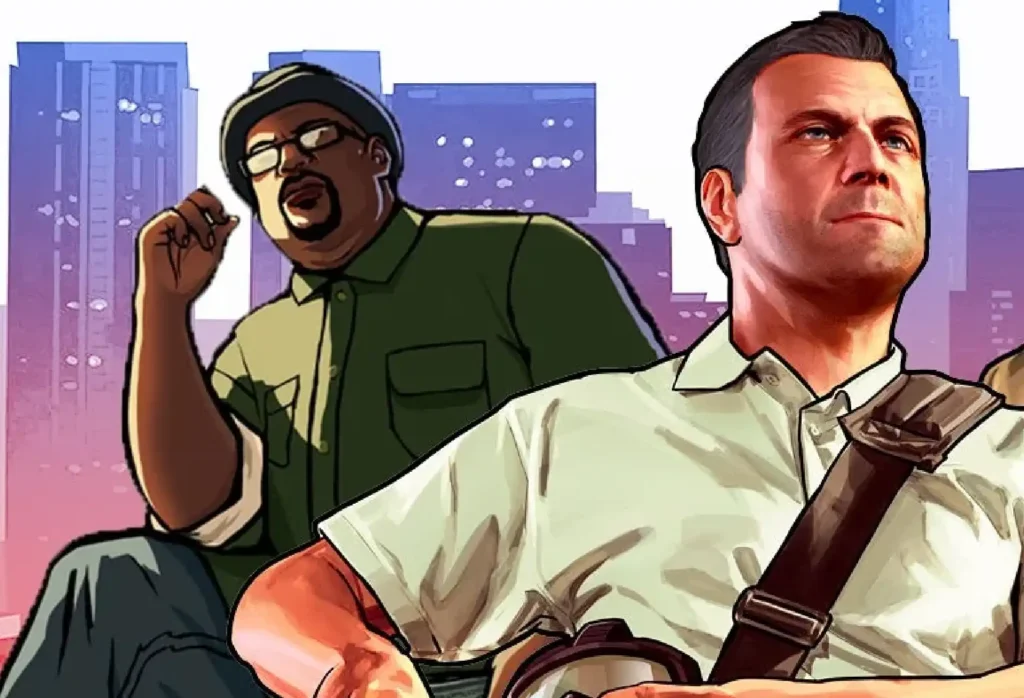
I have put more hours into the Grand Theft Auto series than I probably admit to a therapist. San Andreas is the reason I skipped homework in middle school. GTA V is the reason a friend group of mine still has a Discord server that’s just heists gone wrong. So when people ask “what is the best GTA game,” I don’t have a quick answer. I have opinions, backed by a lot of replaying.
This is not a list assembled from Wikipedia summaries. It’s ranked based on what holds up when you sit down and play these games today, why each one worked mechanically, what it felt like to actually play at the time, and where it falls short in hindsight.
I have also thrown in GTA VI at the end but not ranked, since nobody’s played the finished game yet, but it’s impossible to talk about “the best GTA games” in 2026 without addressing the elephant in the room that’s arriving on November 19.
How I am ranking these
A few criteria, roughly in order of importance
- How the game plays: driving, shooting, mission design, not just “vibes”
- How much the world holds your attention: beyond the main story
- Cultural and technical impact: did it move the series or the industry forward
- How well it’s aged: some of these games are 20 years old, and that matters
With that out of the way, here’s the ranking.
1. Grand Theft Auto V (2013)
GTA V is the pick for the top spot, and honestly, it earns it rather than just inheriting it from being the most famous.
The three-protagonist structure was the real innovation here. You switch between Michael (a retired criminal dragged back in), Franklin (a repo man looking for a way up), and Trevor (chaos given a human shape), and the game uses that switch mechanically, not just narratively. Mid-heist, you can jump from the getaway driver to the guy on the roof with a sniper rifle in real time. It sounds like a gimmick on paper; in practice, it changes how you approach every mission.
Heists are the centerpiece, you scout locations, choose an approach (high or stealth), hire a crew based on skills and cut percentages, and then take action.
The early-game jewel store heist lets you choose a “smart” approach (gas the store, sneak out) or an “obvious” approach (break and grab, make your way out). Both are viable, and both completely change the escape sequence.
The driving physics, the mission variety, and Los Santos as a setting still feel great over a decade later. What’s aged less gracefully is the tone in places (Trevor’s material hasn’t aged as comfortably as it might have felt in 2013), and the game’s continued reliance on GTA Online has meant the single-player campaign has not seen meaningful post-launch content in years, despite the base game still being phenomenal.
2. Grand Theft Auto: San Andreas (2004)
If GTA V is the most polished GTA game, San Andreas is the most ambitious one, and for a lot of players my age, it’s the emotional favorite.
San Andreas didn’t just give you a city. It gave you an entire state. Los Santos, San Fierro, and Las Venturas (thin fictionalizations of LA, San Francisco, and Las Vegas), connected by open countryside you could actually drive across. On PS2 hardware. In 2004. That was genuinely unheard of at the time.
CJ, the protagonist, comes back to a neighborhood falling apart and gets pulled into gang politics, corrupt cops, and eventually a cross-state crime saga. The RPG-lite systems were the real leap forward. You could gain weight from eating too much fast food and lose it by exercising, build muscle at the gym, improve weapon skill through use, and customize CJ’s clothes, haircuts, and tattoos.
Skipping meals for too long would actually make CJ’s stamina and health suffer in missions, which meant the “silly” fast-food system had actual mechanical stakes.
The scale and the RPG systems still feel ahead of their time. What doesn’t hold up as well is some mission design that leans hard into trial-and-error (the flight school and train missions have broken more controllers than any other section of any GTA game, unofficially speaking) and visuals that show their age even in the remastered Definitive Edition.
3. Grand Theft Auto IV (2008)
GTA IV is the most divisive game on this list, and I think it’s underrated because of how different it is from what came before and after.
Nico Bellic’s story is the most grounded, least cartoonish narrative in the series. It’s about an immigrant with a violent past who tries to make a living in Liberty City and is drawn back into crime by people who see him not as a person but as a utility. It’s honestly one of the better-written stories in the franchise, and it does not play for laughs the way the games around it do.
The Euphoria physics engine made combat and driving feel weightier and more consequence-driven than anything before it, cars crumple realistically, Niko stumbles and rag-dolls in ways that felt shockingly real at the time.
Getting T-boned at an intersection doesn’t just deal damage, it visibly deforms the car and throws you against the wheel, which changes how cautiously you drive compared to the arcade-ier handling of San Andreas.
The tone and writing hold up well, it’s arguably the most mature story Rockstar has told in the series. What doesn’t hold up is the moment-to-moment friction: the driving feels heavier in a way that can be more frustrating than satisfying today, the mission structure is repetitive (“go here, shoot people, drive away”), and the PC port has historically been rough.
4. Grand Theft Auto: Vice City (2002)
Vice City is the game that turned GTA from “that game you play for the chaos” into a genuine cultural moment, largely on the strength of its setting and soundtrack.
Set the game in a fictionalized 1986 Miami, drip in neon and synth, gave the series a personality it hadn’t really had before. Tommy Vercetti’s rise from released convict to drug kingpin is pulpy, over-the-top, and completely aware of what it is, closer to Scarface and Miami Vice fan fiction than anything trying to be Grand Theft Auto IV-style serious.
The business ownership mechanic was new here. Tommy buys and manages properties across the city (a print shop, a strip club, a boatyard used for drug running) that generate passive income and unlock unique missions.
Buying the Malibu Club does not just give you money over time, it opens up a whole side-story involving the club’s previous owners and unlocks new outfits and areas.
The atmosphere, music licensing, and setting are still unmatched in the series, nothing else feels quite like Vice City. What does not hold up as well is the actual gameplay loop below it: aiming and combat are dated even by the standards of its own era, and missions can be unforgiving without much in the way of checkpoints.
5. Grand Theft Auto Online (2013–present)
Technically part of GTA V, but at this point GTA Online is functionally its own game, and it deserves to be evaluated separately, because Rockstar has spent over a decade treating it that way.
It took the heist and freeroam concepts from GTA V’s single-player and turned them into a genuinely evolving live-service game, years before “live service” was the industry buzzword it is now. Players build up a criminal empire from scratch: buying properties, running businesses, pulling off increasingly elaborate heists with friends.
The economy loop is the core of it. You earn money through businesses (drug operations, car theft rings, arms dealing) and heists, then reinvest that money into bigger operations, better gear, and properties that unlock further content.
The Cayo Perico Heist, added in 2020, let a single player plan and execute an entire island heist solo, from scouting to extraction, which was a genuinely smart design pivot toward accommodating players without a full crew.
The sheer amount of content and the community that’s built up around it is remarkable for an eleven-plus-year-old game. What does not hold up as well is the increasingly aggressive monetization through Shark Cards (real-money currency), and an economy that’s become progressively harder to progress through without either spending real money or grinding for dozens of hours.
6. Grand Theft Auto III (2001)
The one that started the modern era of the series, and honestly, the hardest to rank fairly because everything after it built directly on what it introduced.
GTA III took the top-down chaos of the original games and put it into a fully 3D, freely explorable city for the first time, Liberty City, rendered in a way that let you drive, walk, and cause mayhem from any angle. It’s easy to take for granted now, but this was the template every open-world game since has been reacting to in some way.
The mission structure introduced the now-standard GTA formula but the freedom of the city between missions was the actual innovation.
Nothing stopped you from ignoring the story entirely and just spending an hour causing a police chase across the city, and the game’s wanted-level system escalated the chaos in a way that felt genuinely dynamic for 2001.
Its historical importance is undeniable. What doesn’t hold up is basically everything mechanical, the protagonist is a silent, forgettable blank slate, missions are punishing and repetitive by modern standards, and the draw distance and controls show their age hard if you go back to it today.
GTA VI (2026): Not Ranked, But Impossible to Ignore
As of this writing, GTA VI hasn’t launched yet. Rockstar and Take-Two have confirmed the release date as November 19, 2026, after two earlier delays, landing on PS5 and Xbox Series X/S. It’s set in the fictional state of Leonida, home to a modern-day reimagining of Vice City, and follows two protagonists, Jason and Lucia, in a story built around their relationship as much as the crimes they pull off together.
I’m not ranking it here for the obvious reason: nobody outside Rockstar has played the finished game. But based on the trailers and confirmed details so far, it’s shaping up to combine what made past entries work.
A strong central relationship like GTA IV’s Niko story, a distinct and stylish setting like Vice City’s, and presumably systems as ambitious as San Andreas or as polished as GTA V. Whether it lives up to that will be the most-discussed question in gaming the moment it launches.
Final Thoughts
Ranking these games always comes down to what you value more, mechanical polish or ambition, story or chaos, nostalgia or objective quality. GTA V sits at the top because it’s the rare game that nails almost everything at once, but San Andreas and GTA IV both make legitimate cases for the top spot depending on what you’re looking for in an open-world game.
If you’re revisiting the series before GTA VI lands in November, my honest suggestion: play GTA V for the polish, San Andreas for the ambition, and Vice City for the vibes. You’ll walk away understanding exactly why this series has stayed at the top of gaming for over two decades.





A little discussion goes a long way.
Ask a question, share your experience, or help someone find an answer.
There is room for your perspective.
No discussions match this view yet.
Your voice belongs here
Keep it useful. Keep it kind.