
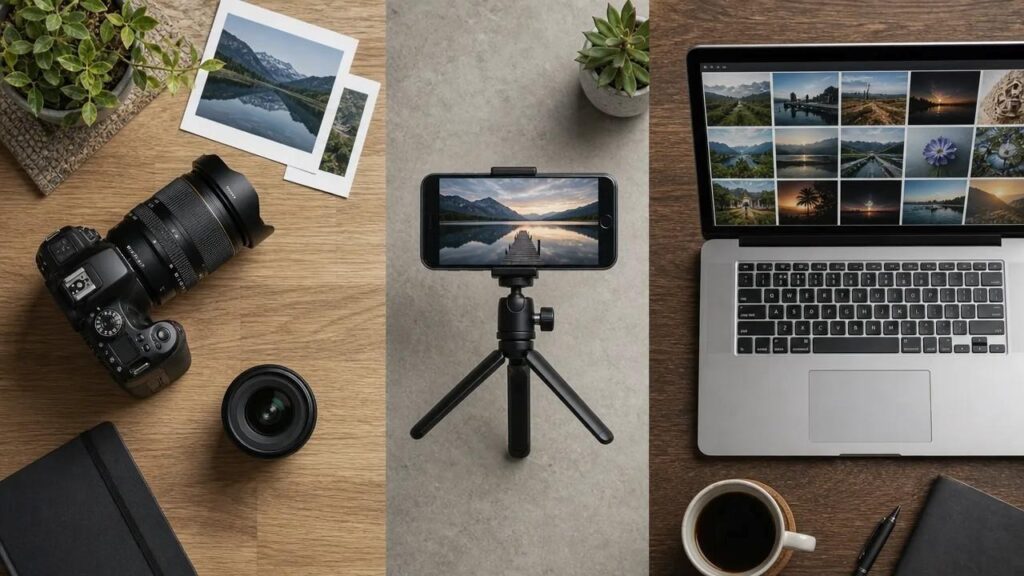
Here is the math nobody wants to hear: dating app data firm SwipeStats puts the average match rate for men at 5.26 percent, and every credible study of swipe behavior lands on the same culprit. Photos decide almost everything, and they decide it in under a second, before your bio gets a single reader.
So the practical question isn’t whether to fix your photos. It’s which of the three available routes to take: hire a photographer, do it yourself with a phone, or use an AI generator. Each one costs something different in money, time, and effort, and each one suits a different kind of person. Let’s run the actual numbers.
Route 1: The professional photographer
The gold standard, and priced like it. Dedicated dating photography services now exist in most big cities. Hey Saturday operates across the UK, The Match Artist works with clients in the US, and plenty of independent portrait photographers have added “dating package” to their menus.
A typical lifestyle shoot for dating profiles runs $300 to $500 in the US market, with premium services going higher. You book a slot, coordinate outfits, spend an afternoon being directed to laugh naturally on a park bench, and wait one to four weeks for editing. Back comes a set of roughly 20 to 40 finished frames from one or two locations.
The quality ceiling is the highest of the three routes. A good photographer reads your angles, fixes your posture, and catches expressions you didn’t know you made. The limits are structural: it’s one afternoon, in one outfit or two, at one or two spots. Your profile will look excellent and slightly like a catalog, because all six photos were born in the same ninety minutes.
Best for: people with the budget who want maximum polish and don’t mind the scheduling.
Route 2: Your phone and a patient friend
The free route, and genuinely workable if you have two things: a friend willing to spend a few hours shooting you, and the discipline to do it across several sessions.
The consensus checklist from photographers and dating coaches is consistent. Five to six photos, mixed: a clear smiling headshot with no sunglasses, a full-body shot, a hobby in action, something social, one candid. Shoot in daylight, avoid bathroom mirrors, skip heavy filters. Modern phone cameras are easily good enough; the bottleneck was never the sensor.
The bottleneck is logistics. One Reddit thread on r/Bumble asked the question that breaks this route for a lot of people: how do you take good dating photos if nobody is around to take them? Thousands of upvotes, no clean answer. Self-timers and tripods produce self-timer-and-tripod photos. And even with a willing friend, most people get one session, one outfit, one location, which recreates the catalog problem at a lower quality level.
Best for: people with a photographer friend, patience, and zero budget.
Route 3: The AI generator
The newest route, and the one that has changed the economics. Services in this category train on a batch of your ordinary selfies and generate finished profile photos in bulk. DatePhotos.AI, an AI dating photo generator, is a representative example of how the pipeline works in 2026: you upload a stack of normal selfies and get back 80 to 180 online dating photos across 40-plus scenes, from coffee shops to hiking trails, in about 20 to 30 minutes, for a one-time payment of $29 to $79.
Three details in that pipeline matter more than the headline speed. First, volume: 80-plus options means you can fill the five-to-six photo checklist with genuinely different scenes instead of six crops of the same afternoon. Second, scoring: each photo gets a realness score from 0 to 100, and the sensible users only publish images that score high enough to pass as ordinary phone photos, which filters out the plasticky renders that give AI away. Third, cost structure: at roughly a tenth of a photographer’s fee, the risk of an unusable batch is an annoyance rather than a financial event.
The honest downside: the ceiling is lower than a great photographer’s. Some frames come out weird. The tool’s own users say the working method is to generate plenty and curate hard, the way an editor treats a contact sheet.
Best for: people who want variety fast, hate cameras pointed at them, or can’t justify $400.
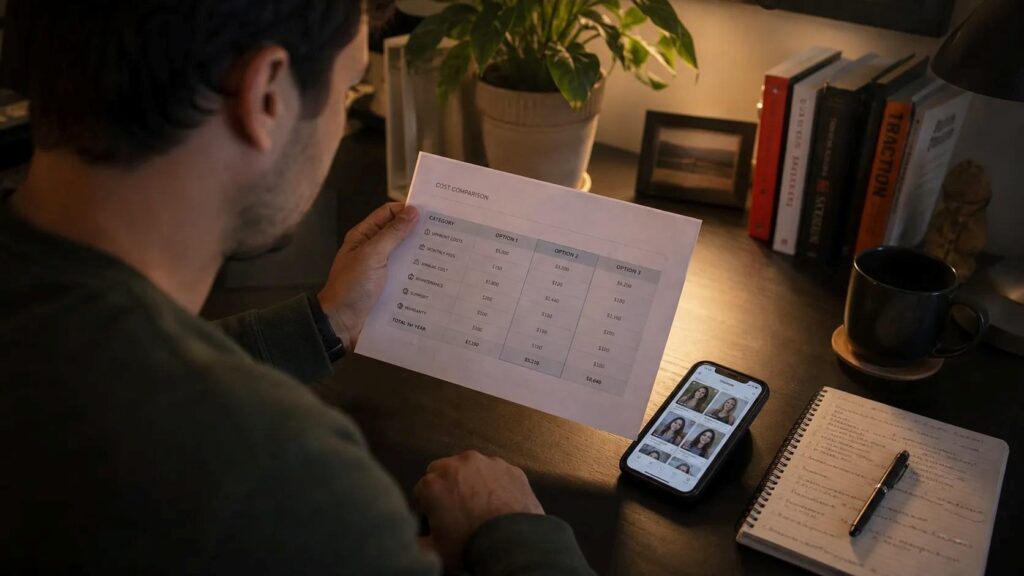
The comparison, side by side
| Factor | Photographer | Phone + friend | AI generator |
| Upfront cost | $300-500+ | Free | $29-79 one-time |
| Time to photos | 1-4 weeks | Days to weeks | 20-30 minutes |
| Photos delivered | 20-40 | Varies wildly | 80-180 |
| Scene variety | 1-2 locations | Usually 1 session | 40+ scenes |
| Quality ceiling | Highest | Depends on friend | High with curation |
| Main risk | Catalog sameness | Never happens | Uncanny frames if uncurated |
Read the table cynically and a pattern appears. The photographer wins on peak quality, the phone wins on price, and the AI route wins on everything measured in time and variety. Which is why the realistic strategy for a lot of people in 2026 is a hybrid: an AI batch as the foundation, topped with one or two genuine photos from real life, so the profile has both coverage and proof.
The rule that applies to all three routes
Whatever route you take, the photos have to survive the same test: would someone who met you believe this is your normal week? Dating app users have developed sharp eyes for fakery of every kind, including over-edited photographer shots and over-smooth AI renders. Skin that’s too perfect, lighting that’s impossible, a lifestyle that doesn’t match your prompts: these read as warnings, not upgrades.
That’s also why the goal is never to look like someone else. The date eventually happens in person. The winning profiles use photos that look like the best believable version of the actual person, sourced from whichever route fits the budget.
The verdict
If money is no object and you want the absolute best frames, book the photographer. If you have a skilled friend and a free weekend every month, the phone route still works. For everyone in between, which in practice is most people, the AI route now covers the checklist faster and cheaper than anything else, as long as you curate ruthlessly and keep one real photo in the lineup.
The 5.26 percent number at the top of this article is not a ceiling, just the average for profiles that treat photos as an afterthought. All three routes exist to get you off that average, and for the first time, the cheapest one is no longer the worst one.



A little discussion goes a long way.
Ask a question, share your experience, or help someone find an answer.
There is room for your perspective.
No discussions match this view yet.
Your voice belongs here
Keep it useful. Keep it kind.