
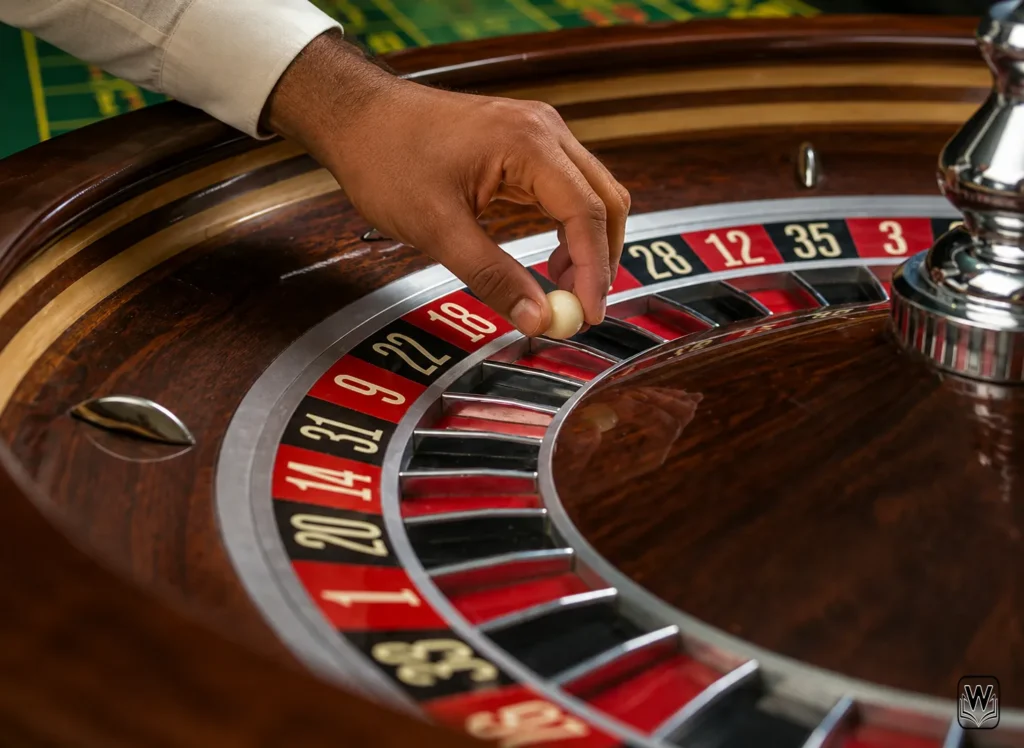
Roulette has this reputation as the purest expression of chance on any casino floor, a game where the ball owes allegiance to nothing and nobody. Every spin looks identical from the rail, all 37 or 38 numbered pockets flashing past at speed, and the assumption holds from a live dealer table to a crypto-fueled session on 1xbit with Bitcoin at stake.
Each pocket gets an equal shot. Or so the theory goes. Roulette wheels are physical objects, though, and physical objects betray their flaws given enough revolutions. A fraction-of-a-millimeter wobble in a rotor, a fret worn slightly softer than its neighbors, and certain numbers start appearing more often than probability permits.
- What Causes a Roulette Wheel to Play Favorites
- When Multiple Flaws Overlap
- The Yorkshire Engineer Who Broke Monte Carlo
- One Month Tracking Six Wheels
- The Casino Fights Back
- Computers, Toe Switches and Frequency Analysis
- The Eudaemons and Their Shoe Computer
- García-Pelayo and the QBasic Roulette Program
- Modern Wheel Manufacturing and Bias Detection
- How Modern Wheels Are Tested for Bias
What Causes a Roulette Wheel to Play Favorites
No two roulette wheels spin identically forever. The instrument looks solid from outside the glass, but inside sits a network of small parts subject to wear and manufacturing variation. Casinos inspect on regular schedules, yet millimeter-scale irregularities can push outcomes away from perfect randomness.
| Bias Source | Effect on the Ball |
| Loose frets | Worn separators absorb ball impact unevenly, favoring specific pockets |
| Rotor imbalance | The roughly 30 kg rotor can develop slight imbalances after thousands of operating hours, leading to uneven weight distribution |
| Unlevel playing surface | A tiny tilt creates a preferred drop zone where the ball exits the track more often |
| Pocket surface wear | Micro-scratches alter friction, trapping the ball more frequently in damaged pockets |
| Ball track deformation | Groove imperfections cause the ball to leave the track at predictable points on the rim |
When Multiple Flaws Overlap
What makes roulette bias tricky for casino operators is that these flaws compound. A slightly loose fret on a slightly tilted wheel produces a much stronger bias than you would expect from adding two minor issues together. Some biases are also fleeting, appearing for only a few hundred spins before the wheel’s condition drifts again.
The Yorkshire Engineer Who Broke Monte Carlo
Joseph Jagger never set out to become one of gambling’s most remarkable figures. A textile engineer from Bradford, he had spent years around spinning machinery, none of which ever rotated with perfect uniformity. Around 1880, he borrowed money from family and traveled to Monte Carlo.
One Month Tracking Six Wheels
His plan was patient. Jagger hired six clerks, one per roulette wheel at the Casino de Monte-Carlo, and had them record every result for about a month. Five wheels showed nothing unusual. The sixth kept producing nine numbers with noticeably higher frequency, among them 7, 8, 9, 17, 18, 19, 22, 28, and 29.
The Casino Fights Back
Jagger bet on those numbers and won over two million francs across several days, an amount The Times valued at approximately £7.5 million in 2018 purchasing power. The casino scrambled. Staff switched wheel positions overnight, hoping to confuse him. Jagger lost money the next morning but spotted a familiar scratch on one of the relocated wheels, tracked it down, and kept winning.
The casino eventually had the metal dividers on every wheel rearranged nightly, destroying the bias. Jagger invested in property and left gambling behind.
Computers, Toe Switches and Frequency Analysis
A full century after Jagger’s Monte Carlo run, two separate groups attacked roulette bias with considerably more firepower and made casinos very uncomfortable in the process.
The Eudaemons and Their Shoe Computer
In the late 1970s, physics postgraduates J. Doyne Farmer and Norman Packard built one of the first wearable digital computers, a three-kilobyte device hidden inside a shoe. A toe switch fed the machine ball speed and rotor position, which it processed into a predicted landing zone and relayed as vibrations to a second person at the betting table.
Across more than eleven trips to Nevada casinos, the system delivered a 20% advantage over the house. For context, roulette normally gives the casino a 2.7% edge on European-style wheels. Hardware malfunctions and safety concerns kept stakes low, and they eventually walked away. Farmer later became a professor at Oxford.
García-Pelayo and the QBasic Roulette Program
Gonzalo García-Pelayo brought a statistician’s obsession to the roulette table in the early 1990s. A record producer by trade, he started visiting Casino Gran Madrid, recording thousands of spin results, and feeding the data into a homemade QBasic program. The software profiled each wheel and flagged numbers with exploitable frequency patterns.
With family members placing bets across the floor, he turned a standard house edge into a significant player advantage, extracting an estimated €1.5 million total, including one reported €600,000 session.
Modern Wheel Manufacturing and Bias Detection
The roulette wheels you find on a modern betting floor bear little resemblance to the wooden-and-brass constructions Jagger encountered. Manufacturers like Cammegh, established in 1989, engineer their wheels around metallurgy, CNC machining, and stainless-steel bearings ground to tolerances of 0.001 inches. A single Cammegh Mercury 360 wheel can cost upward of €16,000.
How Modern Wheels Are Tested for Bias
- Regular component inspection covers frets, pocket pads, shaft integrity, and rotor balance on fixed schedules
- Rotor swapping between wheels on the floor breaks any emerging pattern before it becomes statistically significant
- Automated spin-tracking software catches deviations from expected probability distributions within a few hundred spins
- Temperature and humidity-resistant alloys prevent heat or moisture from warping metal or expanding wooden components
- Low-profile fret designs reduce the odds of separators loosening or absorbing ball impact unevenly
The Mercury 360 carries four invisible in-rim sensors that recognize winning numbers automatically and pass spin data to casino surveillance systems. Floor managers receive alerts whenever results deviate from expected distributions, with most setups flagging anomalies before any bettor at the rail could notice.




A little discussion goes a long way.
Ask a question, share your experience, or help someone find an answer.
There is room for your perspective.
No discussions match this view yet.
Your voice belongs here
Keep it useful. Keep it kind.