
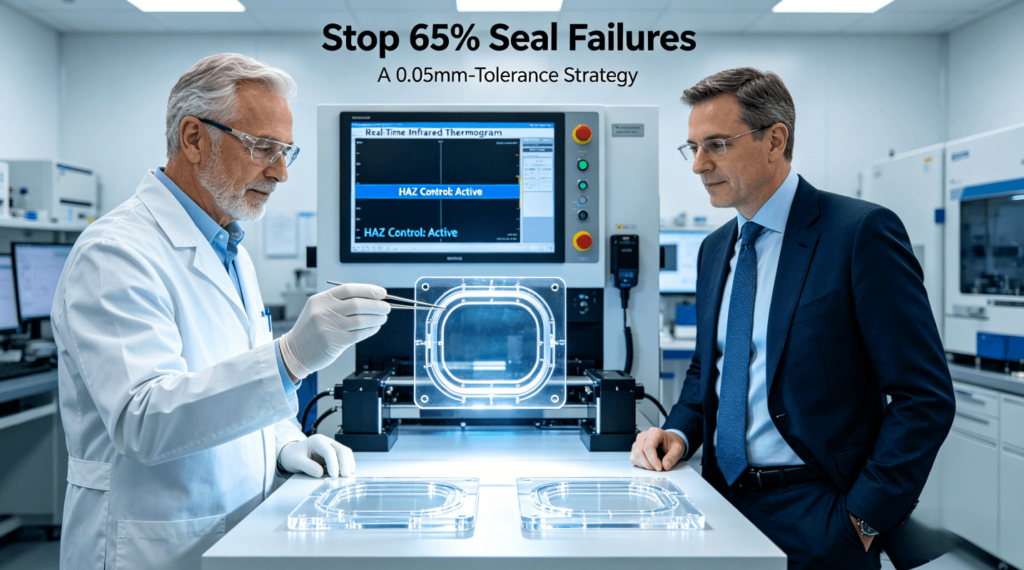
In the demanding fields of medical devices, aerospace, and precision instrumentation, acrylic components are prized for their exceptional optical clarity and biocompatibility. However, achieving the necessary reliability is often undermined by pervasive manufacturing defects. Traditional laser cutting processes frequently introduce micro-cracks, thermal stress concentrations, and edge whitening, particularly in complex geometries and thick materials. These flaws lead directly to product failures in seal tests, degraded optical performance, and unacceptably low assembly yields.
The root cause lies not in a single step, but in a systemic failure to control the heat-affected zone (HAZ), improper cutting path planning, and a neglect of the fundamental differences between cast and extruded acrylic substrates. Many solutions remain reactive, relying on post-process sorting or polishing rather than proactive, engineering-led prevention. This article outlines a comprehensive strategy to systematically eliminate micro-cracks and dimensional drift, enabling stable production with ±0.05mm tolerances.
- Why Does the Heat-Affected Zone Pose the Greatest Risk to Acrylic Part Integrity?
- How Can Proactive DFM Transform Potential Laser Cutting Failures into Predictable Outcomes?
- 1. Geometry Optimization for Thermal Management
- 2. Implementing a Tolerance Locking Strategy
- 3. From Design Intent to Manufacturing Reality
- What Engineering Controls Are Essential for Achieving Optical-Grade Edge Clarity Without Polishing?
- 1. Dynamic Beam and Parameter Synchronization
- 2. The Critical Role of Assist Gas Dynamics
- 3. Validated Process Libraries for Repeatability
- Is Material Selection or Stress Relief More Critical in Preventing Solvent-Induced Cracking?
- 1. The Foundation: Choosing the Right Substrate
- 2. The Essential Step: Engineered Post-Process Annealing
- 3. Verification Through Aggressive Testing
- What Does a True Quality Management System for High-Precision Laser Cutting Entail?
- Case Study: Implementing a Zero-Leak Strategy for a Medical IVD Acrylic Window
- 1. The Challenge: Unacceptable Failure Rates
- 2. The Integrated Engineering Solution
- 3. The Quantifiable Outcome
- Conclusion
- FAQs
Why Does the Heat-Affected Zone Pose the Greatest Risk to Acrylic Part Integrity?
The Heat-Affected Zone (HAZ) is the primary culprit behind micro-cracks and weakened acrylic parts. Uncontrolled heat input during cutting alters the polymer’s molecular structure, creating internal stresses that compromise seal integrity and long-term stability, especially in critical applications.
- The Molecular Mechanism of Thermal Degradation: When a laser beam interacts with acrylic, the intense, localized heat doesn’t just melt a clean path; it creates a gradient of altered material properties known as the HAZ. This zone experiences temperatures that can approach or exceed the polymer’s glass transition temperature (Tg), causing localized molecular chain scission and realignment. According to standards like ASTM D3418 for thermal analysis of polymers, such thermal history can fundamentally change material properties. The result is a region of embrittled material surrounding the cut, which acts as a nucleation site for micro-cracks under mechanical load or exposure to chemicals.
- Stress Concentrations at Geometric Discontinuities: The risk magnifies exponentially at geometric features like sharp internal corners, thin ribs, or sudden changes in wall thickness. These areas act as stress concentrators, where the residual thermal stress from the HAZ accumulates. The combined effect of intrinsic material stress and process-induced thermal stress can exceed the acrylic’s cohesive strength, leading to spontaneous cracking or catastrophic failure under minimal external force. This is not merely a cosmetic issue but a fundamental threat to the structural integrity and hermetic seal of components like fluidic chambers or optical windows.
- From Process Control to Material Engineering: Therefore, managing the HAZ is not solely a laser parameter optimization task; it is a materials engineering challenge. The goal is to minimize both the width and the severity of the HAZ. This requires a deep understanding of the specific acrylic grade being processed — its thermal conductivity, absorption spectrum, and innate stress state from manufacturing — and tailoring the energy input accordingly. Success means the cut edge retains nearly the full strength and chemical resistance of the base material.
How Can Proactive DFM Transform Potential Laser Cutting Failures into Predictable Outcomes?
Proactive Design for Manufacturability (DFM) is the most powerful tool to prevent failures, transforming a design from merely “cuttable” to “reliably manufacturable.” It optimizes geometry to manage heat, stress, and tolerance stack-up before the first laser fires, ensuring high yield and consistent quality.
1. Geometry Optimization for Thermal Management
Effective DFM for laser cut acrylic involves strategic design modifications to balance heat input and dissipation. For instance, specifying minimum internal corner radii prevents localized overheating and cracking. Adjusting the spacing between closely spaced features or holes prevents cumulative heat buildup that can distort the entire part. For components with varying thicknesses, DFM may suggest adding thermal relief features or transitioning geometries to allow for more uniform cooling. This proactive approach neutralizes thermal distortion at the design stage, a far more effective strategy than attempting to compensate for it during cutting.
2. Implementing a Tolerance Locking Strategy
Beyond geometry, DFM enacts a tolerance locking strategy for assemblies. This involves analyzing the cumulative tolerance stack-up of all mated components and allocating tolerances at the individual part level to guarantee perfect interchangeability. For a sealed medical device window, this means defining not just the cut tolerance (±0.05mm) but also the flatness and perpendicularity of the edge to ensure a reliable gasket seal. This strategic planning, done in collaboration with the manufacturing engineer, ensures the final assembly functions as intended. Key DFM considerations vary by material type, as detailed in specialized guides on selecting laser cut acrylic parts.
3. From Design Intent to Manufacturing Reality
Ultimately, DFM is the bridge that aligns design intent with manufacturing reality. It considers factors like material grain orientation in extruded sheets, optimal nesting to minimize waste, and the inclusion of registration features for secondary operations. By addressing these elements early, DFM eliminates costly and time-consuming cycles of prototyping, failure, and redesign. It transforms the relationship with your manufacturing partner from a simple order fulfillment to a collaborative engineering effort aimed at predictable, high-yield production.
What Engineering Controls Are Essential for Achieving Optical-Grade Edge Clarity Without Polishing?
Achieving optically clear, flame-polish quality edges directly from the laser cutter is possible through precise control of the melting and solidification process. This is accomplished by synchronizing laser energy delivery, assist gas dynamics, and cutting path strategy to create a “self-annealing” cut.
1. Dynamic Beam and Parameter Synchronization
The cornerstone of optical clarity is creating a consistent, controlled molten zone. This is achieved through dynamic frequency modulation of the laser pulse. By precisely modulating power and pulse frequency in real-time as the beam moves, the system delivers consistent energy per unit length, preventing overheating or under-melting. This is synchronized with an optimized feed rate to ensure the molten material flows smoothly. The laser focal point is also meticulously controlled, often placed slightly below the material surface, to create the ideal kerf geometry for a smooth finish, a critical capability of advanced precision acrylic laser cutting services.
2. The Critical Role of Assist Gas Dynamics
The second pillar is laminar assist gas flow. High-purity, dry nitrogen is used to create an oxygen-free micro-environment in the cut zone. Oxygen causes oxidation and micro-burning, leading to a rough, frosted edge. The inert nitrogen shield prevents this, allowing the surface tension of the molten acrylic to smooth the cut face as it re-solidifies. The gas pressure, nozzle design, and flow characteristics are tuned to gently eject molten material without causing turbulence that would mar the surface. This combination of precise energy control and gas shielding is what enables laser cutting solutions for acrylic that meet the stringent surface roughness parameters defined by standards like ISO 21920, often achieving Ra values below 0.8 µm without any post-processing.
3. Validated Process Libraries for Repeatability
These parameters are not determined through trial and error for each job. Instead, they are codified in validated process libraries specific to each acrylic type, thickness, and desired edge quality. When a new design is quoted, engineers can call upon this database to immediately deploy a proven parameter set, ensuring that the first part and the ten-thousandth part exhibit the same optical-grade edge quality. This systematization is what separates a basic cutting service from a true engineering partnership capable of delivering reliable custom laser cutting services.
Is Material Selection or Stress Relief More Critical in Preventing Solvent-Induced Cracking?
Both material selection and stress relief are critical and interdependent. Starting with the right, stress-relieved material is foundational, but a controlled cutting and post-processing cycle is essential to eliminate introduced stresses and prevent catastrophic solvent-induced cracking in medical and chemical environments.
1. The Foundation: Choosing the Right Substrate
Material selection sets the baseline for performance. For critical applications, medical-grade cast acrylic is often superior to extruded acrylic. The cast process produces a more homogeneous molecular structure with higher molecular weight, offering better chemical resistance and inherently lower internal stress. It is also more isotropic, meaning its properties are uniform in all directions, leading to more predictable cutting behavior. Specifying a stress-relieved grade of cast acrylic from the supplier is the first and most crucial step in building a crack-resistant component. Understanding these differences is fundamental, as outlined in resources on how to prevent stress cracking in acrylic.
2. The Essential Step: Engineered Post-Process Annealing
However, even the best material acquires new, localized thermal stresses during laser cutting. Therefore, a validated thermal annealing cycle is non-optional for parts exposed to solvents like isopropyl alcohol (common in medical disinfection) or other chemical agents. This is not a simple baking process but a carefully engineered thermal profile. The parts are gradually heated to a temperature just below the material’s distortion point, held (soaked) to allow molecular chains to relax and redistribute stress, and then cooled at a controlled rate. This post-process stress relief effectively “resets” the material, making it immune to the environmental stress cracking that can occur when residual stresses interact with aggressive chemicals.
3. Verification Through Aggressive Testing
The effectiveness of this combined approach must be verified. This is done through aggressive validation testing, such as immersing finished parts in a 70% IPA solution for a specified duration, a common test for medical device components. Parts that have undergone proper stress relief will show no signs of grazing or cracking, confirming their suitability for harsh operational environments. This level of process validation and control is a hallmark of manufacturers operating under stringent quality management systems like ISO 13485 for medical devices.
What Does a True Quality Management System for High-Precision Laser Cutting Entail?
A true Quality Management System (QMS) for high-precision work is predictive and data-driven, not just reactive. It employs Statistical Process Control (SPC), closed-loop machine calibration, and comprehensive First Article Inspection (FAI) to guarantee micron-level consistency across production runs, ensuring every part meets the stringent requirements for high-tolerance acrylic parts.
- Real-Time Process Control and SPC: True quality is built into the process. A robust QMS uses real-time process monitoring of key variables: laser power, cutting speed, assist gas pressure, and focus position. This data is fed into Statistical Process Control (SPC) dashboards that track process stability. Instead of waiting to measure finished parts, engineers can see trends and make preemptive adjustments if a parameter begins to drift, ensuring the process remains in control and capable (Cpk > 1.67) of holding tight tolerances. This predictive quality approach is fundamental for precision laser cutting services at volume.
- Closed-Loop Dimensional Fidelity: To maintain ±0.05mm accuracy over thousands of parts, the machine itself must compensate for variables like thermal expansion of its frame. Advanced systems use a closed-loop digital control with feedback from high-resolution linear encoders. If thermal drift is detected, the control system dynamically adjusts the coordinate system to compensate, locking in accuracy. Furthermore, automated vision systems or touch probes can be used for in-process verification of critical features, providing another layer of assurance that dimensional fidelity is maintained throughout the entire production run for complex part laser cutting services.
- Comprehensive Documentation and Traceability: For regulated industries, documentation is as critical as the part itself. A complete QMS ensures full traceability from raw material lot to finished part. This includes detailed First Article Inspection Reports (FAIR) with data from Coordinate Measuring Machines (CMM) to verify every critical dimension. The system also maintains records of all process parameters, SPC charts, and inspection results for each batch. This level of documentation is not just bureaucratic; it provides objective evidence of control and is essential for audits, failure analysis, and continuous improvement, underpinning certifications like ISO 9001 and AS9100.
Case Study: Implementing a Zero-Leak Strategy for a Medical IVD Acrylic Window
A medical IVD manufacturer faced 65% yield loss on a 15mm-thick clear acrylic inspection window due to micro-cracks causing leaks during autoclave validation. An integrated engineering solution combining material science, DFM, precision laser cutting, and targeted stress relief achieved 100% seal test pass rate and 99.8% first-pass assembly yield.
1. The Challenge: Unacceptable Failure Rates
The component was a critical optical window for an in-vitro diagnostic device, requiring absolute clarity and a perfect hermetic seal to withstand repeated autoclave sterilization cycles. The initial process, using standard laser cutting on generic cast acrylic, resulted in a 35% yield. Failures manifested as solvent-induced cracking and leakage after sterilization, traced back to uncontrolled HAZ and unmanaged internal stress. The cost of rework, scrap, and assembly delays was unsustainable.
2. The Integrated Engineering Solution
The solution was multidisciplinary. First, the material was switched to a high-crosslink density, medical-grade cast acrylic with superior chemical resistance. Second, DFM analysis led to a slight modification of the sealing edge geometry to reduce stress concentration. Third, the cutting process was re-engineered using a bi-directional gas-cooled laser technique with dynamically modulated parameters to minimize the HAZ. Finally, and most critically, a proprietary multi-stage thermal annealing cycle was developed and validated specifically for this part geometry and material to eliminate all residual stresses.
3. The Quantifiable Outcome
The result was transformative. The new process produced windows that passed a rigorous helium leak test with a 100% success rate. The as-cut edge quality measured Ra 0.4µm, eliminating any need for polishing. The first-pass yield at the customer’s assembly line jumped to 99.8%. This integrated approach not only solved the quality crisis but also reduced the total unit cost by 18% and shortened the overall assembly timeline by two weeks, demonstrating the powerful return on investment from a deep, engineering-focused manufacturing partnership.
Conclusion
Achieving reliable, defect-free laser cut acrylic components is a systems engineering challenge, integrating materials science, thermal management, proactive design, and digital quality control. From initial DFM analysis and substrate selection to controlled energy input and validated stress relief, each step is a critical link in the chain ensuring part performance in demanding applications. Moving beyond simple cutting services to embrace an engineered manufacturing solution is the key to mastering complexity and meeting the stringent requirements of medical, aerospace, and precision industries.
FAQs
Q: What is the most critical factor in preventing cracks in laser cut acrylic for medical devices?
A: The most critical factor is comprehensive internal stress management. This combines selecting stress-relieved, medical-grade cast acrylic, using a laser process optimized to minimize the heat-affected zone, and implementing a validated post-process thermal annealing cycle. This integrated approach eliminates stress that causes solvent-induced cracking.
Q: How can optical clarity on cut edges be achieved without manual polishing?
A: It is achieved through synchronized control of laser parameters and assist gas dynamics. A focused beam creates a uniform molten zone, while a laminar flow of high-purity nitrogen shields it, allowing surface tension to smooth the edge as it solidifies. This “laser polishing” yields Ra <0.8µm finishes directly.
Q: What role does DFM play in laser cutting complex acrylic parts?
A: DFM plays a proactive, risk-mitigation role. It optimizes geometry (like corner radii and feature spacing) to manage heat distribution and prevent stress concentrations before cutting begins. This transforms a design from merely cuttable to reliably manufacturable with high yield and predictable outcomes.
Q: Can laser cutting maintain tight tolerances like ±0.05mm in high-volume production?
A: Yes, but it requires a closed-loop, digitally-controlled system. Real-time feedback from encoders and in-process monitoring compensates for variables like thermal drift. Coupled with Statistical Process Control (SPC) to monitor process stability, this system ensures micron-level consistency across thousands of parts.
Q: Why might laser cutting be more cost-effective than CNC machining for clear acrylic parts?
A: Laser cutting is often more cost-effective for 2D profiles due to higher speed, no tooling costs or wear, and the inherent polished edge quality it produces. This eliminates the separate, expensive manual polishing step typically required after CNC machining, consolidating processes and reducing unit cost.




A little discussion goes a long way.
Ask a question, share your experience, or help someone find an answer.
There is room for your perspective.
No discussions match this view yet.
Your voice belongs here
Keep it useful. Keep it kind.